
The Union, State and Concurrent Lists
The Constitution divides law-making subjects into three lists.
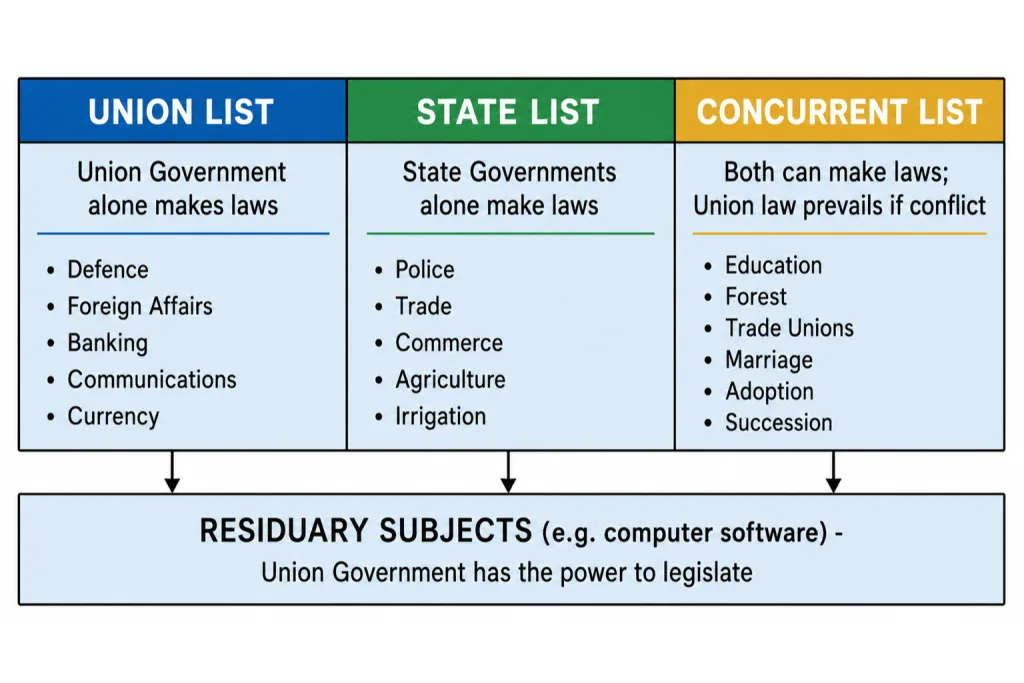
- Union List includes subjects of national importance, such as defence of the country, foreign affairs, banking, communications and currency. These are on this list because we need a uniform policy on them throughout the country. The Union Government alone can make laws on Union List subjects.
- State List contains subjects of State and local importance, such as police, trade, commerce, agriculture and irrigation. The State Governments alone can make laws on these subjects.
- Concurrent List includes subjects of common interest to both, such as education, forest, trade unions, marriage, adoption and succession. Both the Union and the State Governments can make laws on these. If their laws conflict, the law made by the Union Government prevails.
Residuary Powers
What about subjects that do not fall in any of the three lists? Or subjects like computer software that came up after the Constitution was made?
According to our Constitution, the Union Government has the power to legislate on these 'residuary' subjects. These leftover or newly emerging subjects are called residuary subjects, and the power to make laws on them is called residuary power. Because this power rests with the Centre, it is one more reason why India's federal structure gives comparatively greater strength to the Union.
Special Status and Union Territories
As in most 'holding together' federations, all States in the Indian Union do not have identical powers.
- Some States enjoy a special status. States such as Assam, Nagaland, Arunachal Pradesh and Mizoram enjoy special powers under Article 371 of the Constitution, because of their peculiar social and historical circumstances. These powers especially protect the land rights, culture and preferential employment of indigenous peoples. Indians who are not permanent residents of such a State cannot buy land or a house there.
- Some units have very little power. Areas too small to become a State, and which could not be merged with an existing State - like Chandigarh, Lakshadweep or the capital city of Delhi - are called Union Territories. They do not have the powers of a State, and the Central Government has special powers in running them.
Rigidity of Power-Sharing and the Role of the Judiciary
This sharing of power between the Union and the States is basic to the structure of the Constitution, and it is not easy to change. The Parliament cannot on its own change this arrangement. Any change must:
- first be passed by both Houses of Parliament with at least a two-thirds majority, and then
- be ratified by the legislatures of at least half of the total States.
The judiciary plays an important role in overseeing the implementation of these provisions. In case of any dispute about the division of powers, the High Courts and the Supreme Court make a decision - acting as the umpire of the federation. Finally, both the Union and the State Governments have the power to raise resources by levying taxes to carry out their responsibilities.
Questions and Answers
Q1. Distinguish between the Union List, the State List and the Concurrent List with examples.
Answer: The Union List has subjects of national importance (defence, foreign affairs, banking, currency) on which only the Union can legislate. The State List has subjects of State and local importance (police, agriculture, trade, irrigation) on which only the States can legislate. The Concurrent List has subjects of common interest (education, forest, marriage, adoption) on which both can legislate; if their laws conflict, the Union law prevails.
Q2. What are residuary powers, and who exercises them in India?
Answer: Residuary powers are the powers to make laws on subjects that do not fall in any of the three lists, including new subjects like computer software that arose after the Constitution was framed. In India, the Union Government has the power to legislate on these residuary subjects.
Q3. How difficult is it to change the sharing of powers between the Union and the States?
Answer: It is deliberately made difficult. Parliament cannot change it alone. A change must first be passed by both Houses with at least a two-thirds majority and then ratified by the legislatures of at least half of the States. This rigidity protects the federal balance from being altered by the Centre at will.