
What is Federalism?
In the previous chapter we noted that the vertical division of power among different levels of government is one of the major forms of power-sharing in modern democracies. This form of power-sharing is most commonly called federalism.
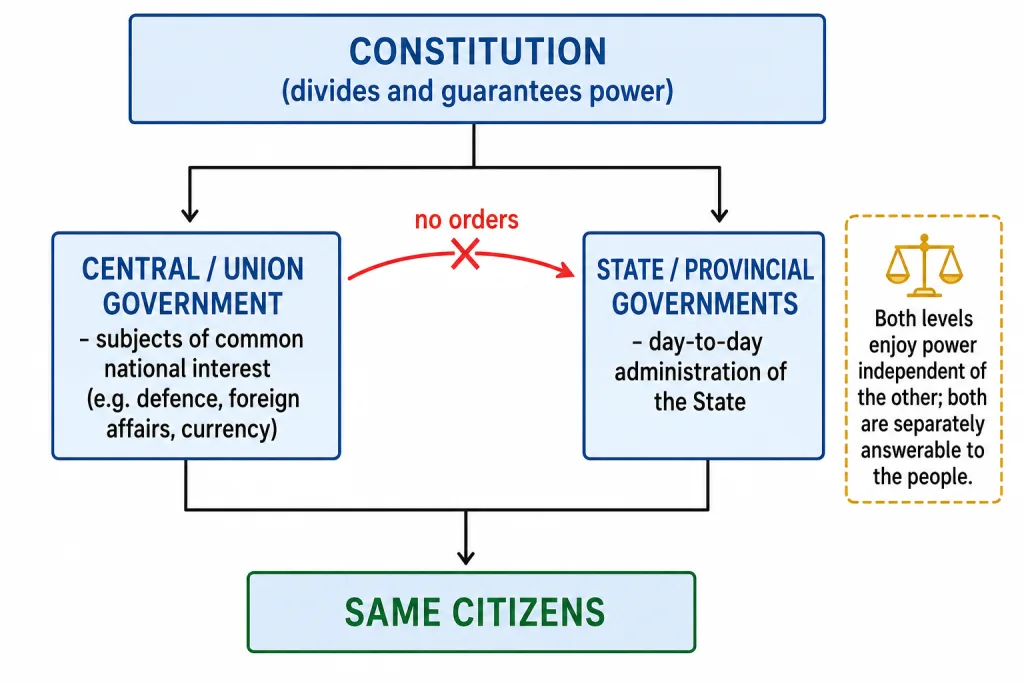
Federalism is a system of government in which the power is divided between a central authority and the various constituent units of the country. Usually, a federation has two levels of government:
- One is the government for the entire country - usually responsible for a few subjects of common national interest.
- The others are governments at the level of provinces or States that look after much of the day-to-day administration of their State.
The most important point is that both these levels of government enjoy their power independent of the other. Neither is a subordinate of the other.
The Belgium and Sri Lanka Contrast
We can understand federalism by returning to the contrast between Belgium and Sri Lanka from the last chapter.
Regional governments existed in Belgium even earlier. They had their roles and powers, but all these powers were given to them by the Central Government and could be withdrawn by it. The key change made in 1993 was that the regional governments were given constitutional powers that were no longer dependent on the central government. Thus, Belgium shifted from a unitary to a federal form of government.
Sri Lanka, on the other hand, continues to be, for all practical purposes, a unitary system where the national government has all the powers. Tamil leaders there want Sri Lanka to become a federal system. This contrast shows the heart of federalism: in a federation, a State's powers are guaranteed by the constitution and cannot simply be taken away by the centre.
Federal Systems Around the World
Federalism is not only for large countries, but most large countries do adopt it. Though only 25 of the world's 193 countries have federal political systems, their citizens make up about 40 per cent of the world's population. Most of the large countries of the world - the USA, Brazil, Russia, Canada, Australia and India among them - are federations.
The exact balance of power between the central and the state governments varies from one federation to another. This balance depends mainly on the historical context in which the federation was formed. In some federations the constituent States are very strong and roughly equal; in others the Central Government is clearly more powerful. Federalism is therefore a flexible idea that can be adapted to a country's own history and needs.
Questions and Answers
Q1. Define federalism.
Answer: Federalism is a system of government in which the power is divided between a central authority and the various constituent units of the country. Usually there are two levels of government - one for the whole country and one for the provinces or States - and both levels enjoy their power independent of each other, with their jurisdictions guaranteed by the constitution.
Q2. How did Belgium shift from a unitary to a federal system?
Answer: Regional governments existed in Belgium earlier, but their powers were given and could be withdrawn by the Central Government. In 1993, the Constitution was changed so that the regional governments were given constitutional powers no longer dependent on the central government. Because their powers were now guaranteed by the constitution, Belgium became a federal system instead of a unitary one.
Q3. Why do we say both levels of government in a federation are independent of each other?
Answer: In a federation, the powers of each level are fixed in the constitution, so one level cannot take away the powers of the other. The State government has powers of its own for which it is not answerable to the central government, and the central government cannot order the state government about its own subjects. Both are separately answerable to the people. This mutual independence is what distinguishes a federation from a unitary system.