
Average Income and Its Limitations
Averages are useful for comparison, but they also hide disparities — that is, they do not tell us how income is shared among people. Two countries can have exactly the same average income and yet be very different places to live.
The Country A and Country B Example
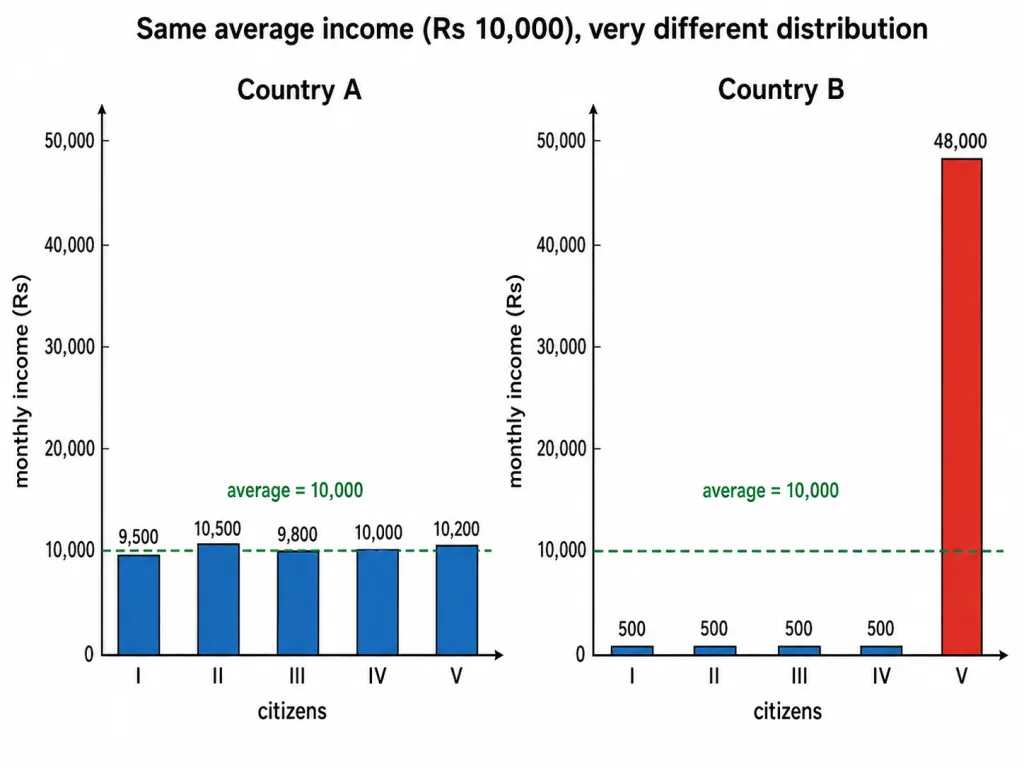
Suppose two countries, A and B, each have only five citizens. Their monthly incomes (in Rupees) are:
| Citizen | I | II | III | IV | V | Average |
|---|---|---|---|---|---|---|
| Country A | 9,500 | 10,500 | 9,800 | 10,000 | 10,200 | 10,000 |
| Country B | 500 | 500 | 500 | 500 | 48,000 | 10,000 |
Both countries have the same average income of Rs 10,000. But in Country A incomes are fairly equal — nobody is very rich or very poor. In Country B, four people are very poor and one person is extremely rich.
Most of us would prefer to live in Country A, because it has a more equitable (equal) distribution of income. This shows that while average income is useful for comparison, it does not tell us how income is distributed among people.
Questions and Answers
Q1. 'While averages are useful for comparison, they also hide disparities.' Explain using the example of Country A and Country B.
Answer: Countries A and B both have an average income of Rs 10,000, so by averages they look equally rich. But in Country A the five incomes are close to each other (about Rs 9,500–10,500), while in Country B four people earn only Rs 500 and one earns Rs 48,000. The average hides this huge inequality. Most people would prefer Country A because its income is more equitably distributed, even though the averages are identical.
Q2. Besides the size of per capita income, what other property of income is important when comparing societies?
Answer: The distribution of income — how equally or unequally income is shared among people — is very important. A society where income is spread fairly evenly (like Country A) is usually preferred to one where a few are very rich and most are very poor (like Country B), even if both have the same average income.
Q3. If the average income of a country has been rising over time, can we conclude that all sections have become better off? Illustrate.
Answer: No. A rising average can hide the fact that only a small rich section has gained while the poor remain the same or become worse off. For example, if one person's income jumps from Rs 48,000 to Rs 98,000 while four others stay at Rs 500, the average rises, yet the poor are no better off. A higher average does not guarantee that everyone has benefited.