
Sustainability of Development
Suppose a country is quite developed. We would want that level of development to go up further, or at least be maintained for future generations. Since the second half of the twentieth century, however, many scientists have warned that the present type and level of development is not sustainable.
Sustainable development means using resources in a way that meets present needs without harming the ability of future generations to meet their own needs. As the saying goes: "We have not inherited the world from our forefathers — we have borrowed it from our children."
Renewable and Non-Renewable Resources
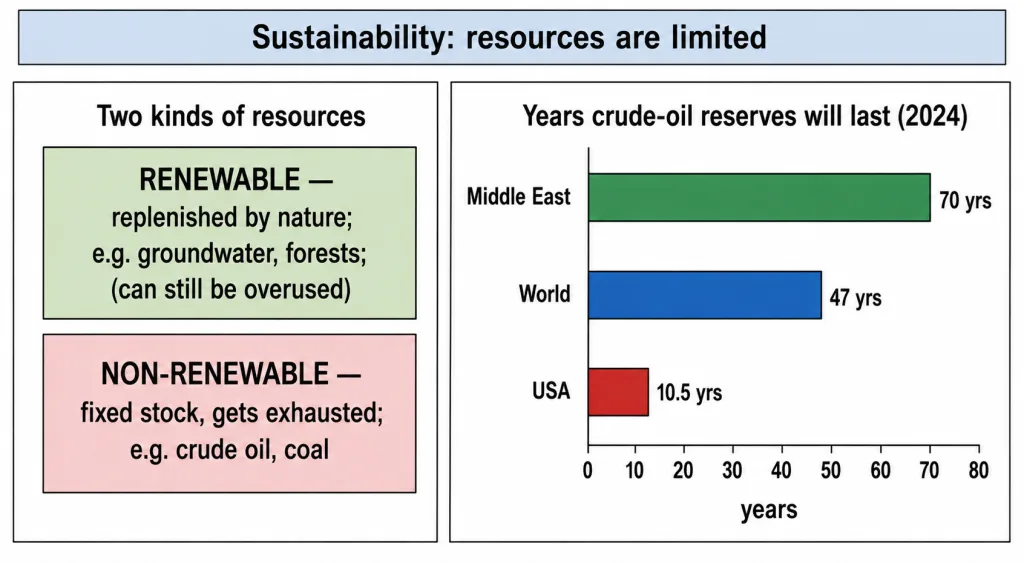
- Renewable resources are replenished by nature — like groundwater, crops and plants. But even these can be overused: if we draw more groundwater than the rain replenishes, we overuse the resource. Recent evidence shows about 300 districts have reported a water-level decline of over 4 metres in the past 20 years, and nearly one-third of the country is overusing its groundwater.
- Non-renewable resources get exhausted after some years of use — like crude oil. We have a fixed stock on earth that cannot be replenished; we may discover new sources, but over time even these will run out.
The Example of Crude Oil
| Region / Country | Reserves 2017 (thousand million barrels) | Years reserves will last |
|---|---|---|
| Middle East | 836 | 70 |
| United States of America | 69 | 10.5 |
| World | 1,732 | 47 |
Source: Energy Institute's Statistical Review of World Energy, 2024.
The world's crude oil reserves would last only about 50 more years at the present rate of use. India depends heavily on importing oil, so rising oil prices become a burden. The consequences of environmental degradation do not respect national boundaries — our future is linked together. Sustainability of development is a comparatively new area of knowledge in which scientists, economists and philosophers work together.
Questions and Answers
Q1. What is sustainability of development, and why is it important?
Answer: Sustainability of development means that development should be maintained for future generations — resources should be used so that the needs of the present are met without destroying the ability of future generations to meet their own needs. It is important because many resources (like groundwater and crude oil) are being overused or exhausted, and environmental damage threatens the well-being of people yet to be born.
Q2. Distinguish between renewable and non-renewable resources with examples.
Answer:
- Renewable resources are replenished by nature and can last if used carefully — for example, groundwater, crops and forests. But they can still be overused (e.g., drawing groundwater faster than rain refills it).
- Non-renewable resources exist in a fixed stock and get exhausted with use — for example, crude oil and coal. Once used up, they cannot be replaced within a human timescale.
Q3. Why is groundwater, though a renewable resource, under threat in India?
Answer: Groundwater is renewable because rain replenishes it, but it is overused in many areas. About 300 districts have seen the water level fall by more than 4 metres in 20 years, and nearly one-third of the country is over-drawing its groundwater — especially in prosperous farming regions like Punjab and western Uttar Pradesh. If this continues, about 60 per cent of the country could be overusing groundwater within 25 years, making it unsustainable.