
The Human Development Report and HDI
Once we realise that income, though important, is an inadequate measure of development, we look for other criteria. We do not want a very long list, so we choose a small number of the most important things — chiefly health, education and income.
The Human Development Report (HDR), published every year by the UNDP (United Nations Development Programme), compares countries using the Human Development Index (HDI). HDI is based on:
- the educational levels of the people (mean years of schooling),
- their health (life expectancy at birth), and
- per capita income (Gross National Income per capita in PPP dollars).
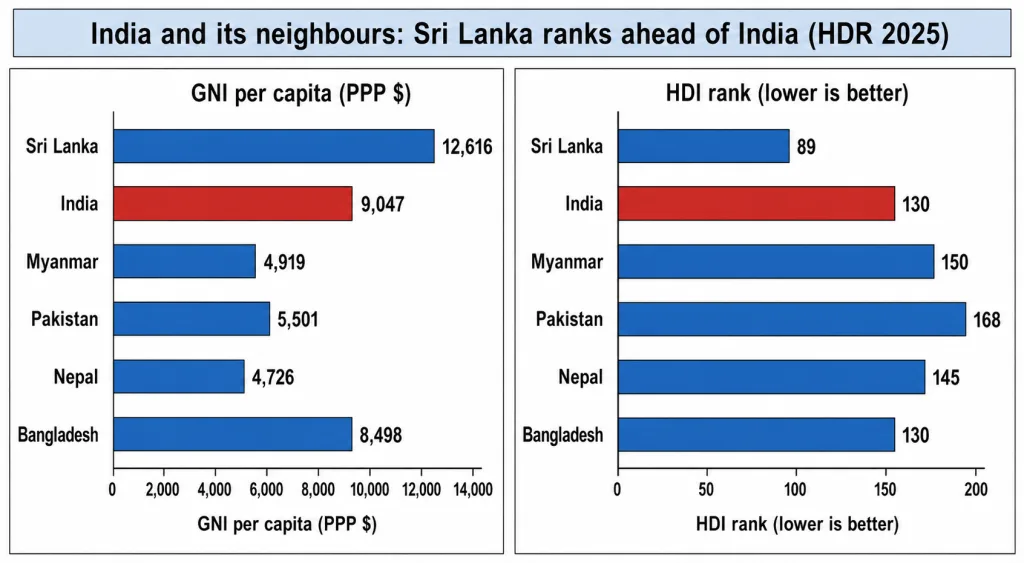
India and Its Neighbours (HDR 2025, data for 2023)
| Country | GNI per capita (PPP dollars) | Life Expectancy (years) | Mean Years of Schooling | HDI Rank (world) |
|---|---|---|---|---|
| Sri Lanka | 12,616 | 77.5 | 10.8 | 89 |
| India | 9,047 | 72.0 | 6.9 | 130 |
| Myanmar | 4,919 | 66.9 | 6.4 | 150 |
| Pakistan | 5,501 | 67.6 | 4.3 | 168 |
| Nepal | 4,726 | 70.4 | 4.5 | 145 |
| Bangladesh | 8,498 | 74.7 | 6.8 | 130 |
Two striking facts stand out. First, Sri Lanka — a small neighbour — is ahead of India in every respect, with a much better HDI rank (89 vs 130). Second, Nepal and Bangladesh have a lower per capita income than India, yet they do better in life expectancy. This again shows that income is not the whole story.
Why 'Human' Development?
By pre-fixing the word 'Human' to development, the report makes clear that what matters most is what is happening to the citizens of a country — their health, education and well-being, not just the money. Many improvements have been suggested for calculating HDI, and new components continue to be added. The central message is that people are the real wealth of a nation.
Questions and Answers
Q1. On what three factors does the UNDP compare countries in the Human Development Index?
Answer: The UNDP's Human Development Index compares countries on three broad factors: (i) health — measured by life expectancy at birth; (ii) education — measured by the mean years of schooling of people aged 25 and above; and (iii) income — measured by Gross National Income per capita in PPP dollars. Together these give a fuller picture of development than income alone.
Q2. How is the UNDP's criterion for measuring development DIFFERENT from the World Bank's?
Answer: The World Bank classifies countries using only per capita income. The UNDP, in its Human Development Report, uses a broader measure — the HDI — which combines health (life expectancy), education (years of schooling) and income. Thus the UNDP measures development in terms of people's well-being, not income alone.
Q3. Nepal and Bangladesh have a lower per capita income than India but a higher life expectancy. What does this tell us?
Answer: It tells us that a higher income does not automatically mean better human development. Despite lower per capita income, Nepal and Bangladesh achieve longer life expectancy than India, probably through better provision of basic health facilities. Development therefore depends on how income and public services translate into people's health and well-being, not on income by itself.