
How to Compare Different Countries or States?
When we compare things, we choose one or more important characteristics to compare them by, and the characteristic we pick depends on the purpose of comparison. We use a different criterion to pick a sports team, a debate team or a music team. So how do we compare the all-round progress of countries?
For comparing countries, their income is considered one of the most important attributes. Countries with higher income are generally treated as more developed than those with less income. This is based on the idea that more income means more of the things human beings need.
Total Income vs Per Capita (Average) Income
The income of a country is the income of all its residents. Adding these up gives the country's total income. But for comparing countries, total income is not very useful, because countries have different populations. A country with a large total income but a huge population may still have poor people.
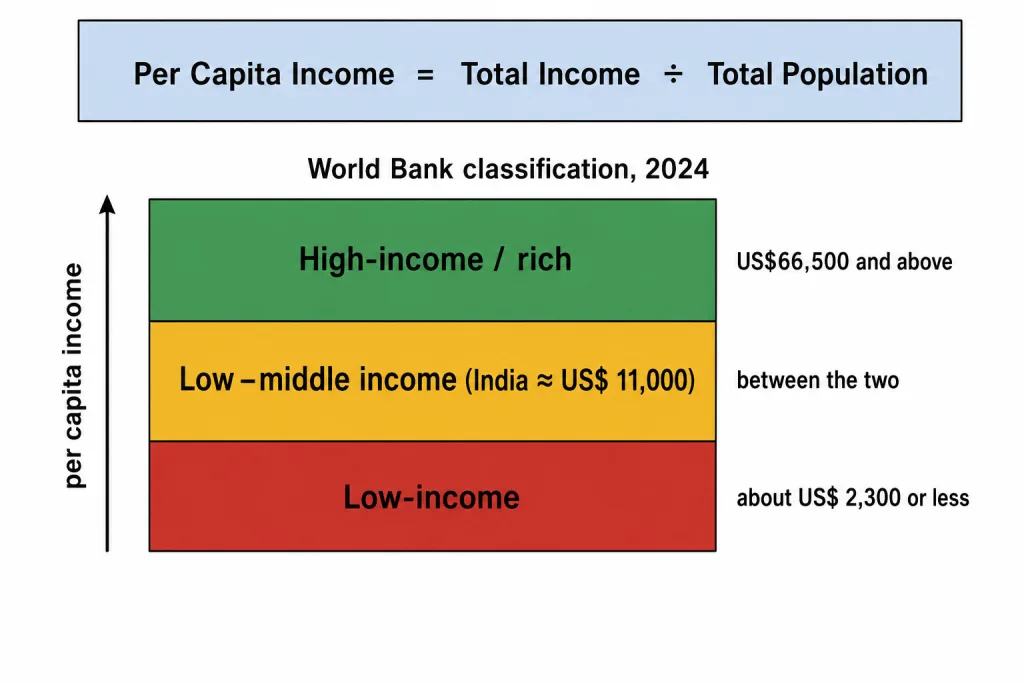
So we compare the average income, which is:
Average income = Total income of the country ÷ Total population
Average income is also called per capita income. It tells us what an average person is likely to earn.
World Bank Classification (2024)
In its World Development Reports, the World Bank uses per capita income to classify countries:
- High-income (rich) countries: per capita income of USD 66,500 per year and above (2024).
- Low-income countries: per capita income of about USD 2,300 or less.
- India had a per capita income of about USD 11,000 per year in 2024, so it falls in the low-middle income group.
The rich countries — excluding the Middle East and certain small countries — are generally called developed countries.
Questions and Answers
Q1. What is per capita income? How is it calculated?
Answer: Per capita income (also called average income) is the total income of a country divided by its total population. It tells us the income of an average person. It is used for comparing countries because, unlike total income, it adjusts for differences in population size.
Q2. What is the main criterion used by the World Bank to classify countries? What is its limitation?
Answer: The World Bank uses per capita income as the main criterion. Countries with per capita income of USD 66,500 or more per year (2024) are called rich, and those with about USD 2,300 or less are called low-income. Its limitation is that per capita income is an average — it hides how income is distributed, and it ignores non-income aspects like health, education and the environment.
Q3. Why is total income NOT a useful measure for comparing countries?
Answer: Because countries have different populations. A large country may have a big total income simply because it has many people, yet an average person there may be poor. To know how well-off an average person is, we must divide the total income by the population and use per capita (average) income instead.