
Public Facilities
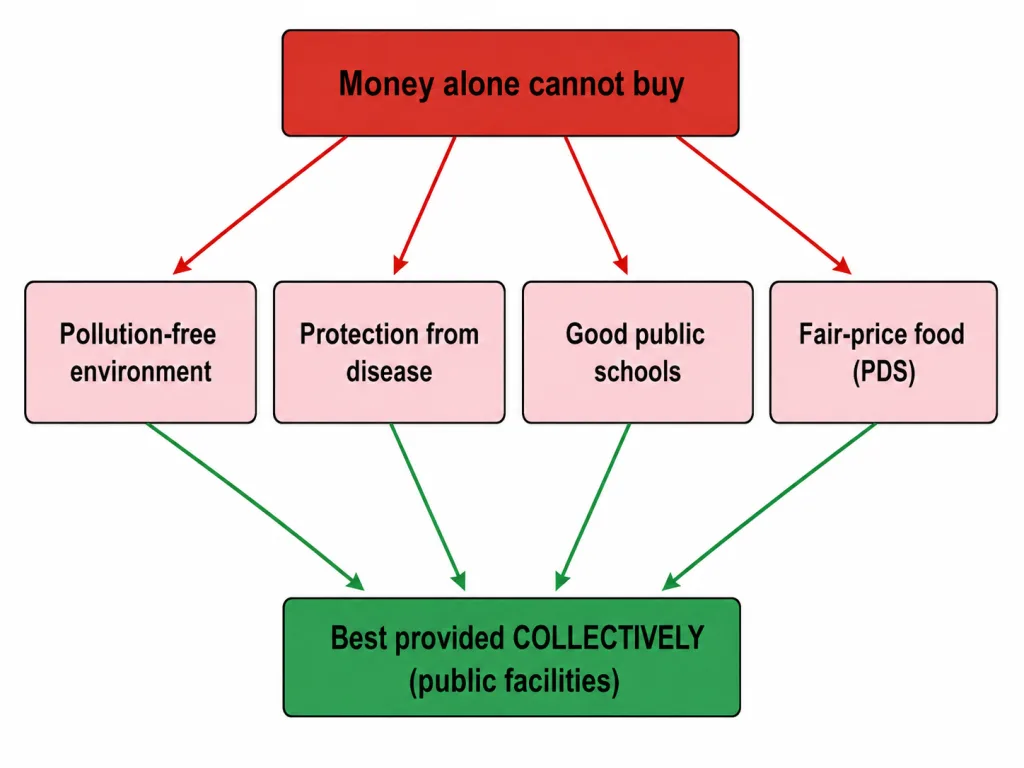
How can the average person in Haryana have more income than in Kerala, yet lag behind in health and education? The reason is that money in your pocket cannot buy all the goods and services you need to live well. Income by itself is not a complete indicator of the goods and services citizens can actually use.
For many important things in life, the best and cheapest way is to provide them collectively. For example, it is cheaper to have collective security for a whole locality than for each house to hire its own guards.
Why Collective Provision Matters
Consider schooling. You are able to study because many other children also want to study, and because society and the government believe schools should be open to all. If you were the only person in your village interested in studying, you would not be able to unless your parents could afford a distant private school. In many areas, children — especially girls — cannot attend high school because the government has not provided adequate facilities.
Kerala has a low Infant Mortality Rate because it has good provision of basic health and educational facilities. In some states the Public Distribution System (PDS) — which supplies food grains at fair prices — functions well, so the health and nutritional status of people there is better. This is why public facilities are central to development.
Questions and Answers
Q1. Why can the average person in Haryana have more income than in Kerala but still be worse off in health and education?
Answer: Because money alone cannot buy many essential goods and services — such as good public schools, hospitals, clean water and protection from disease. These are best provided collectively through public facilities. Kerala provides good basic health and education services, so despite lower income its people enjoy better health and education than in Haryana.
Q2. What is the Public Distribution System (PDS), and how does it help development?
Answer: The Public Distribution System (PDS) is the network of ration shops through which the government supplies food grains and essential items at fair (subsidised) prices. Where the PDS works well, people — especially the poor — get enough affordable food, so their health and nutritional status improves. Good public facilities like the PDS therefore contribute directly to human development.
Q3. 'For many important things in life the cheapest way is to provide them collectively.' Explain with an example.
Answer: Some services are far cheaper when shared by a whole community than when bought by each person alone. For example, collective security for an entire locality costs less per household than each family hiring its own guards; a public school educates many children at low cost per child. Collective provision of such goods and services is efficient and makes them available even to those who cannot afford them individually.