
What Development Promises — Different People, Different Goals
The idea of development or progress has always been with us. We have aspirations about what we want to do, how we want to live, and what our country should be like. Can life be better for all? Can there be more equality? Development involves thinking about these questions and about the ways in which we can work towards achieving these goals.
Different people can have different developmental goals. What one person considers development may not be development for another — it may even be destructive for the other. So two things are clear:
- different persons can have different developmental goals, and
- what is development for one may not be development for another.
Different People Seek Different Things
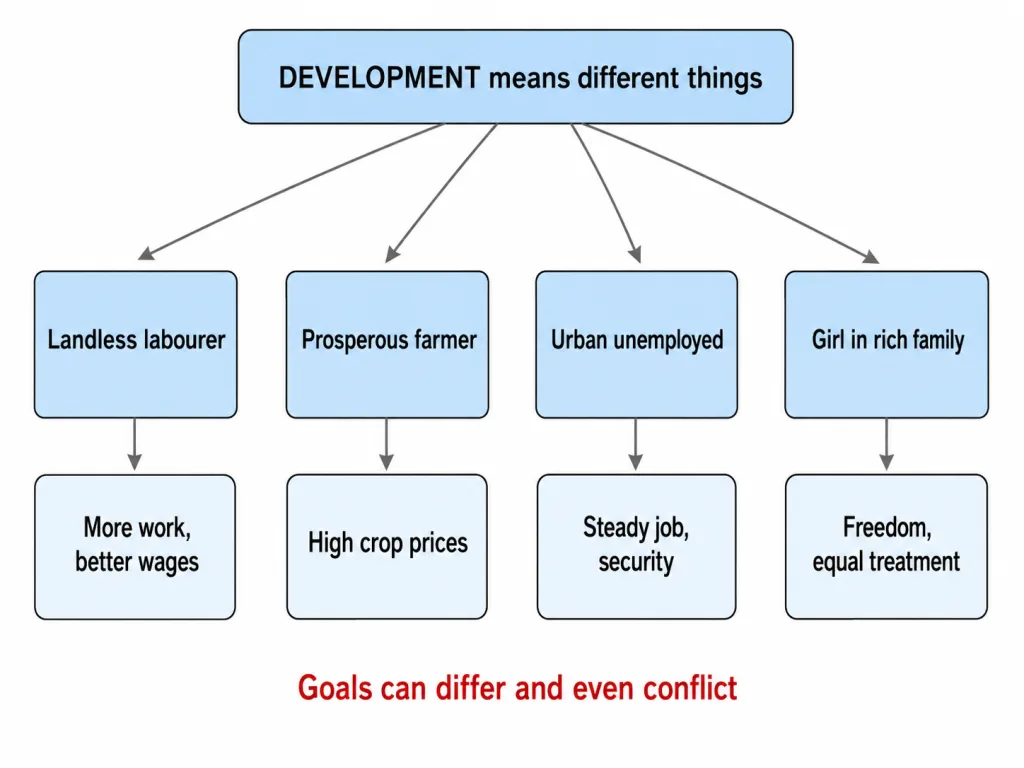
Imagine what development means to different people. A landless rural labourer wants more days of work and better wages, a good local school for their children, and an end to social discrimination. Prosperous farmers from Punjab want higher support prices for their crops and cheap labour, and the ability to settle their children abroad. A girl from a rich urban family wants as much freedom and opportunity as her brother and the freedom to decide her own life.
Sometimes the goals of two persons or groups may be conflicting. A girl expects as much freedom as her brother — but her brother may not like sharing the housework. To get more electricity, industrialists may want more dams — but a dam may submerge land and displace people such as tribals, who may instead prefer small check dams or tanks to irrigate their land.
Income and Other Goals
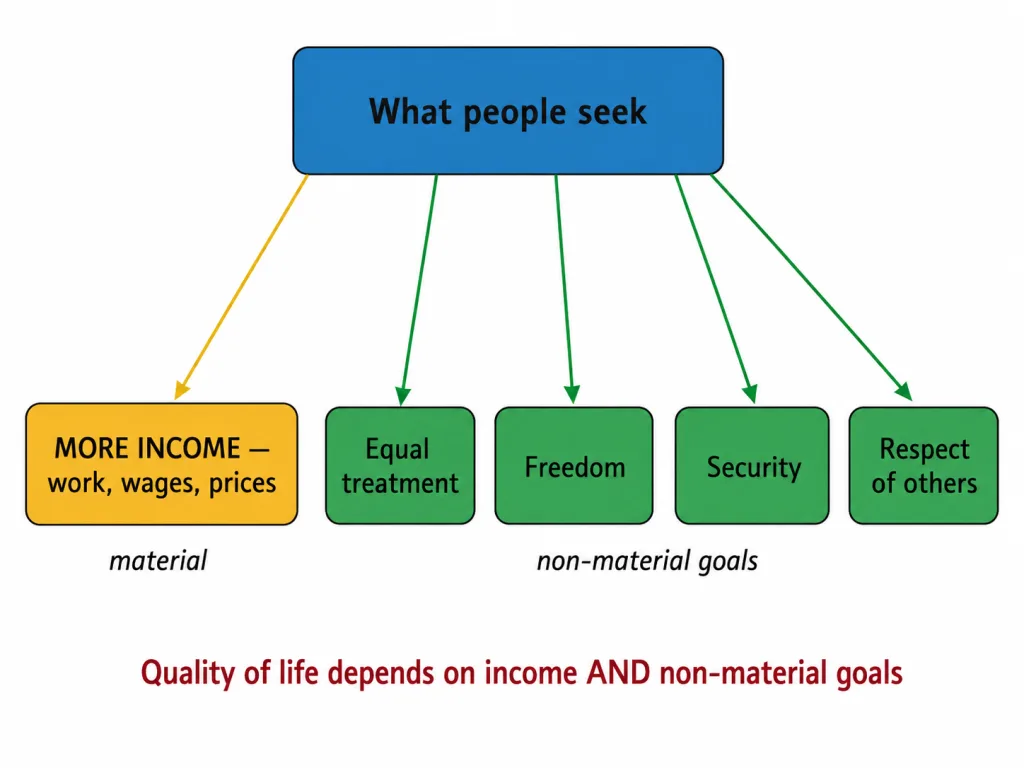
If we look carefully, one thing is common to what most people want: regular work, better wages, and a decent price for their crops or goods. In other words, people want more income.
But besides seeking more income, people also seek things like equal treatment, freedom, security, and respect from others. They resent discrimination. All of these are important goals. In fact, in some cases these non-material goals may be more important than more income or more consumption, because material goods are not all that one needs to live.
Money, or the things money can buy, is one factor on which our life depends. But the quality of our life also depends on non-material things — like friendship, dignity, and a pollution-free environment — many of which are not easily measured but mean a great deal to us. It would be wrong to conclude that what cannot be measured is not important.
A Mix of Goals
For most decisions, people look at a mix of goals. Before accepting a job in a far-off place, a person weighs many factors besides income — facilities for the family, the working atmosphere, opportunities to learn, and job security. A job may pay less but offer regular, secure employment; another may pay more but give no security and leave no time for family.
The same is true for development. For example, if women are engaged in paid work, their dignity in the household and society increases. And if there is respect for women, there is more sharing of housework and greater acceptance of women working outside. A safe and secure environment may allow more women to take up a variety of jobs or run a business. Hence, the developmental goals people have are not only about better income but also about other important things in life.
Questions and Answers
Q1. Why do different persons have different notions of development?
Answer: Different persons have different developmental goals mainly because the life situations of persons are different. A landless labourer, a big farmer, an urban businessperson and a tribal in the Narmada valley all live in very different circumstances, so each seeks what is most important for their situation. What looks like development to one — such as building a large dam — may be destructive for another, whose land gets submerged.
Q2. Do the two statements — 'people have different developmental goals' and 'people have conflicting developmental goals' — mean the same thing?
Answer: No, they are not the same.
- Different goals simply means people want different things — one wants a good school, another wants better crop prices.
- Conflicting goals means the goal of one person is achieved only at the cost of another. For example, industrialists wanting a big dam for electricity conflicts with tribals whose homes will be submerged. All conflicting goals are different, but not all different goals are conflicting.
Q3. Give some examples where factors other than income are important aspects of our lives.
Answer: Several non-income factors shape the quality of our lives:
- Freedom and equal treatment — e.g., a girl wanting the same freedom as her brother.
- Security — regular, secure employment rather than high but insecure pay.
- Respect and dignity — an end to social discrimination.
- A pollution-free environment and safety from disease.
- Friendship and family life. These cannot always be bought with money, yet they matter greatly.