
Income and Other Criteria
Just as individuals want more than income — security, respect, freedom — a nation too should be judged by more than average income. Money in your pocket cannot buy all the goods and services you need for a good life, such as a pollution-free environment, safety from disease, or good schools for all.
Let us compare three Indian states — Haryana, Kerala and Bihar — to see why income alone is not enough.
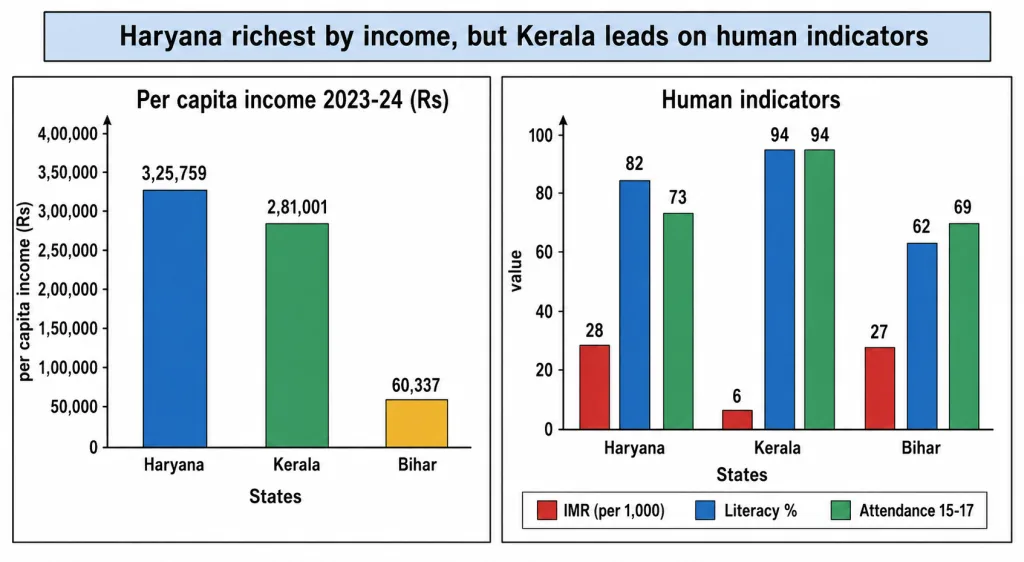
Per Capita Income of the Three States (2023–24)
| State | Per Capita Income (2023–24, in Rs) |
|---|---|
| Haryana | 3,25,759 |
| Kerala | 2,81,001 |
| Bihar | 60,337 |
Source: Economic Survey 2024-25.
By per capita income, Haryana is the richest and Bihar the poorest of the three. If income were the only measure of development, Haryana would be the most developed and Bihar the least developed.
Other Comparative Data
| State | Infant Mortality Rate (per 1,000, 2020) | Literacy Rate % (2017–18) | Net Attendance Ratio, class 15–17 (2017–18) |
|---|---|---|---|
| Haryana | 28 | 82 | 73 |
| Kerala | 6 | 94 | 94 |
| Bihar | 27 | 62 | 69 |
Notice that Kerala, though it has a lower per capita income than Haryana, does far better on human indicators — its Infant Mortality Rate is only 6 (against 28 in Haryana), and its literacy and attendance are the highest. So per capita income is not enough on its own to judge development.
Key terms:
- Infant Mortality Rate (IMR): the number of children who die before the age of one year, per 1,000 live births in a year.
- Literacy Rate: the proportion of the literate population in the age group of 7 years and above.
- Net Attendance Ratio: the number of children aged 15–17 attending school as a percentage of all children in that age group.
Questions and Answers
Q1. Kerala has a lower per capita income than Haryana but a better human development record. What does this show?
Answer: It shows that per capita income alone is not an adequate measure of development. Kerala's Infant Mortality Rate is just 6 (against Haryana's 28) and its literacy (94%) and attendance (94) are higher, even though Haryana has a higher per capita income. Good health and education, provided through public facilities, matter as much as income.
Q2. Define Infant Mortality Rate, Literacy Rate and Net Attendance Ratio.
Answer:
- Infant Mortality Rate (IMR): the number of children who die before completing one year of age, per 1,000 live births in a given year.
- Literacy Rate: the proportion of the literate population in the 7-years-and-above age group.
- Net Attendance Ratio: the total number of children aged 15–17 years attending school, as a percentage of all children in that age group.
Q3. 'Money cannot buy all the goods and services needed to live well.' Give examples.
Answer: Some of the most important things for a good life cannot be bought individually with money — for example, a pollution-free environment, unadulterated medicines, protection from infectious diseases, or good roads and public schools. These are best provided collectively by society or the government. So a person may have income yet still lack these facilities.