
Factors that Have Enabled Globalisation — Technology
Rapid improvement in technology has been a major factor driving globalisation.
- Transportation technology: the past fifty years have brought much faster delivery of goods over long distances at lower cost. Containers — into which goods are packed and loaded intact onto ships, railways, planes and trucks — have hugely reduced port-handling costs and sped up exports. Air-transport costs have also fallen.
- Information and communication technology (IT): developments in telecommunications, computers and the Internet let people contact one another instantly across the world at negligible cost (through e-mail, voice-mail and the Internet). This has helped spread out the production of services across countries — for example, a magazine for London can be designed and printed in Delhi and sent by air, with payment made instantly via e-banking.
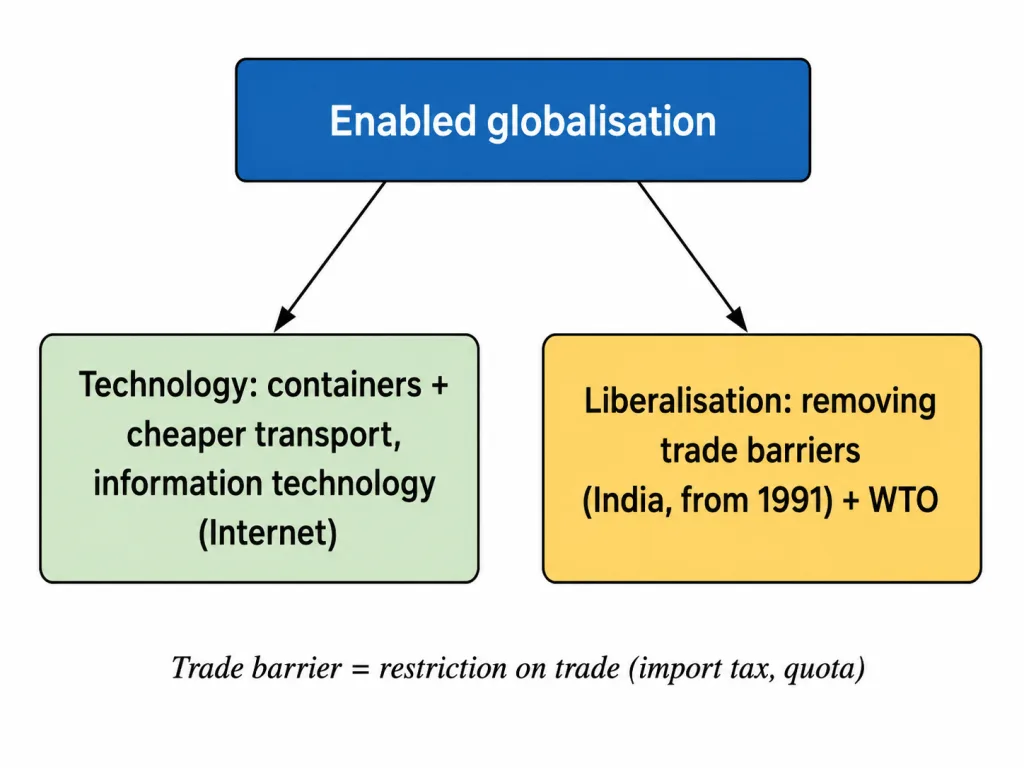
Liberalisation of Trade and Investment
A trade barrier is a restriction on foreign trade — for example, a tax on imports (or a quota, a limit on the quantity that can be imported). Governments use trade barriers to regulate foreign trade and decide what and how much may enter the country.
After Independence, India put barriers on foreign trade and investment to protect its new industries (1950s–60s) from foreign competition, allowing imports of only essential items. But around 1991, India made far-reaching policy changes: the government felt Indian producers should now compete globally to improve their quality. Supported by powerful international organisations, it removed barriers to a large extent, so goods could be imported and exported easily and foreign companies could set up here. Removing government-set barriers or restrictions is called liberalisation — the government becomes more liberal.
Questions and Answers
Q1. How has technology enabled globalisation?
Answer: Technology has enabled globalisation in two big ways. Transportation technology — especially containers and cheaper air transport — allows goods to be moved faster, over long distances, at lower cost. Information and communication technology (IT) — telecom, computers and the Internet — lets people communicate and share information instantly across the world at negligible cost, which makes it possible to spread out the production of services (like designing a London magazine in Delhi). Without IT, today's globalisation would not have been possible.
Q2. What is liberalisation of foreign trade?
Answer: Liberalisation is the removal of government-set barriers or restrictions on foreign trade and investment. With liberalisation, businesses are free to decide what to import or export, and foreign companies can set up factories and offices in the country. The government imposes far fewer restrictions than before, so it is said to be more 'liberal'. India carried out major liberalisation around 1991.
Q3. What is a trade barrier? Why did India use trade barriers after Independence, and why did it remove them around 1991?
Answer: A trade barrier is a restriction on foreign trade, such as a tax on imports or a quota. After Independence India used trade barriers to protect its new industries from foreign competition, since these industries could not yet survive cheap imports. Around 1991, believing that competition would improve quality, India removed most barriers (liberalisation) so producers could compete globally and foreign companies could invest here.