
Interlinking Production and Foreign Investment
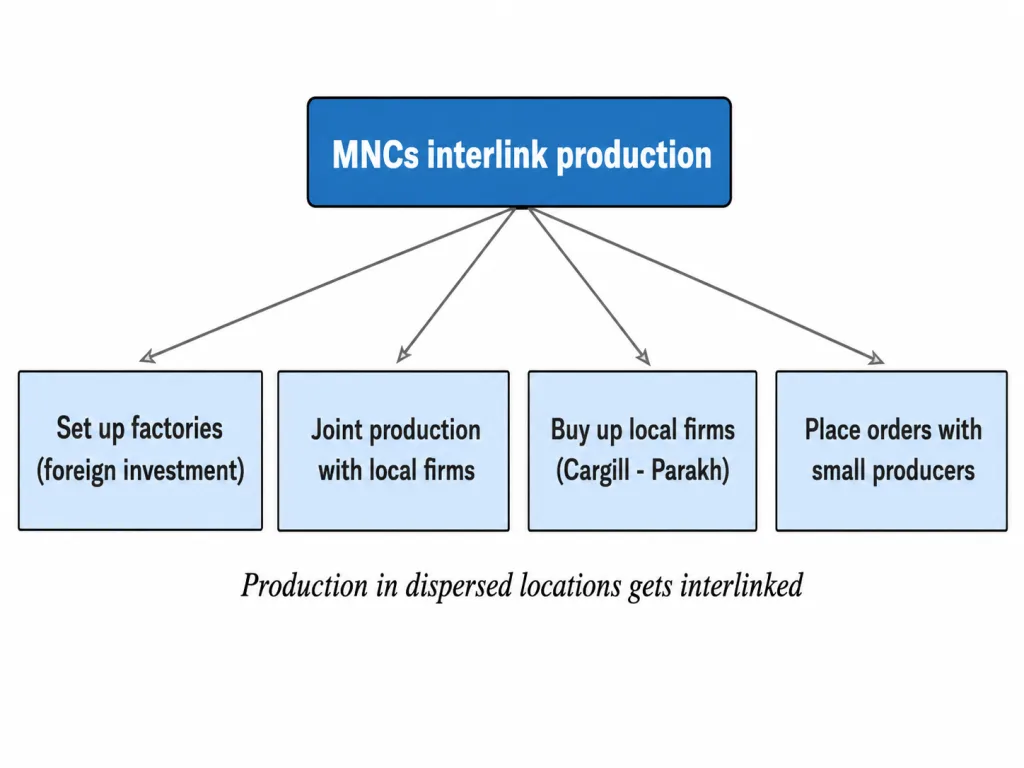
Having found the right conditions, MNCs set up factories and offices for production. The money spent to buy assets such as land, buildings, machines and equipment is called investment, and investment made by MNCs is called foreign investment. Any investment is made hoping the assets will earn profits.
Ways MNCs Spread and Control Production
MNCs interlink production with local firms in several ways:
- Setting up production jointly with local companies — the MNC provides money for extra investment (like new machines) and brings the latest technology.
- Buying up local companies and expanding — e.g., Cargill Foods, a large American MNC, bought the Indian company Parakh Foods (with its marketing network and four oil refineries), becoming the largest producer of edible oil in India (5 million pouches a day).
- Placing orders with small producers — for garments, footwear and sports items made by many small producers, who supply the MNC; the MNC then sells them under its own brand and has huge power to fix price, quality, delivery and labour conditions.
Many top MNCs have wealth exceeding the entire budgets of developing-country governments, giving them enormous power. Through all these routes, production in widely dispersed locations gets interlinked.
Questions and Answers
Q1. What is foreign investment? How is it different from foreign trade?
Answer: Investment is the money spent to buy assets such as land, buildings, machines and equipment; foreign investment is investment made by MNCs. It differs from foreign trade: foreign trade is the buying and selling (export and import) of goods and services across borders, whereas foreign investment is the setting up of production (assets) in another country. Trade moves goods; investment builds production.
Q2. Describe the ways in which MNCs control or interlink production across countries.
Answer: MNCs interlink production by: (i) setting up production jointly with local firms, providing money and technology; (ii) buying up local companies and expanding (e.g., Cargill bought Parakh Foods); (iii) placing orders with small producers for items like garments and footwear, then selling them under the MNC's own brand while controlling price, quality and labour conditions; and (iv) competing with or setting up their own factories. Through these routes, production across countries becomes interlinked.
Q3. How does an MNC like Cargill exert influence by buying a local company?
Answer: By buying a well-reputed local company, an MNC instantly gains its brand, marketing network and assets. For example, Cargill Foods bought Parakh Foods, acquiring its large marketing network and four oil refineries, and became the largest edible-oil producer in India (5 million pouches daily). With wealth often exceeding the budgets of developing countries, such MNCs gain great power and influence over production.