
Foreign Trade and Integration of Markets
For a long time, foreign trade has been the main channel connecting countries — think of the old trade routes linking India to markets in the East and West, which attracted trading companies like the East India Company.
The basic function of foreign trade is that it creates an opportunity for producers to reach beyond their domestic markets. Producers can sell not only within their own country but also compete in markets of other countries. For buyers, importing goods produced abroad is a way of expanding their choice beyond what is produced at home.
Chinese Toys and the Integration of Markets
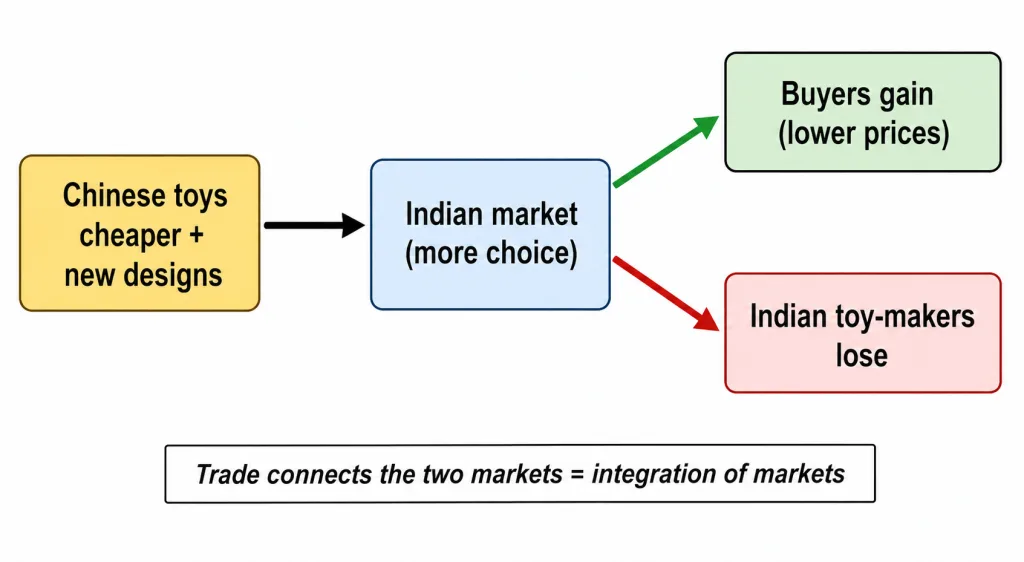
Suppose Chinese manufacturers begin exporting cheap plastic toys to India. Indian buyers can now choose between Indian and Chinese toys. Because Chinese toys are cheaper and have new designs, within a year 70–80 per cent of toy shops replace Indian toys with Chinese toys. Buyers get greater choice at lower prices; Chinese toy-makers expand their business, while Indian toy-makers face losses.
In general, when trade opens up, goods travel between markets, choice rises, prices of similar goods tend to become equal, and producers in different countries compete closely even though they are far apart. Foreign trade thus results in connecting markets, or integration of markets, across countries.
Questions and Answers
Q1. What is the basic function of foreign trade?
Answer: The basic function of foreign trade is to create an opportunity for producers to reach beyond their domestic markets. Producers can sell their goods in other countries and compete there, while buyers can import goods to widen their choice beyond what is produced at home. Foreign trade thus links the markets of different countries.
Q2. How does foreign trade lead to the integration of markets? Explain with the Chinese-toys example.
Answer: When Chinese toys enter India, they compete with Indian toys; buyers get greater choice at lower prices, and toy prices in the two countries move closer together. Producers in China and India now compete directly even though far apart. In this way trade connects the two markets — an integration of markets — so that goods, prices and competition in one country are linked to those in the other.
Q3. What happens to choice, prices and competition when trade opens up between two countries?
Answer: When trade opens up, goods travel from one market to another, so the choice of goods rises for buyers. The prices of similar goods tend to become equal in the two markets. And producers in the two countries compete closely against each other despite being separated by long distances. Together these effects mean the two markets become integrated.