
Production Across Countries
Until the middle of the twentieth century, production was largely organised within countries. What crossed national boundaries were raw materials, foodstuff and finished products. Colonies such as India exported raw materials and imported finished goods, and trade was the main channel connecting distant countries.
This changed with the rise of large companies called multinational corporations (MNCs). A MNC is a company that owns or controls production in more than one nation. MNCs set up offices and factories in regions where they can get cheap labour and other resources, so that the cost of production is low and they can earn greater profits.
Spreading Production Across the Globe
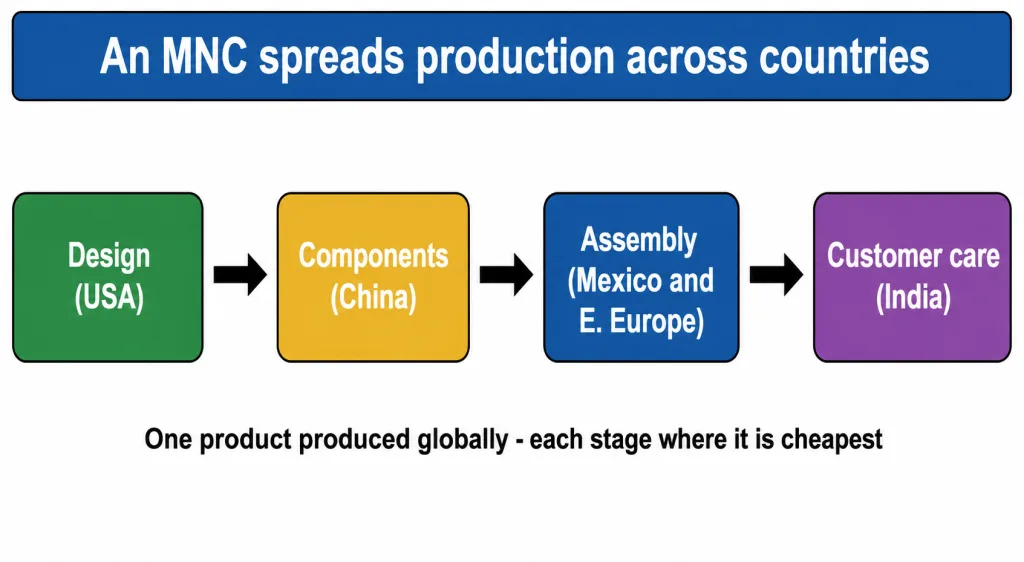
Consider a large MNC producing industrial equipment. It designs its products in research centres in the United States, has the components manufactured in China, gets them assembled in Mexico and Eastern Europe, sells the finished products worldwide, and runs its customer care through call centres in India.
Here the MNC not only sells globally but, more importantly, the goods and services are produced globally. The production process is divided into small parts and spread across the world, each located where it is cheapest or most useful: China offers cheap manufacturing, Mexico and Eastern Europe are close to US and European markets, and India offers skilled engineers and educated English-speaking youth for customer care — giving the MNC 50–60 per cent cost savings.
Questions and Answers
Q1. What is a multinational corporation (MNC)?
Answer: A multinational corporation (MNC) is a company that owns or controls production in more than one nation. MNCs set up offices and factories in different countries, usually where they can get cheap labour and other resources, so that their cost of production is low and they can earn greater profits. Their production and sales span several countries at once.
Q2. Why do MNCs set up production in particular locations?
Answer: MNCs set up production where it is close to the markets; where skilled and unskilled labour is available at low cost; where other factors of production are assured; and where government policies favour their interests. By choosing such locations — for example, cheap manufacturing in China and skilled customer-care staff in India — MNCs keep their costs low (often saving 50–60 per cent) and their profits high.
Q3. How is production 'spread out' across countries by an MNC? Give an example.
Answer: An MNC divides the production process into small parts and locates each part where it is cheapest or best. For example, an equipment MNC designs in the USA, gets components made in China, assembles in Mexico and Eastern Europe, sells worldwide, and provides customer care from call centres in India. Thus a single product is produced globally, with different stages spread across many countries.