
The World Trade Organisation (WTO)
The liberalisation of trade and investment was supported by powerful international organisations that argue all barriers to foreign trade and investment are harmful and that trade between countries should be 'free'.
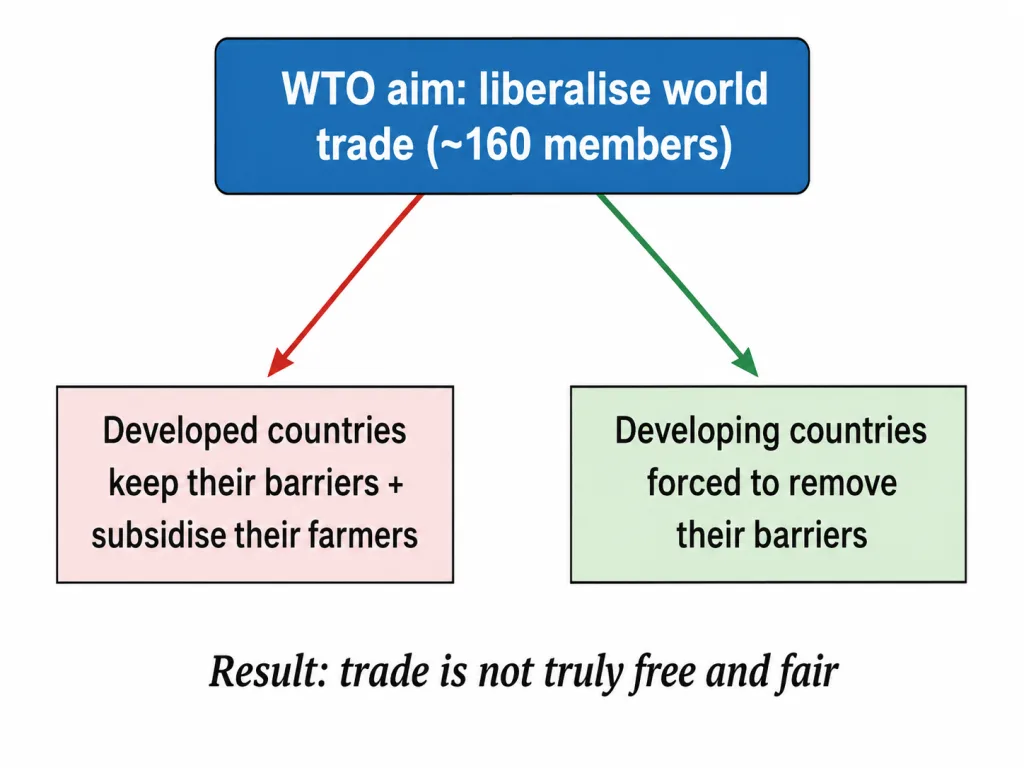
The World Trade Organisation (WTO) is one such organisation whose aim is to liberalise international trade. Started at the initiative of the developed countries, the WTO establishes rules for international trade and sees that they are obeyed. About 160 countries are currently members of the WTO.
Is Trade Really Free and Fair?
Although the WTO is supposed to allow free trade for all, in practice the developed countries have unfairly kept their own trade barriers, while WTO rules have forced developing countries to remove theirs.
A clear example is the debate on agricultural trade. In a developed country like the US, agriculture is only about 1 per cent of GDP and 0.5 per cent of employment, yet the government gives its farmers massive sums of money for production and export. With this support, US farmers sell farm products at abnormally low prices, and the surplus is dumped in other countries at low prices — hurting farmers there. Developing countries argue that this is not free and fair trade: they have reduced their barriers as required, while developed countries keep subsidising their own farmers.
Questions and Answers
Q1. What is the World Trade Organisation (WTO)? What is its aim?
Answer: The World Trade Organisation (WTO) is an international organisation whose aim is to liberalise international trade. Started at the initiative of the developed countries, it establishes rules for international trade and ensures they are obeyed. About 160 countries are members. It argues that barriers to trade are harmful and that trade between countries should be free.
Q2. Why do developing countries feel that WTO trade is not fair?
Answer: Because in practice the developed countries retain their own trade barriers and heavily subsidise their farmers, while WTO rules force developing countries to remove their barriers. For example, the US gives massive money to its farmers, letting them sell at abnormally low prices and dump surplus abroad, which harms farmers in developing countries. So developing countries feel the rules are applied one-sidedly and are not truly free and fair.
Q3. Explain the debate on trade in agricultural products with the example of the US.
Answer: In the US, agriculture makes up only about 1 per cent of GDP and 0.5 per cent of employment, yet US farmers receive massive government support for production and export. This lets them sell farm products at abnormally low prices and dump surplus in other countries' markets, adversely affecting farmers there. Developing countries like India, which have reduced their own support as per WTO rules, argue that such subsidies by rich countries make trade unfair.