
Impact of Globalisation in India — The Winners
Over the last twenty years, globalisation of the Indian economy has advanced a long way, but its impact has not been uniform.
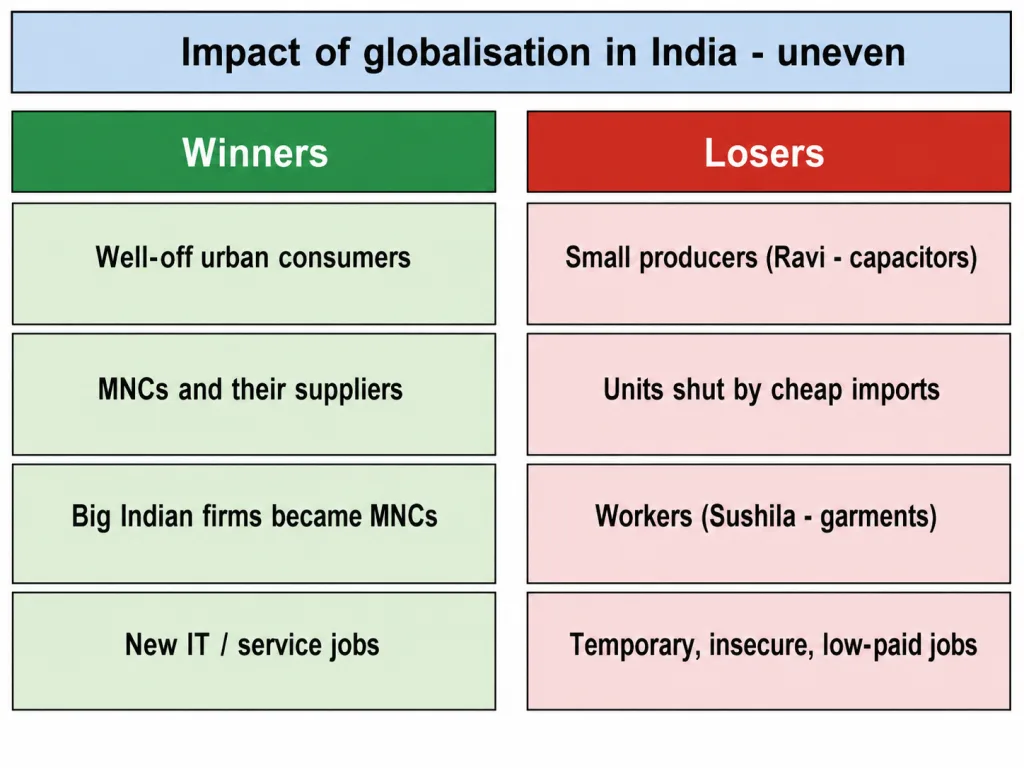
- Consumers, especially the well-off in urban areas, have gained: greater choice, better quality and lower prices for many products (cars, phones, electronics), so they enjoy higher standards of living.
- MNCs increased investment in industries like cell phones, automobiles, electronics, soft drinks, fast food and banking — creating new jobs, and helping local suppliers prosper.
- Top Indian companies benefited from competition by investing in new technology and methods; some even became MNCs themselves — Tata Motors (automobiles), Infosys (IT), Ranbaxy (medicines), Asian Paints (paints), Sundaram Fasteners (nuts and bolts).
- New service opportunities in IT grew — call centres, data entry, accounting and engineering services done cheaply in India and exported to developed countries.
Attracting Foreign Investment, and the Losers
To attract foreign companies, governments set up Special Economic Zones (SEZs) with world-class facilities (electricity, water, roads, transport); companies in SEZs pay no taxes for an initial five years. Governments have also allowed flexibility in labour laws — hiring workers 'flexibly' for short periods to cut labour costs, even though this weakens workers' protection.
For many small producers and workers, globalisation has posed major challenges:
- Ravi, who made capacitors in Hosur (Tamil Nadu) and had 20 workers, was hit hard when import restrictions were removed (per the WTO agreement, 2001): imported items were half the price, so he now makes less than half his earlier output with only seven workers. Batteries, plastics, toys, tyres, dairy and vegetable oil are other industries where small manufacturers were hit. India's small and medium industries employ 11 crore workers, next only to agriculture.
- Workers face uncertain employment: to cut costs, employers hire on a temporary basis, with long hours, night shifts, low wages and no benefits. Sushila, once a 'permanent' garment worker with provident fund and health insurance, is now a temporary worker earning less than half her earlier pay. Increasingly, even organised-sector work resembles the unorganised sector.
Questions and Answers
Q1. How has globalisation benefited people in India?
Answer: Globalisation has benefited: (i) well-off urban consumers, who now enjoy greater choice, better quality and lower prices and higher living standards; (ii) MNCs and their local suppliers, through new investment and new jobs in industries like automobiles, phones and electronics; and (iii) top Indian companies, some of which invested in new technology and even became MNCs themselves (Tata Motors, Infosys, Ranbaxy, Asian Paints, Sundaram Fasteners). It has also created new IT-based service jobs exported to developed countries.
Q2. How has globalisation hurt small producers and workers? Explain with examples.
Answer: Rising competition has hurt many small producers: Ravi, a capacitor maker with 20 workers, could not compete with cheaper imports after barriers were removed and now produces less than half with only seven workers; many similar units (batteries, toys, tyres, dairy) shut down. Workers face insecure, temporary jobs with long hours and no benefits — Sushila, once a permanent garment worker with provident fund and health insurance, is now a temporary worker earning less than half her earlier wage.
Q3. What are Special Economic Zones (SEZs), and why are they set up?
Answer: Special Economic Zones (SEZs) are industrial zones with world-class facilities — electricity, water, roads, transport, storage and recreational and educational facilities. Companies that set up production units in SEZs do not pay taxes for an initial period of five years. SEZs are set up to attract foreign companies to invest in India by offering good infrastructure and tax benefits.