
Sugarcane
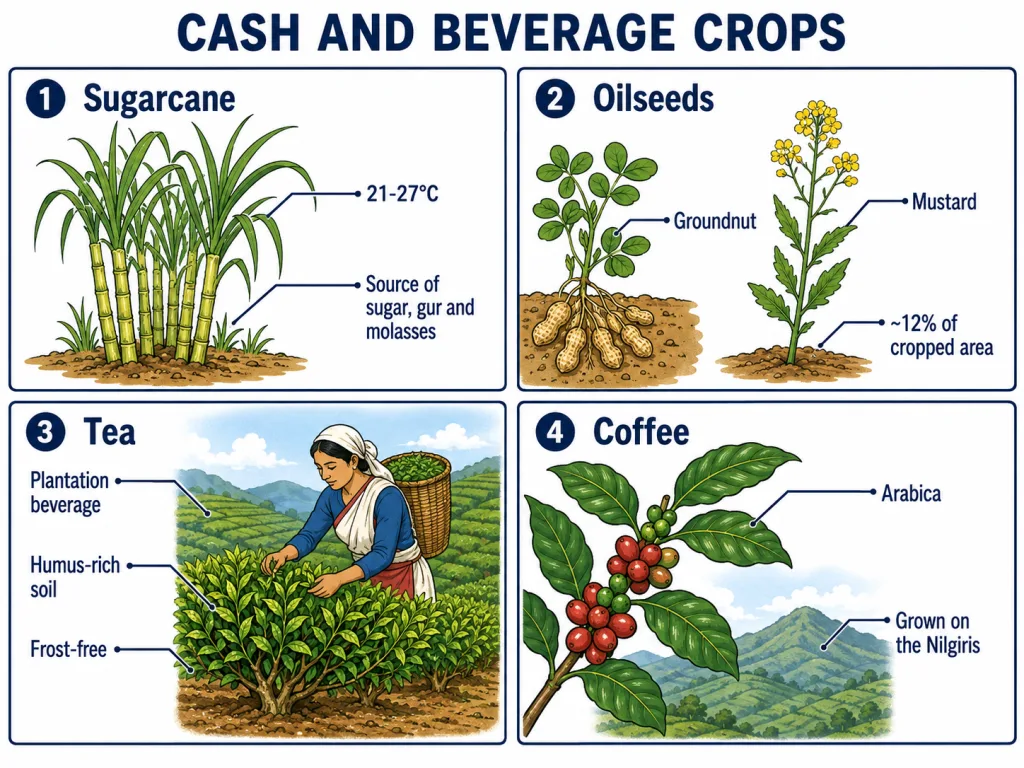
Sugarcane is a tropical and subtropical crop. It grows well in a hot and humid climate with a temperature of 21°C to 27°C and an annual rainfall of 75-100 cm (irrigation is needed in low-rainfall areas). It can be grown on a variety of soils and needs manual labour from sowing to harvesting, taking almost a year to grow.
- India is the second largest producer of sugarcane, after Brazil.
- It is the main source of sugar, gur (jaggery), khandsari and molasses.
- Major states: Uttar Pradesh, Maharashtra, Karnataka, Tamil Nadu, Andhra Pradesh, Telangana, Bihar, Punjab and Haryana.
Oilseeds
Oilseeds cover about 12 per cent of the total cropped area. The main oilseeds are groundnut, mustard, coconut, sesamum (til), soyabean, castor seed, cottonseed, linseed and sunflower. Most are edible and used as cooking media; some are raw material for soap, cosmetics and ointments.
- Groundnut is a kharif crop and accounts for about half of the major oilseeds; Gujarat is the largest producer, followed by Rajasthan and Tamil Nadu.
- Linseed and mustard are rabi crops; sesamum is kharif in the north and rabi in the south; castor is grown both as rabi and kharif.
Tea and Coffee — Beverage Crops
Tea is an example of plantation agriculture and an important beverage crop, introduced in India by the British.
- The tea plant grows in tropical and sub-tropical climates with deep, fertile, well-drained soil rich in humus, and needs a warm, moist, frost-free climate with frequent showers.
- Tea is labour-intensive. Major states: Assam, the hills of Darjeeling and Jalpaiguri (West Bengal), Tamil Nadu and Kerala (also Himachal Pradesh, Uttarakhand, Meghalaya). India is the second largest producer of tea, after China.
Coffee: Indian coffee is famous for its quality. The Arabica variety, initially brought from Yemen, is grown on the Baba Budan Hills and today on the Nilgiris in Karnataka, Kerala and Tamil Nadu.
Horticulture Crops
India is a large producer of fruits and vegetables (horticulture), and is a significant producer of many of them in the world.
- Fruits: mangoes (Maharashtra, Andhra Pradesh, Uttar Pradesh, West Bengal), oranges (Nagpur, Cherrapunji), bananas (Kerala, Mizoram, Maharashtra, Tamil Nadu), lichi and guava (Uttar Pradesh, Bihar), apples (Jammu & Kashmir, Himachal Pradesh).
- India is also an important producer of vegetables such as peas, cauliflower, onion, cabbage, tomato and potato.
Key Point: Sugarcane, oilseeds, tea and coffee are cash crops grown for the market; horticulture (fruits and vegetables) adds nutrition and income.
Questions and Answers
Q1. State the geographical conditions and uses of sugarcane.
Answer: Sugarcane is a tropical/subtropical crop needing a hot and humid climate (21-27°C) and 75-100 cm rainfall, and it takes almost a year to grow. India is the second largest producer after Brazil. It is the main source of sugar, gur (jaggery), khandsari and molasses.
Q2. Name one important beverage crop and the geographical conditions required for its growth.
Answer: Tea is an important beverage crop. It requires a tropical/sub-tropical climate, deep, fertile, well-drained soil rich in humus, and a warm, moist, frost-free climate with frequent, evenly-distributed showers. It is a labour-intensive plantation crop.
Q3. Write a short note on coffee cultivation in India.
Answer: Indian coffee is known worldwide for its good quality. The Arabica variety, initially brought from Yemen, is grown in India. Its cultivation began on the Baba Budan Hills and is today confined mainly to the Nilgiris in Karnataka, Kerala and Tamil Nadu.
Q4. Which crop accounts for about half of India's major oilseeds, and where is it mainly grown?
Answer: Groundnut, a kharif crop, accounts for about half of India's major oilseeds. Gujarat is the largest producer, followed by Rajasthan and Tamil Nadu.