
Millets — Nutritious Coarse Grains
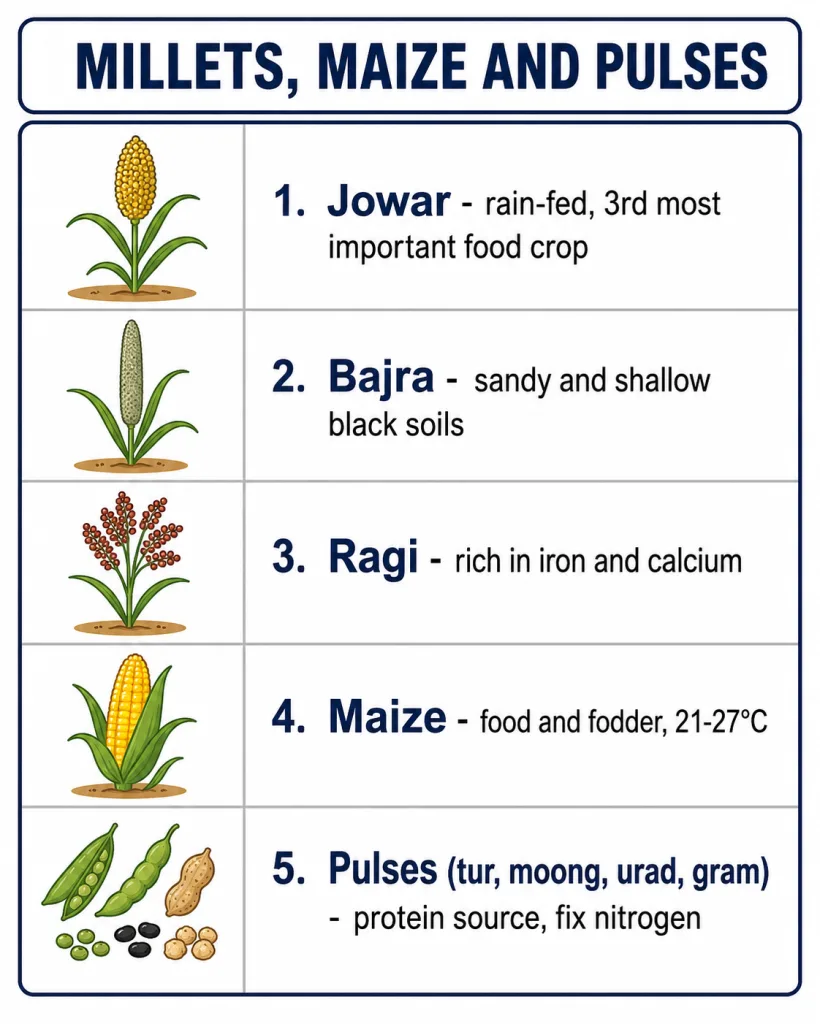
Jowar, bajra and ragi are the important millets grown in India. Though called coarse grains, they have very high nutritional value — for example, ragi is very rich in iron, calcium, other micronutrients and roughage.
- Jowar is the third most important food crop by area and production. It is a rain-fed crop grown mostly in moist areas needing little irrigation. Major states: Maharashtra, Karnataka, Andhra Pradesh and Madhya Pradesh.
- Bajra grows well on sandy soils and shallow black soil. Major states: Rajasthan, Uttar Pradesh, Maharashtra, Gujarat and Haryana.
- Ragi is a crop of dry regions, growing on red, black, sandy and loamy soils. Major states: Karnataka, Tamil Nadu, Himachal Pradesh, Uttarakhand and others.
Maize — Food and Fodder
Maize is a crop used both as food and fodder.
- It is a kharif crop requiring a temperature between 21°C and 27°C and grows well in old alluvial soil. In some states like Bihar, maize is also grown in the rabi season.
- The use of modern inputs — HYV seeds, fertilisers and irrigation — has increased maize production.
- Major producing states: Karnataka, Madhya Pradesh, Uttar Pradesh, Bihar, Andhra Pradesh and Telangana.
Pulses — The Protein of the Vegetarian Diet
India is the largest producer as well as the largest consumer of pulses in the world. Pulses are the major source of protein in a vegetarian diet.
- Major pulses: tur (arhar), urad, moong, masur, peas and gram.
- Pulses need less moisture and survive even in dry conditions.
- Being leguminous crops, all pulses except arhar help restore soil fertility by fixing nitrogen from the air — so they are mostly grown in rotation with other crops.
- Major producing states: Madhya Pradesh, Rajasthan, Maharashtra, Uttar Pradesh and Karnataka.
Key Point: Pulses enrich the soil with nitrogen, which is why farmers grow them in rotation with cereals.
Questions and Answers
Q1. Why are millets called coarse grains, and why are they valuable?
Answer: Jowar, bajra and ragi are called coarse grains because of their texture, but they have very high nutritional value. For example, ragi is very rich in iron, calcium, other micronutrients and roughage, making millets a highly nutritious food.
Q2. State the conditions and producing states of maize.
Answer: Maize is a kharif crop (grown in rabi in some states like Bihar) requiring a temperature of 21-27°C and old alluvial soil. Its production has risen with HYV seeds, fertilisers and irrigation. Major producing states are Karnataka, Madhya Pradesh, Uttar Pradesh, Bihar, Andhra Pradesh and Telangana.
Q3. Why are pulses important, and how do they help the soil?
Answer: India is the largest producer and consumer of pulses, which are the main source of protein in a vegetarian diet. Being leguminous crops, all pulses except arhar fix nitrogen from the air and restore soil fertility, so they are grown in rotation with other crops. They also need little moisture and survive in dry conditions.