
Globalisation and Its Long History
Globalisation — the integration of a country's economy with the world economy — is not entirely new to Indian agriculture. Under colonial rule, Indian farmers were already made to grow crops like cotton, indigo, opium, tea and jute for foreign markets, often being exploited to serve British industry.
After the economic reforms of 1991, globalisation gathered pace, opening Indian agriculture to the world market — bringing both opportunities and challenges.
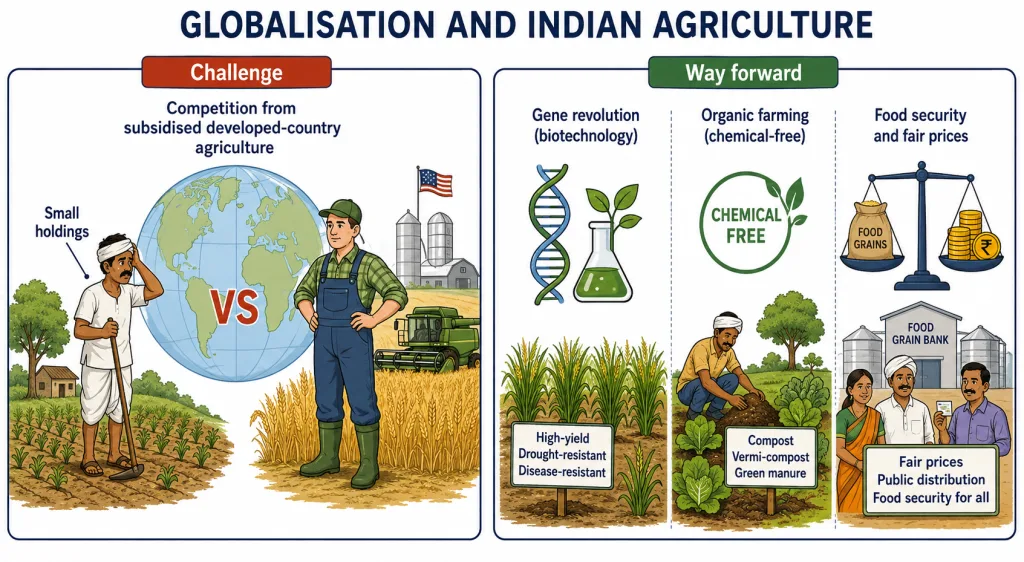
The Challenge of Competition
Under globalisation, Indian farmers face stiff competition from the highly subsidised agriculture of developed countries:
- Developed nations give huge subsidies to their farmers, allowing them to sell produce cheaply. Indian farmers, with small holdings and fewer resources, find it hard to compete.
- Cheaper imported produce can lower the prices Indian farmers receive.
This is why there is a need to make Indian agriculture successful and competitive by improving productivity, quality and infrastructure.
The Way Forward — Gene Revolution and Organic Farming
Several strategies can help Indian agriculture meet global competition while remaining sustainable:
- The 'gene revolution' — using genetic engineering and biotechnology to develop better, higher-yielding and pest-resistant crop varieties.
- Organic farming — farming without chemical fertilisers and pesticides, which is in growing demand, is environment-friendly and fetches good prices.
- Providing farmers with better seeds, storage, credit, marketing and fair prices, and improving infrastructure.
Key Point: The goal is a competitive yet sustainable Indian agriculture that also ensures the country's food security — enough food for all, at all times.
Questions and Answers
Q1. How did globalisation affect Indian agriculture even during the colonial period?
Answer: Globalisation is not new: under colonial rule, Indian farmers were made to grow commercial crops such as cotton, indigo, opium, tea and jute for foreign (mainly British) markets. Farmers were often exploited, growing cash crops for export rather than food for themselves.
Q2. What is the main challenge that globalisation poses to Indian farmers?
Answer: The main challenge is competition from the highly subsidised agriculture of developed countries. These countries give huge subsidies to their farmers, who can then sell cheaply, while Indian farmers with small holdings and fewer resources struggle to compete. This can lower the prices Indian farmers receive.
Q3. Suggest ways to make Indian agriculture competitive and sustainable under globalisation.
Answer: India can adopt the 'gene revolution' (genetic engineering for better, pest-resistant crops), promote organic farming (chemical-free, environment-friendly and in demand), and provide farmers with better seeds, credit, storage, marketing and fair prices, along with improved infrastructure — while safeguarding food security.