
Why Reforms Were Needed
Agriculture has supported India for thousands of years, but it stagnated under colonial rule and could not sustain the growing population. To modernise it, India introduced a series of technological and institutional reforms after Independence.
Land reforms — such as the abolition of zamindari, consolidation of holdings, and collectivisation — were the main focus of the First Five Year Plans. However, the laws were enacted but their implementation was lacking or lukewarm.
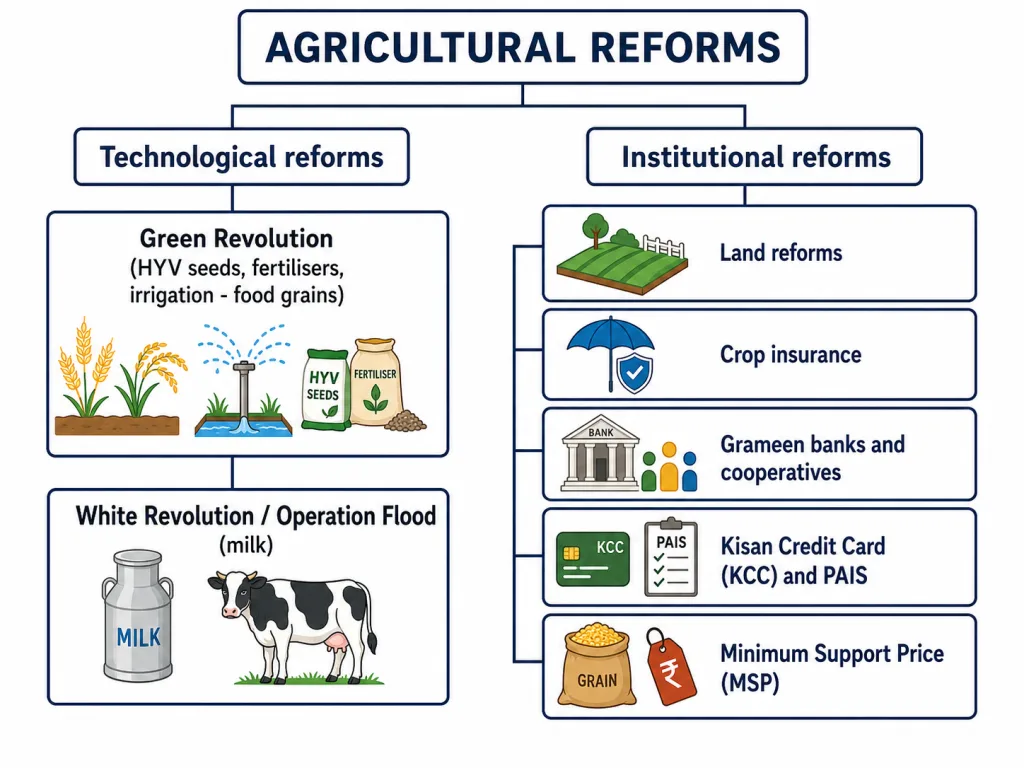
The Green and White Revolutions
In the 1960s and 1970s, the Government introduced major reforms:
- The Green Revolution was based on the use of package technology — HYV seeds, chemical fertilisers, irrigation and machinery — which greatly raised food-grain (especially wheat and rice) production.
- The White Revolution (Operation Flood) greatly increased milk production.
But these gains concentrated development in a few selected areas. So, in the 1980s and 1990s, a comprehensive land development programme was launched, including both institutional and technical reforms.
Institutional Support for Farmers
Many steps were taken to support and protect farmers:
- Crop insurance against drought, flood, cyclone, fire and disease.
- Establishment of Grameen (rural) banks, cooperative societies and banks to provide loans at low interest.
- The Kisan Credit Card (KCC) and the Personal Accident Insurance Scheme (PAIS).
- Special weather bulletins and agricultural programmes on radio and television.
- The Government announces a minimum support price (MSP) and procurement prices for important crops to protect farmers from exploitation by speculators and middlemen.
The Bhoodan-Gramdan Movement
Vinoba Bhave, declared by Mahatma Gandhi as his spiritual heir, led the Bhoodan-Gramdan movement:
- At Pochampally in Telangana, when landless villagers asked for land, Shri Ram Chandra Reddy offered 80 acres to be distributed among 80 landless villagers. This act of donating land was called 'Bhoodan' (land gift).
- Later, some landlords donated whole villages, known as 'Gramdan' (village gift).
- This movement, based on Gandhi's idea of gram swarajya, is also called the 'Blood-less Revolution'.
Key Point: Reforms combined technology (Green/White Revolution, HYV) with institutions (banks, insurance, MSP, land redistribution) to strengthen Indian agriculture.
Questions and Answers
Q1. What were the Green Revolution and the White Revolution?
Answer: The Green Revolution (1960s-70s) was based on package technology — HYV seeds, fertilisers, irrigation and machinery — which sharply raised food-grain production (especially wheat and rice). The White Revolution (Operation Flood) greatly increased milk production in India.
Q2. Enlist the various institutional reform programmes introduced by the government in the interest of farmers.
Answer: These include land reforms (abolition of zamindari, consolidation of holdings); crop insurance against natural calamities; Grameen banks and cooperatives for cheap credit; the Kisan Credit Card (KCC) and Personal Accident Insurance Scheme (PAIS); weather bulletins and farm programmes on radio/TV; and the announcement of a minimum support price (MSP) and procurement prices.
Q3. Suggest the initiatives taken by the government to ensure an increase in agricultural production.
Answer: The government promoted the Green Revolution (HYV seeds, fertilisers, irrigation) and White Revolution; enacted land reforms; set up Grameen banks and cooperatives for cheap loans; provided crop insurance, the KCC and PAIS; broadcast weather and farm bulletins; and fixed minimum support prices to protect farmers and encourage production.
Q4. Write a note on the Bhoodan-Gramdan movement.
Answer: Led by Vinoba Bhave (Gandhi's spiritual heir), the Bhoodan-Gramdan movement encouraged landowners to donate land to the landless. At Pochampally, Ram Chandra Reddy donated 80 acres to 80 landless villagers (Bhoodan); later, whole villages were donated (Gramdan). Based on gram swarajya, it is called the 'Blood-less Revolution'.