
Agriculture — India's Primary Activity
Agriculture is the most important primary activity in India. About two-thirds of India's population is still engaged in agricultural activities, which provide food grains and raw materials for many industries.
Different types of farming are practised in different parts of the country, depending on the physical environment, technology, and social customs.
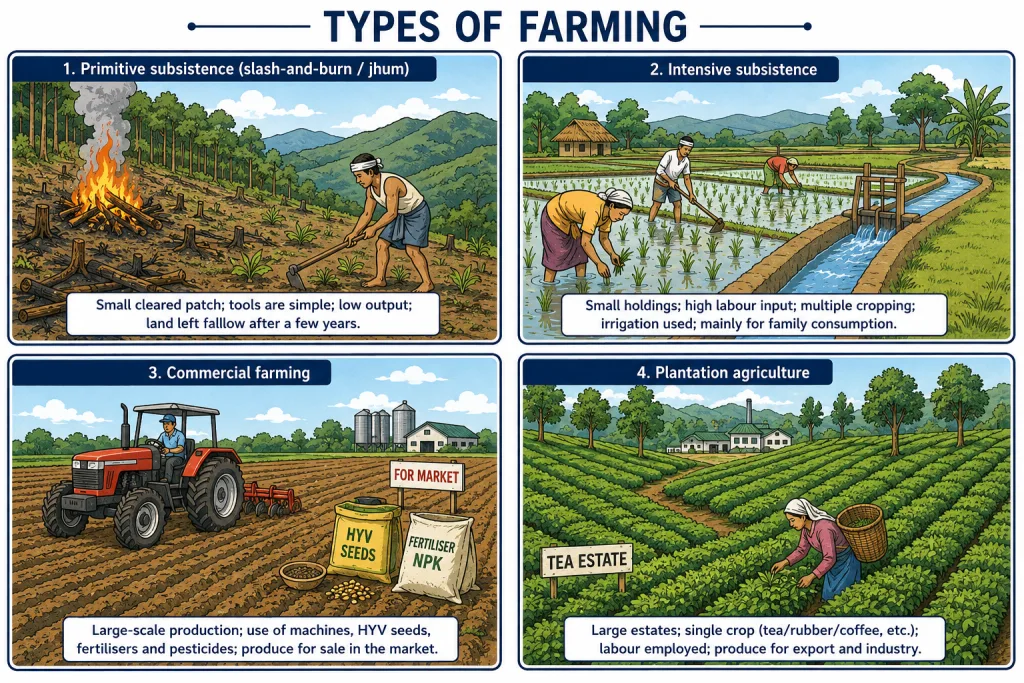
Primitive Subsistence Farming
Primitive subsistence farming is still practised in a few pockets of India. It is a 'slash-and-burn' type of agriculture:
- Farmers clear a patch of land and produce cereals and other food crops to sustain their family.
- It is carried on using primitive tools (hoe, dao, digging sticks) and family/community labour, and depends on the monsoon, natural fertility of the soil and the suitability of other environmental conditions.
- When the soil loses its fertility, farmers shift to a new patch — allowing nature to replenish the old one.
This shifting cultivation is known by different local names — 'jhumming' in the north-east, and by many other names across India and the world.
Intensive Subsistence Farming
Intensive subsistence farming is practised in areas of high population pressure on land:
- It is labour-intensive, using high doses of biochemical inputs (fertilisers) and irrigation to obtain higher production.
- Because land holdings are small (due to the 'right of inheritance' dividing land among successive generations), farmers take the maximum output from a limited piece of land.
Key Point: Primitive subsistence farming depends on nature and shifts land; intensive subsistence farming stays on the same small plot and uses heavy labour and inputs.
Commercial Farming and Plantations
Commercial farming aims to produce crops for sale in the market:
- It uses modern inputs — high-yielding-variety (HYV) seeds, chemical fertilisers, insecticides and pesticides — to obtain higher productivity. (What is commercial in one region may be subsistence in another — e.g. rice is commercial in Punjab but subsistence in Odisha.)
Plantation is a special type of commercial farming:
- A single crop is grown on a large area using capital-intensive inputs and migrant labour.
- Tea, coffee, rubber, sugarcane and banana are important plantation crops. All produce is used as raw material in industries, so a well-developed network of transport and communication connecting plantations, factories and markets is essential.
Questions and Answers
Q1. What is primitive subsistence farming?
Answer: Primitive subsistence farming is a slash-and-burn type of agriculture practised on small patches of land with primitive tools and family/community labour. It depends on the monsoon and natural soil fertility. When the soil loses fertility, the farmer shifts to a new patch. It is called jhumming in the north-east and by other names elsewhere.
Q2. How does intensive subsistence farming differ from commercial farming?
Answer: Intensive subsistence farming is practised on small plots under high population pressure, using much labour, fertilisers and irrigation to maximise output for the family. Commercial farming produces crops mainly for sale in the market, using modern inputs (HYV seeds, fertilisers, pesticides). The same crop can be commercial in one region and subsistence in another.
Q3. What is plantation agriculture? Name any three plantation crops.
Answer: Plantation agriculture is a type of commercial farming in which a single crop is grown on a large area using capital-intensive inputs and migrant labour, with the produce used as industrial raw material. Three plantation crops are tea, coffee and rubber (also sugarcane and banana).