
International Trade — the Economic Barometer
The exchange of goods among people, states and countries is called trade, and the place where such exchange happens is the market. Trade between two countries is international trade, carried through sea, air or land routes. Local trade is carried on in cities, towns and villages, while state-level trade is between two or more states.
The advancement of a country's international trade is an index of its economic prosperity — it is therefore called the economic barometer. Because resources are space-bound, no country can survive without international trade. Export and import are the two components of trade.
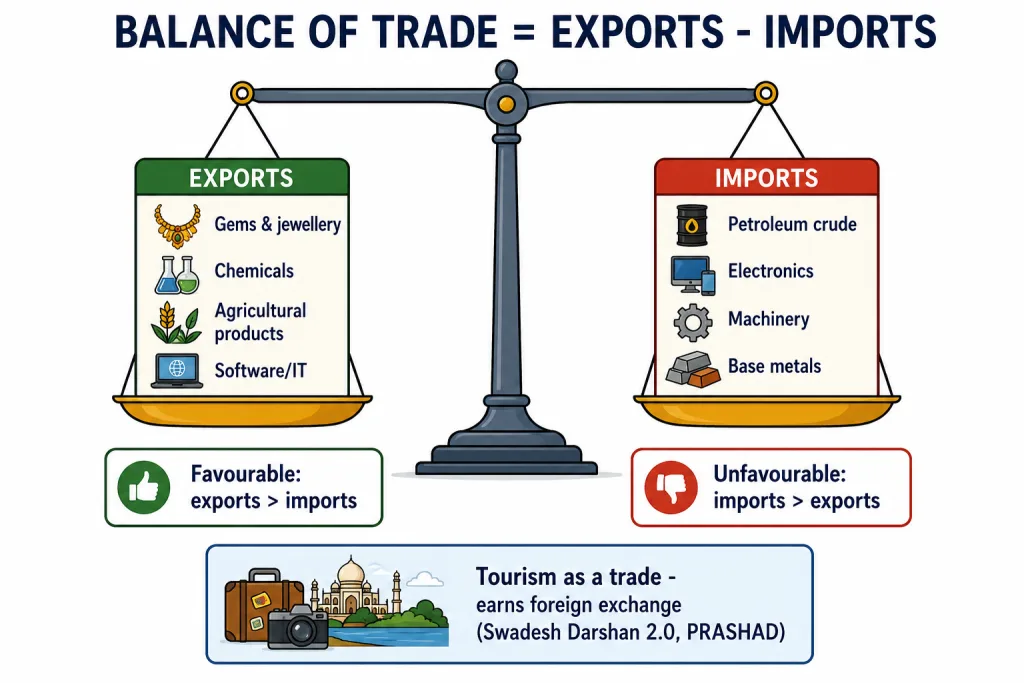
Balance of Trade and India's Commodities
The balance of trade is the difference between a country's exports and imports:
- When the value of exports exceeds the value of imports, it is a favourable (positive) balance of trade.
- When the value of imports exceeds the value of exports, it is an unfavourable (negative) balance of trade.
India has trade relations with all major trading blocks. Commodities exported from India include gems and jewellery, chemicals and related products, and agriculture and allied products. Commodities imported include petroleum crude and products, gems and jewellery, chemicals, base metals, electronic items, machinery, and agriculture and allied products. India has emerged as a software giant and earns large foreign exchange through the export of information technology.
Tourism as a Trade
Tourism in India has grown remarkably over the past two decades, helped by government initiatives, infrastructure development and global branding. Schemes such as Swadesh Darshan 2.0, the Vibrant Village Programme, PRASHAD (Pilgrimage Rejuvenation and Spiritual Heritage Augmentation Drive) and Paryatan Mitra have been started to boost tourism.
Tourism earns foreign exchange, promotes national integration, and provides support to local handicrafts and cultural pursuits, while also building international understanding of our culture and heritage. Foreign tourists visit India for heritage, eco, adventure, cultural, medical and business tourism. There is a vast potential for developing tourism in all parts of the country following a sustainable development approach.
Questions and Answers
Q1. What is trade? Distinguish between local and international trade. Ans. Trade is the exchange of goods among people, states and countries at a market. Local trade is carried on within cities, towns and villages; international trade is trade between two countries, carried through sea, air or land routes.
Q2. Why is international trade called the economic barometer of a country? Ans. Because the advancement of a country's international trade is an index of its economic prosperity — a healthy, growing trade reflects a healthy economy, just as a barometer reflects the weather.
Questions and Answers (continued)
Q3. What is the balance of trade? Explain favourable and unfavourable balance of trade. Ans. The balance of trade is the difference between a country's exports and imports. When the value of exports exceeds imports, it is a favourable balance of trade; when the value of imports exceeds exports, it is an unfavourable balance of trade.
Q4. How is tourism important as a trade? Ans. Tourism earns foreign exchange, promotes national integration, supports local handicrafts and culture, and builds international understanding. Foreign tourists come for heritage, eco, adventure, cultural, medical and business tourism.
Questions and Answers (continued)
Q5. Name any two commodities each that India exports and imports. Ans. Exports: gems and jewellery, chemicals, and agricultural and allied products (any two). Imports: petroleum crude and products, base metals, electronic items and machinery (any two).