
Why Transport is a Lifeline
We use different materials and services in our daily life. Some are available in our immediate surroundings, while others are brought from distant places. Goods and services do not move from supply locations to demand locations on their own — this movement needs transport, and the people who make products reach consumers are called traders.
The pace of development of a country depends not only on the production of goods and services but also on their movement over space. Therefore, efficient means of transport are prerequisites for fast development. Transport, communication and trade are complementary to each other — a dense and efficient network is a prerequisite for local, national and global trade. Today the whole world has been converted into a large village by fast-moving transport.
Roadways
India has the second-largest road network in the world, aggregating to about 62.16 lakh km (2020–21). In India, roadways preceded railways and still have an edge over railways for several reasons:
- Construction cost of roads is much lower than that of railway lines.
- Roads can cross more dissected and undulating land.
- Roads can negotiate higher gradients, so they can climb mountains such as the Himalayas.
- Road transport is economical for few persons and small loads over short distances.
- It provides door-to-door service, so loading and unloading cost is lower.
- It acts as a feeder to other modes — linking railway stations, air and sea ports.
The Six Classes of Roads
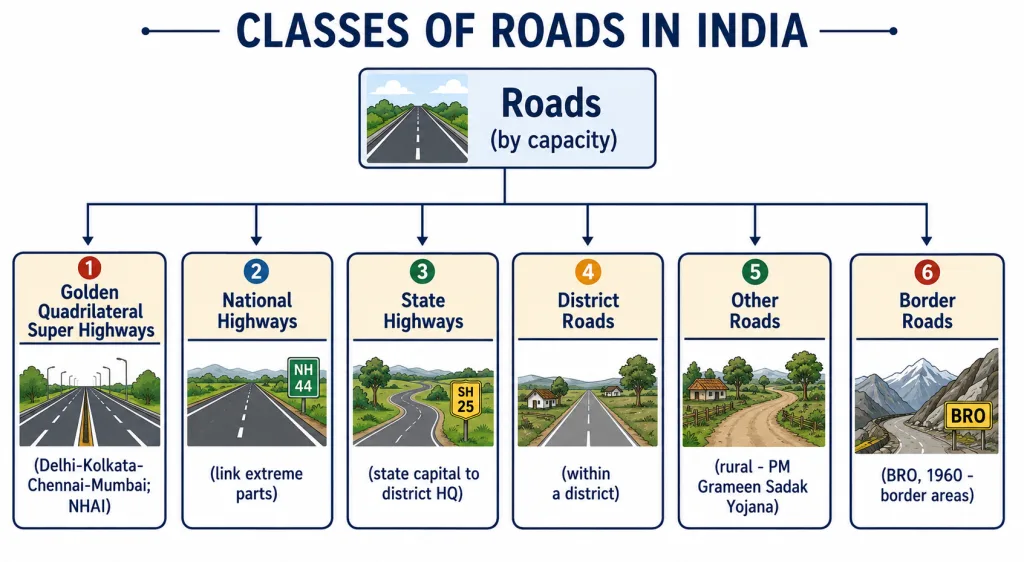
According to their capacity, roads in India are classified into six classes:
- Golden Quadrilateral Super Highways: Six-lane super highways linking Delhi–Kolkata–Chennai–Mumbai–Delhi, plus the North–South corridor (Srinagar to Kanniyakumari) and the East–West corridor (Silchar to Porbandar). They reduce the time and distance between mega-cities and are built by the National Highways Authority of India (NHAI).
- National Highways: Primary roads that link the extreme parts of the country.
- State Highways: Link a state capital with district headquarters.
- District Roads: Connect district headquarters with other places of the district.
- Other Roads: Rural roads linking villages with towns, given a boost under the Pradhan Mantri Grameen Sadak Yojana.
- Border Roads: Built and maintained by the Border Roads Organisation (set up in 1960) in the strategic northern and north-eastern border areas.
Types of Road by Material
On the basis of the material used, roads are of two kinds:
- Metalled roads — made of cement, concrete or bitumen; these are all-weather roads.
- Unmetalled roads — go out of use in the rainy season.
Did you know? The world's longest highway tunnel, the Atal Tunnel (9.02 km), built by the Border Roads Organisation in the Pir Panjal range at about 3,000 m altitude, connects Manali to the Lahaul-Spiti valley throughout the year — the valley was earlier cut off for about six months each year by snow.
Questions and Answers
Q1. Why are efficient means of transport called a prerequisite for fast development? Ans. Goods and services must move from supply areas to demand areas; the faster and cheaper this movement, the quicker production reaches consumers and markets grow. Hence efficient transport is essential for fast economic development.
Q2. State any three reasons why road transport has an edge over railways. Ans. (1) Roads are cheaper to build than railway lines; (2) they can cross dissected, undulating land and steep slopes (even the Himalayas); and (3) they give door-to-door service, lowering loading and unloading cost.
Questions and Answers (continued)
Q3. What are the Golden Quadrilateral Super Highways? Ans. They are six-lane super highways linking the four mega-cities Delhi, Kolkata, Chennai and Mumbai, along with the North–South and East–West corridors, built by NHAI to cut the time and distance between the big cities.
Q4. What is the role of the Border Roads Organisation? Ans. The Border Roads Organisation (established 1960) constructs and maintains roads in the strategic northern and north-eastern border areas, improving accessibility in difficult terrain and aiding the economic development of these areas.