
Personal and Mass Communication
Ever since humans appeared on the earth they have used different means of communication, but the pace of change has been rapid in modern times. Long-distance communication is now far easier without the physical movement of the sender or receiver.
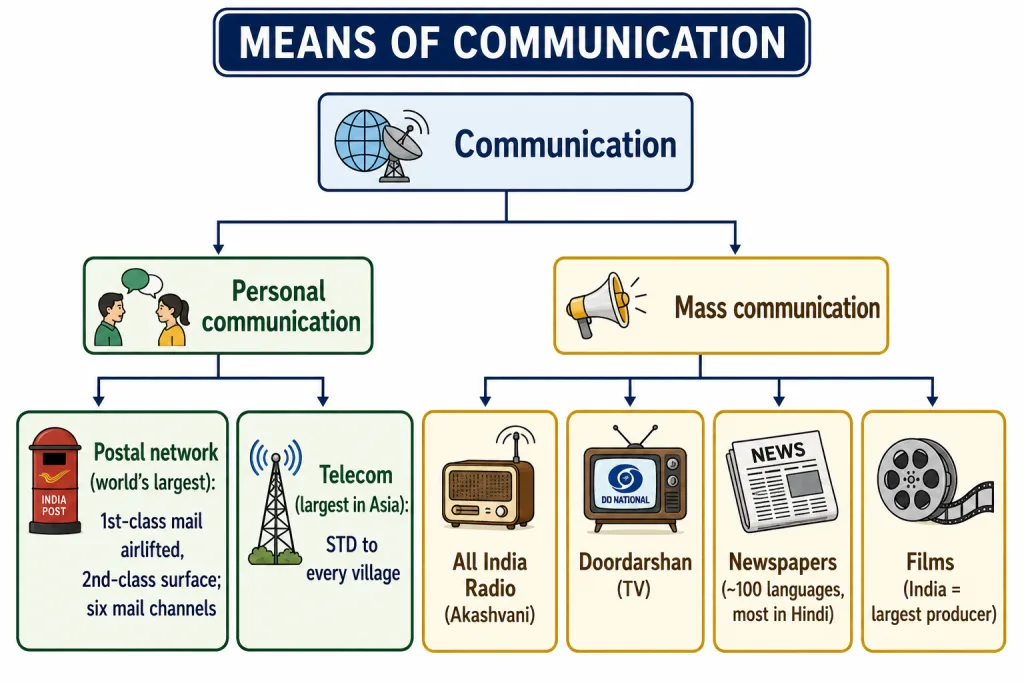
Communication is of two broad kinds: personal communication and mass communication (television, radio, press, films, etc.). The Indian postal network is the largest in the world. It handles both parcels and personal written communication. First-class mail (cards and envelopes) is airlifted between stations over land and air, while second-class mail (book packets, registered newspapers and periodicals) is carried by surface mail over land and water. To speed delivery in large cities, six mail channels have been introduced — Rajdhani, Metro, Green, Business, Bulk Mail and Periodical channels.
Telecom and Mass Media
India has one of the largest telecom networks in Asia. More than two-thirds of the villages already have Subscriber Trunk Dialling (STD) facilities, and the government has extended 24-hour STD facility to every village at a uniform rate, by integrating space technology with communication technology.
Mass communication provides entertainment and creates awareness about national programmes and policies; it includes radio, television, newspapers, magazines, books and films. All India Radio (Akashvani) broadcasts programmes in national, regional and local languages. Doordarshan, the national television channel, is one of the largest terrestrial networks in the world. India publishes newspapers in about 100 languages and dialects — the largest number are in Hindi, followed by English and Urdu. India is the largest producer of feature films in the world, and the Central Board of Film Certification certifies both Indian and foreign films. The Digital India programme aims to prepare India for a knowledge-based transformation.
Questions and Answers
Q1. How is mail classified in the Indian postal system? Ans. First-class mail — cards and envelopes — is airlifted between stations over land and air. Second-class mail — book packets, registered newspapers and periodicals — is carried by surface mail, covering land and water transport.
Q2. Name the six mail channels introduced to speed up delivery in large towns. Ans. The Rajdhani, Metro, Green, Business, Bulk Mail and Periodical channels.
Questions and Answers (continued)
Q3. Write a short note on mass communication in India. Ans. Mass communication provides entertainment and spreads awareness about national policies. It includes radio, television, newspapers, magazines, books and films. All India Radio broadcasts in many languages; Doordarshan is one of the world's largest terrestrial networks; India publishes newspapers in about 100 languages and is the largest producer of feature films in the world.
Q4. What is the aim of the Digital India programme? Ans. Digital India is an umbrella programme to prepare India for a knowledge-based transformation, making technology central to enabling change — 'IT (Indian Talent) + IT (Information Technology) = IT (India Tomorrow)'.
Questions and Answers (continued)
Q5. In how many languages are newspapers published in India, and which language has the most? Ans. Newspapers are published in about 100 languages and dialects. The largest number are published in Hindi, followed by English and Urdu.