
Pipelines — a New Arrival
Pipeline transport is a new arrival on the transport map of India. In the past, pipelines were used only to carry water to cities and industries. Now they are used to transport crude oil, petroleum products and natural gas from oil and gas fields to refineries, fertiliser factories and big thermal power plants. Solids can also be moved through a pipeline when converted into slurry.
Pipelines made it possible to set up refineries and gas-based fertiliser plants at far inland locations such as Barauni, Mathura and Panipat. The initial cost of laying pipelines is high, but the running cost is minimal, and pipelines rule out trans-shipment losses or delays.
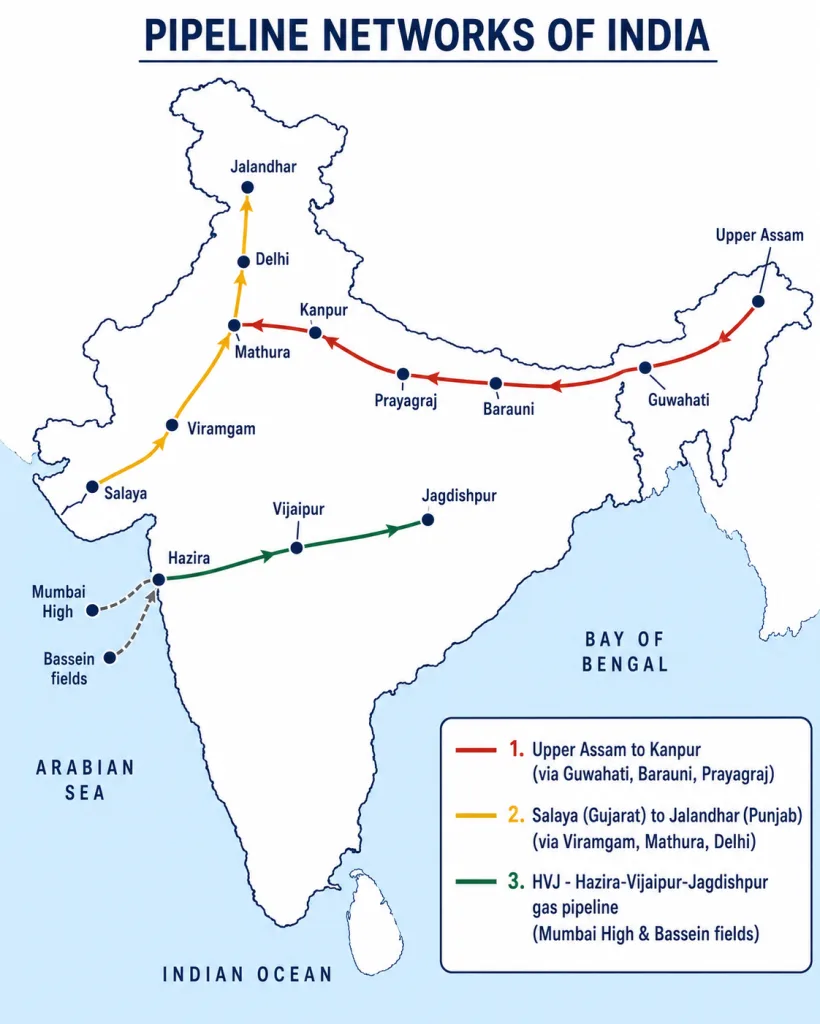
The Three Major Pipeline Networks
There are three important pipeline networks in the country:
- From the oil field in upper Assam to Kanpur (Uttar Pradesh), via Guwahati, Barauni and Prayagraj, with branches from Barauni to Haldia, and Guwahati to Siliguri.
- From Salaya (Gujarat) to Jalandhar (Punjab), via Viramgam, Mathura, Delhi and Sonipat, with branches to Koyali and other places.
- The Hazira–Vijaipur–Jagdishpur (HVJ) gas pipeline — the first, about 1,700 km long — links the Mumbai High and Bassein gas fields with fertiliser, power and industrial complexes in western and northern India.
Overall, India's gas-pipeline infrastructure has expanded from 1,700 km to about 18,500 km of cross-country pipelines. Advantages of pipelines: low running cost, no trans-shipment loss or delay, and the ability to reach far inland plants — but they cannot be repaired easily and detecting leakage is difficult.
Questions and Answers
Q1. What can be transported through pipelines? Ans. Pipelines transport crude oil, petroleum products and natural gas from fields to refineries, fertiliser factories and thermal power plants. Solids can also be sent as slurry.
Q2. Why is pipeline transport described as a "new arrival" that changed inland industry? Ans. Because pipelines allowed refineries and gas-based fertiliser plants to be located at far inland places like Barauni, Mathura and Panipat, which was earlier impossible without cheap bulk transport of oil and gas.
Questions and Answers (continued)
Q3. State the merits and one demerit of pipeline transport. Ans. Merits: though the initial cost is high, the running cost is minimal; pipelines rule out trans-shipment losses and delays and can reach far inland plants. Demerit: they cannot be easily repaired and leakage is hard to detect.
Q4. Which is the first long cross-country gas pipeline, and what does it connect? Ans. The Hazira–Vijaipur–Jagdishpur (HVJ) pipeline, about 1,700 km long, connects the Mumbai High and Bassein gas fields with fertiliser, power and industrial complexes in western and northern India.