
Railways — the Principal Mode
Railways are the principal mode of transport for freight and passengers in India. They also make it possible for people to carry out many activities — business, sightseeing and pilgrimage — along with moving goods over long distances.
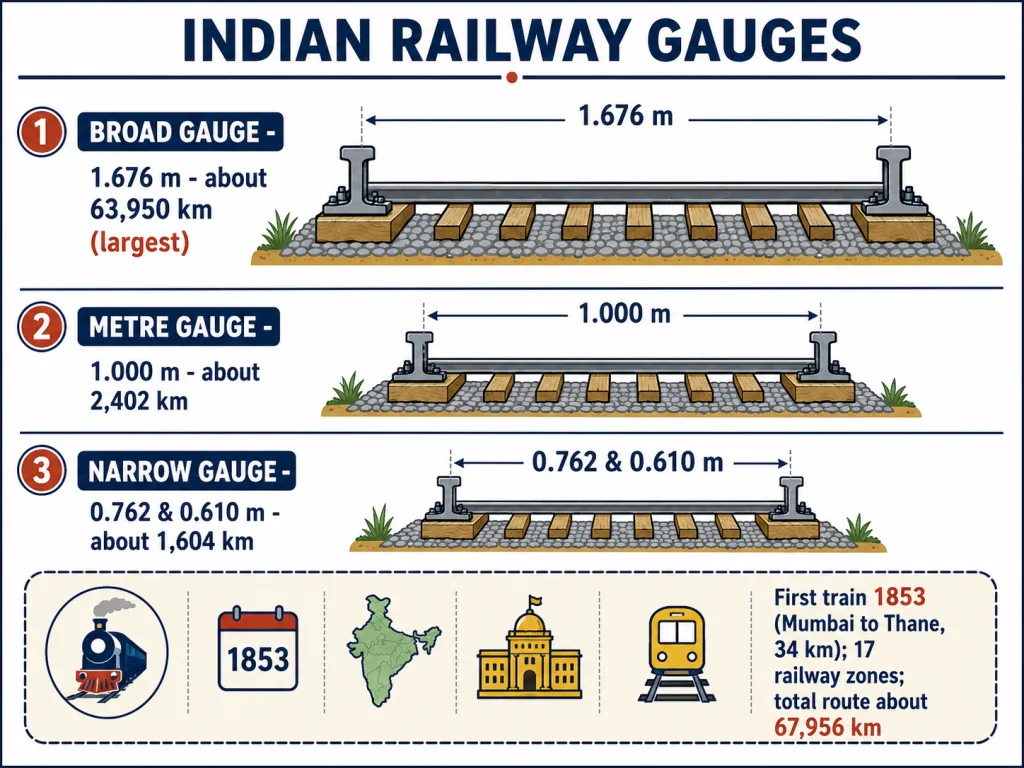
For more than 150 years the Indian Railways have been a great integrating force, binding the economic life of the country and accelerating the development of industry and agriculture. The first train steamed off from Mumbai to Thane in 1853, covering 34 km. The Indian Railways is the largest public-sector undertaking in the country and is now reorganised into 17 zones. Today the railways are more important to our national economy than all other means of transport put together.
What Shaped the Railway Network
The distribution of the railway network has been shaped by physiographic, economic and administrative factors:
- The northern plains — vast level land, high population density and rich agriculture — gave the most favourable conditions, though the many rivers needed costly bridges.
- In the peninsular region, tracks pass through low hills, gaps or tunnels.
- The Himalayan region is unfavourable due to high relief, sparse population and few economic opportunities.
- It was also difficult to lay lines on the sandy plains of western Rajasthan, the swamps of Gujarat, and the forested tracts of Madhya Pradesh, Chhattisgarh, Odisha and Jharkhand.
- The Sahyadri could be crossed only through gaps or passes (ghats). The recent Konkan Railway along the west coast has eased movement but faces track sinking and landslides.
Railway Gauges and Problems
The Indian Railway network runs on multiple gauges, extending over about 67,956 km:
- Broad Gauge (1.676 m) — about 63,950 km (by far the largest).
- Metre Gauge (1.000 m) — about 2,402 km.
- Narrow Gauge (0.762 and 0.610 m) — about 1,604 km.
Problems of rail transport: many passengers travel without tickets; there is theft and damage to railway property; and people pull the chain unnecessarily and stop trains, causing heavy loss and delay. As responsible citizens we should help the railways run on schedule.
Questions and Answers
Q1. Why are the railways called a great integrating force? Ans. For over 150 years the railways have connected distant parts of the country, letting people travel for business, pilgrimage and tourism and moving goods over long distances. They bind the economic life of the nation and speed up industry and agriculture, thus integrating the country.
Q2. When and between which places did the first train in India run? Ans. The first train ran in 1853 from Mumbai to Thane, covering a distance of 34 km.
Questions and Answers (continued)
Q3. Why is the northern plain favourable for the growth of railways, and what obstacle did it pose? Ans. The northern plain has vast level land, dense population and rich agriculture, giving heavy traffic and easy construction — the most favourable conditions. The obstacle was the large number of rivers, which needed many bridges across their wide beds.
Q4. Name the three railway gauges in India. Ans. Broad gauge (1.676 m), metre gauge (1.000 m) and narrow gauge (0.762 and 0.610 m).
Questions and Answers (continued)
Q5. State any two problems faced by the Indian Railways. Ans. (1) Many passengers travel without tickets and there is theft and damage to railway property; and (2) people pull the chain unnecessarily and stop trains, causing heavy financial loss and delays.