
India's Ports
India has a long coastline of about 11,098.81 km and is dotted with 12 major ports and about 200 notified non-major (minor/intermediate) ports. The major ports handle 95 per cent of India's foreign trade, since India's trade with foreign countries is carried from ports located along the coast.
Ports serve a hinterland — the region behind the port whose goods pass through it. The ports are spread along both the western and the eastern coasts of the country.
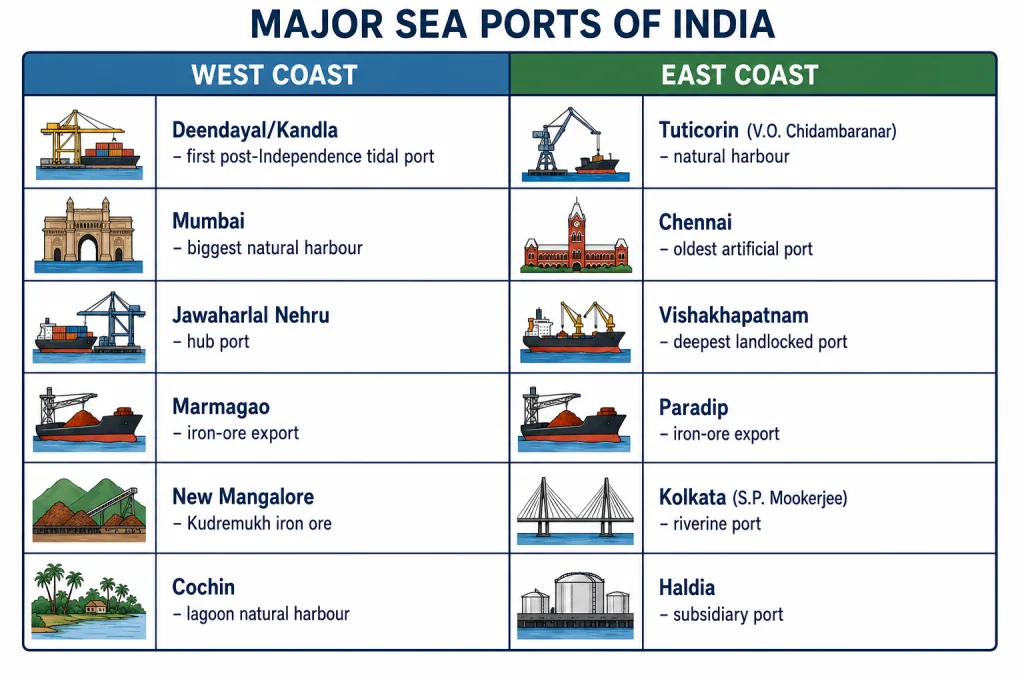
Ports of the West Coast
- Deendayal Port (Kandla) in Kuchchh — a tidal port, the first port developed after Independence to ease the load on Mumbai port after the loss of Karachi to Pakistan at Partition. It serves the granary and industrial belt of the north-west.
- Mumbai — the biggest port, with a spacious, natural, well-sheltered harbour.
- Jawaharlal Nehru Port — planned to decongest Mumbai port and act as a hub port.
- Marmagao Port (Goa) — the premier iron-ore exporting port, handling about fifty per cent of India's iron-ore export.
- New Mangalore Port (Karnataka) — exports iron-ore concentrates from the Kudremukh mines.
- Cochin — the extreme south-western port, at the entrance of a lagoon with a natural harbour.
Ports of the East Coast
- V.O. Chidambaranar Port (Tuticorin), Tamil Nadu — a natural harbour with a rich hinterland, trading with Sri Lanka, the Maldives and India's coastal regions.
- Chennai — one of the oldest artificial ports, ranked next to Mumbai in volume of trade and cargo.
- Vishakhapatnam — the deepest, landlocked and well-protected port, originally built as an outlet for iron-ore exports.
- Paradip Port (Odisha) — specialises in the export of iron ore.
- Shyama Prasad Mookerjee Port, Kolkata — an inland riverine port serving the rich Ganga–Brahmaputra hinterland; being tidal, it needs constant dredging of the Hugli.
- Haldia Port — developed as a subsidiary to relieve pressure on Kolkata port.
Questions and Answers
Q1. Why was Deendayal (Kandla) port developed soon after Independence? Ans. After Partition, India lost the Karachi port to Pakistan, and there was heavy pressure on the Mumbai port. Deendayal (Kandla), a tidal port, was developed to ease this volume of trade and to serve the productive granary and industrial belt of north-west India.
Q2. Which is the premier iron-ore exporting port, and how much of India's iron-ore export does it handle? Ans. Marmagao Port (Goa) is the premier iron-ore exporting port, handling about fifty per cent of India's iron-ore export.
Questions and Answers (continued)
Q3. Describe Vishakhapatnam and Kolkata (Shyama Prasad Mookerjee) ports. Ans. Vishakhapatnam is the deepest, landlocked and well-protected port, first built as an outlet for iron-ore export. Shyama Prasad Mookerjee, Kolkata is an inland riverine, tidal port serving the Ganga–Brahmaputra hinterland; it needs constant dredging of the Hugli.
Q4. Why was the Jawaharlal Nehru port planned? Ans. It was planned to decongest the Mumbai port and to serve as a hub port for the region.