
Waterways — the Cheapest Mode
Since ancient times India was one of the seafaring countries; its seamen spread Indian commerce and culture far and wide. Waterways are the cheapest means of transport. They are the most suitable for carrying heavy and bulky goods, and are fuel-efficient and environment-friendly.
India has inland navigable waterways of about 14,500 km in length. To build a wide network and promote inland water transport as an economical, eco-friendly supplement to road and rail, 111 inland waterways (including the 5 National Waterways declared earlier) were declared as National Waterways by the National Waterways Act, 2016.
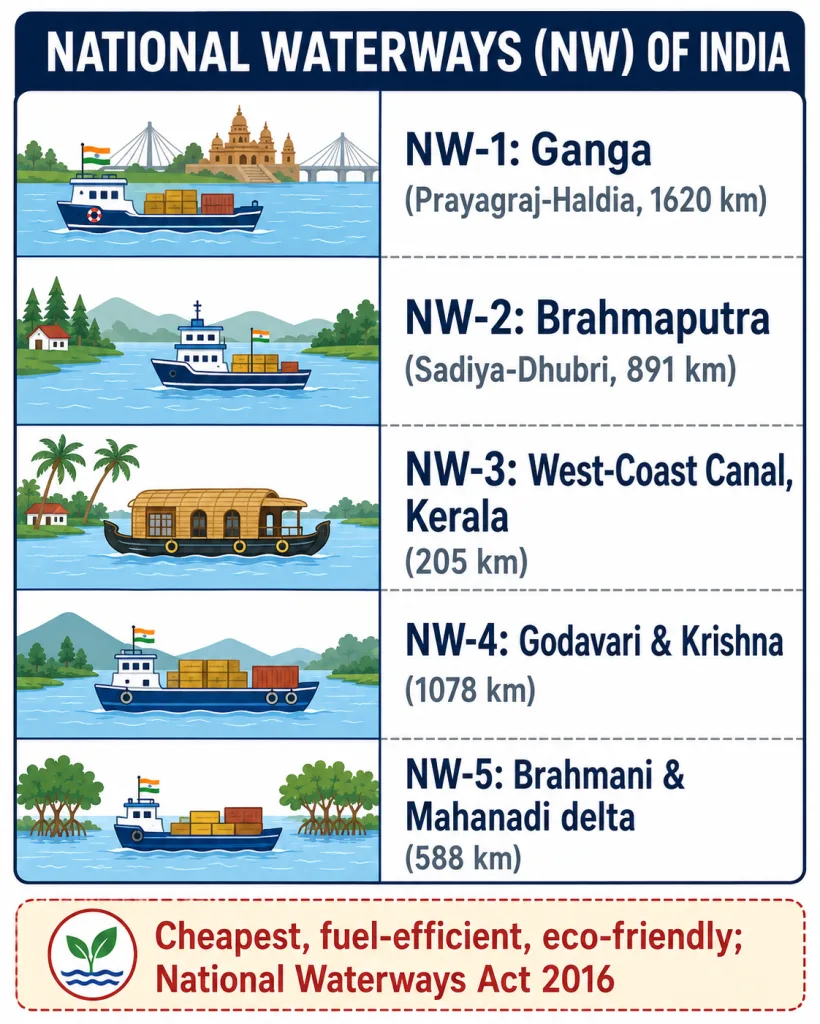
The National Waterways
The most important National Waterways (NWs) are:
- NW-1: The Ganga river between Prayagraj and Haldia (1,620 km).
- NW-2: The Brahmaputra river between Sadiya and Dhubri (891 km).
- NW-3: The West-Coast Canal in Kerala (Kottapuram–Kollam, Udyogamandal and Champakkara canals — 205 km).
- NW-4: Specified stretches of the Godavari and Krishna rivers with the Kakinada–Puducherry canals (1,078 km).
- NW-5: Specified stretches of the Brahmani river with the Matai river, the delta channels of the Mahanadi and Brahmani, and the East-Coast Canal (588 km).
Some other inland waterways with substantial traffic are the Mandavi, Zuari and Cumberjua, the Sunderbans, the Barak, and the backwaters of Kerala. India's foreign trade, too, moves mostly by sea — 95 per cent of the trade volume (68 per cent by value) is carried by sea.
Questions and Answers
Q1. Why are waterways called the cheapest and most eco-friendly means of transport? Ans. Waterways use natural or built channels and need little energy to move heavy loads, so they are fuel-efficient, cause little pollution and cost the least — making them ideal for carrying heavy and bulky goods.
Q2. What was declared under the National Waterways Act, 2016? Ans. Under the Act, 111 inland waterways (including the 5 National Waterways declared earlier) were declared as National Waterways to promote inland water transport as an economical, eco-friendly supplement to road and rail.
Questions and Answers (continued)
Q3. Describe National Waterways NW-1 and NW-2. Ans. NW-1 is the Ganga between Prayagraj and Haldia (1,620 km), and NW-2 is the Brahmaputra between Sadiya and Dhubri (891 km).
Q4. What share of India's foreign trade moves by sea? Ans. About 95 per cent of the country's trade by volume (and 68 per cent by value) is moved by sea.