
Hypermetropia (Far-Sightedness)
Hypermetropia is also called far-sightedness. A person with hypermetropia:
- can see distant objects clearly, but
- cannot see nearby objects distinctly.
The near point of such a person is farther away than the normal near point (25 cm). They have to hold reading material much beyond 25 cm to see it comfortably.
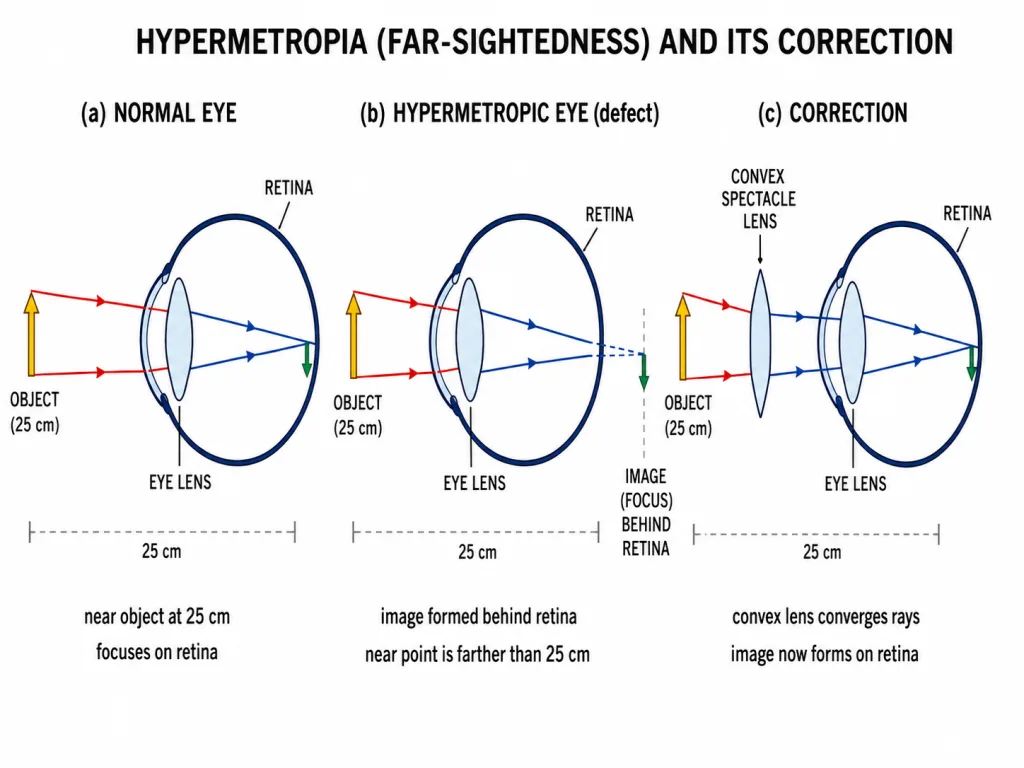
In a hypermetropic eye, light rays from a nearby object are focused at a point behind the retina. This defect arises because:
- the focal length of the eye lens is too long (too little converging power), or
- the eyeball is too small (too short).
Correcting Hypermetropia
Hypermetropia is corrected using a convex (converging) lens of suitable power. A convex lens provides the extra converging power needed so that the image of a nearby object is brought forward onto the retina.
The convex lens is chosen so that it takes an object at the normal near point (25 cm) and forms its virtual image at the actual (farther) near point of the defective eye. The eye can then see that image comfortably.
Using the lens formula, with the object at the normal near point (here cm) and the image at the eye's actual near point :
Since , the value of is positive, confirming a convex lens (positive power).
Presbyopia and Bi-focal Lenses
The power of accommodation of the eye usually decreases with age. For most people the near point gradually recedes (moves away), and they find it hard to see nearby objects clearly without corrective glasses. This defect of old age is called presbyopia.
Presbyopia arises due to:
- the gradual weakening of the ciliary muscles, and
- the decreasing flexibility of the eye lens.
Sometimes a person suffers from both myopia and hypermetropia. Such people need bi-focal lenses, which have two different parts:
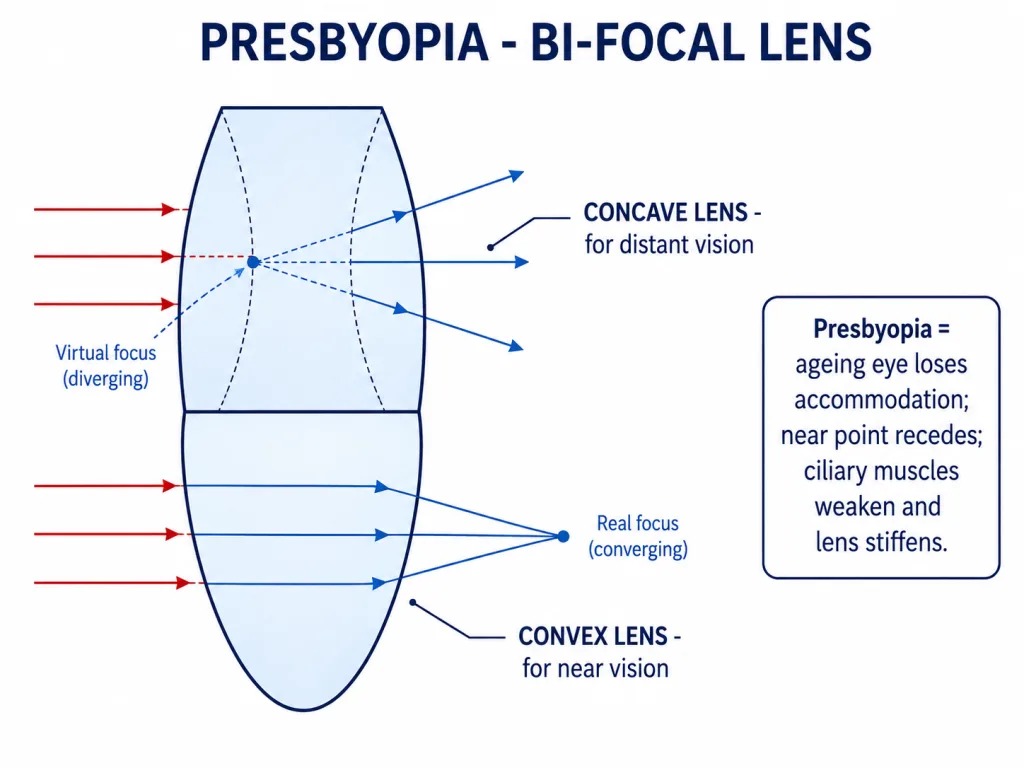
- the upper part is a concave lens for distant vision (corrects myopia), and
- the lower part is a convex lens for near vision (corrects hypermetropia).
These days refractive defects can also be corrected with contact lenses or by surgery (such as LASIK).
[Exam Tip] Hypermetropia → image of near object forms behind the retina → use a convex lens → power positive. Presbyopia is an age-related loss of accommodation, often needing bi-focal lenses.
Solved Examples
Example 1: Hypermetropia correction (NCERT)
The near point of a hypermetropic eye is 1 m. What is the power of the lens required to correct this defect? Assume the near point of a normal eye is 25 cm.
Solution: The convex lens must form the image of an object at 25 cm at the eye's actual near point, 1 m. So cm m and cm m.
A convex lens of power +3.0 D (focal length +0.33 m) is required.
Example 2: Near vision correction from power (NCERT part)
A person needs a lens of power +1.5 D for correcting his near vision. What is the focal length of this lens?
Solution: The positive sign shows it is a convex lens of focal length about 66.7 cm, used for near-vision (hypermetropia) correction.
Example 3: Bi-focal lens
A person suffers from both myopia and hypermetropia. What kind of spectacles will help, and how is each part used?
Solution: The person needs bi-focal lenses. The upper concave portion corrects myopia (helps in seeing distant objects), and the lower convex portion corrects hypermetropia (helps in reading nearby objects).
Example 4: Near point at 50 cm
The near point of a hypermetropic eye is 50 cm. Find the power of the correcting lens (normal near point 25 cm).
Solution: cm m, cm m. A convex lens of power +2 D is needed.