
Myopia (Near-Sightedness)
Sometimes the eye gradually loses its power of accommodation or develops a refractive defect, so that it cannot focus the image on the retina. The vision becomes blurred. There are three common refractive defects: myopia, hypermetropia and presbyopia. All three can be corrected with suitable spherical lenses.
Myopia is also called near-sightedness. A person with myopia:
- can see nearby objects clearly, but
- cannot see distant objects distinctly.
The far point of a myopic eye is nearer than infinity - such a person may see clearly only up to a few metres.
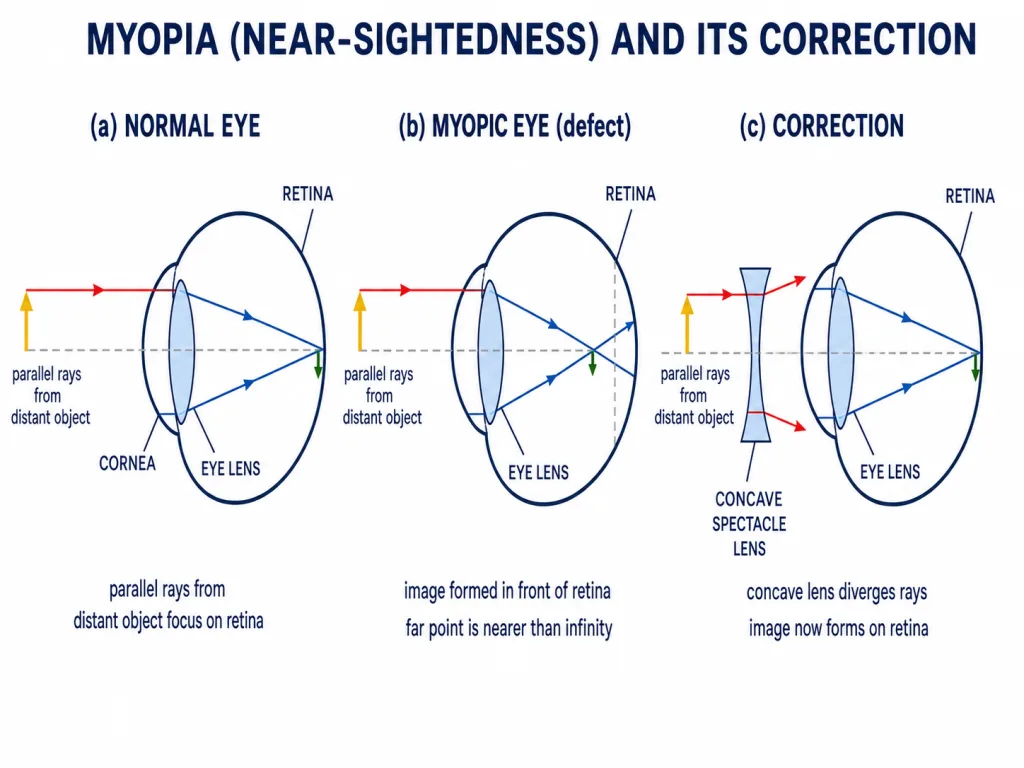
Why Myopia Happens and How to Correct It
In a myopic eye, the image of a distant object is formed in front of the retina, not on it. This happens because:
- the eye lens has excessive curvature (too much converging power), or
- the eyeball is too long (elongated).
Correction: Myopia is corrected using a concave (diverging) lens of suitable power. The concave lens diverges the incoming parallel rays a little before they enter the eye, so that the eye's own lens then brings them to focus exactly on the retina.
The concave lens should have a focal length such that it forms a virtual image of a very distant object (at infinity) at the far point of the defective eye. Then the eye can see that image comfortably.
For a myopic eye the correcting lens is concave, so its focal length and power are negative.
Working Out the Correcting Lens
For a myopic eye whose far point is at a distance (in front of the eye), the concave lens must take an object at infinity and form its image at the far point.
Using the lens formula with the object at infinity () and image at the far point ():
So the required focal length is (a concave lens), and the power is:
[Exam Tip] For myopia: image of far object forms before the retina → use a concave lens → power is negative. The magnitude of the focal length equals the far-point distance.
Solved Examples
Example 1: Far point of a myopic eye (NCERT)
The far point of a myopic person is 80 cm in front of the eye. What is the nature and power of the lens required to correct the problem?
Solution: The lens must form the image of a distant object (at infinity) at the far point, 80 cm in front of the eye. So object distance and image distance cm m.
Power D. A concave lens of power -1.25 D (focal length -0.8 m) is required.
Example 2: Distant vision correction from power (NCERT part)
A person needs a lens of power -5.5 D for correcting his distant vision. What is the focal length of this lens?
Solution: The negative sign shows it is a concave lens of focal length about 18.2 cm, used to correct myopia (distant vision).
Example 3: Identifying the defect
A student cannot read what is written on the blackboard from the last row, but can read a book easily. Name the defect and the corrective lens.
Solution: The student can see near objects (the book) but not distant ones (the blackboard) → this is myopia (near-sightedness). It is corrected with a concave (diverging) lens of suitable power.
Example 4: Far point 2 m
The far point of a myopic eye is 2 m. Find the power of the correcting lens.
Solution: m, . A concave lens of power -0.5 D (focal length -2 m) corrects it.