
Refraction Through a Glass Prism
You have learnt that when light passes through a rectangular glass slab, the emergent ray is parallel to the incident ray (only shifted sideways). A prism behaves very differently because its refracting surfaces are not parallel.
A triangular glass prism has two triangular bases and three rectangular side (lateral) faces that are inclined to each other. The angle between its two lateral faces (through which light enters and leaves) is called the angle of the prism, denoted .
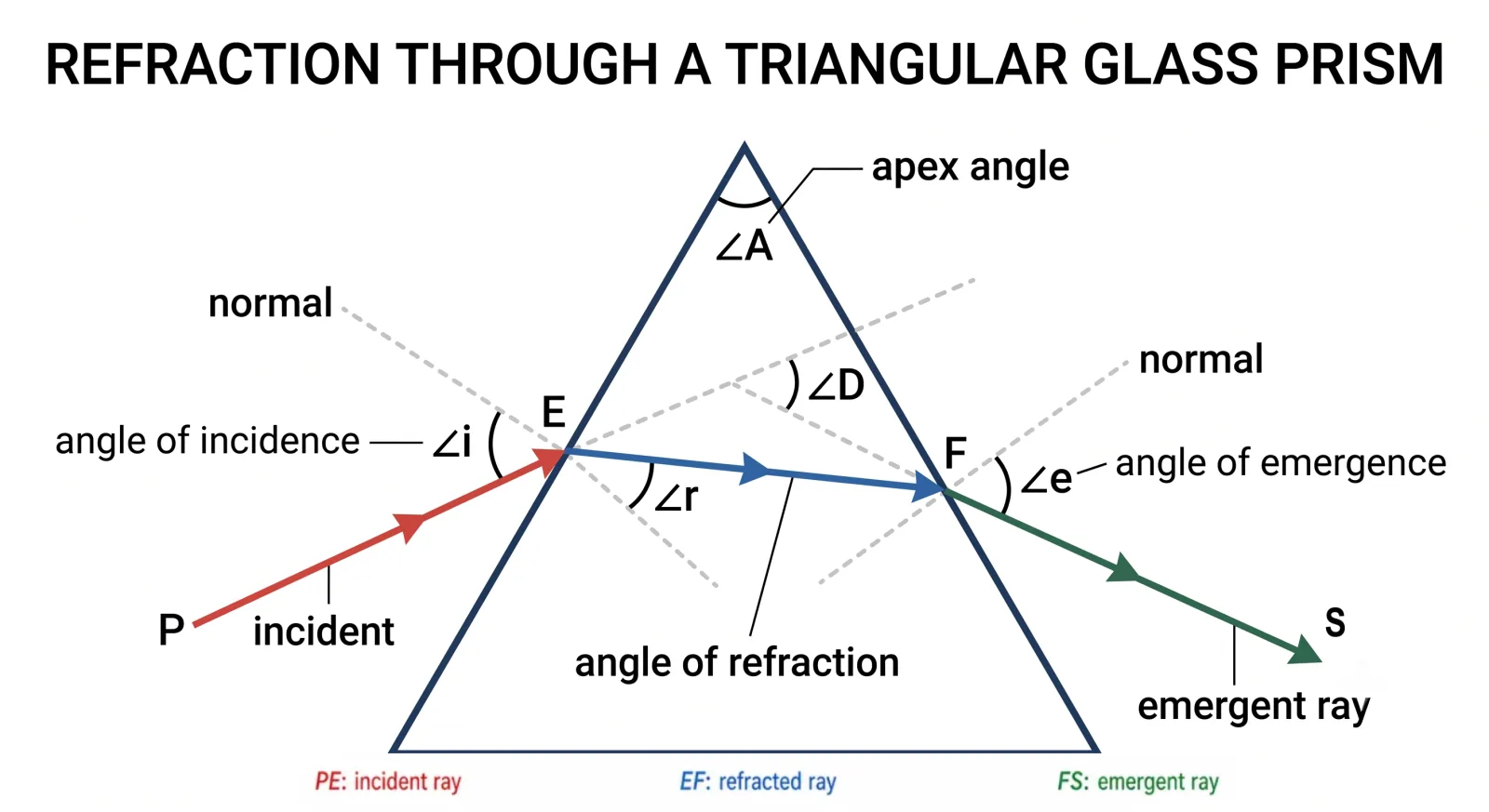
Angles in Prism Refraction
Consider a ray of light PE striking one face (AB) of the prism:
- PE is the incident ray; the angle it makes with the normal is the angle of incidence .
- Entering from air (rarer) to glass (denser), the ray bends towards the normal. Inside the prism it travels as the refracted ray EF, making the angle of refraction .
- At the second face (AC) the ray goes from glass (denser) to air (rarer), so it bends away from the normal and leaves as the emergent ray FS, making the angle of emergence .
Because the two faces are inclined, the emergent ray is not parallel to the incident ray. It travels in a new direction, bent through an angle relative to the original direction. This angle between the direction of the incident ray and the emergent ray is called the angle of deviation, .
Key Points About Prism Deviation
- In a glass slab the emergent ray is parallel to the incident ray, so there is no net deviation of direction (only lateral shift). In a prism the emergent ray is turned through the angle of deviation .
- The amount of deviation depends on the angle of the prism, the material of the prism (its refractive index), the wavelength (colour) of light, and the angle of incidence.
- The bending is always towards the base of the prism.
Key Point: In a prism, light bends towards the thicker part (the base), and the overall change of direction is measured by the angle of deviation .
[Exam Tip] Remember the five prism angles: angle of prism , angle of incidence , angle of refraction , angle of emergence , and angle of deviation .
Solved Examples
Example 1: Slab vs prism
How does refraction through a prism differ from refraction through a rectangular glass slab?
Solution: In a glass slab the two refracting surfaces are parallel, so the emergent ray is parallel to the incident ray (only laterally displaced) - there is no change in direction. In a prism the two refracting surfaces are inclined at the angle of the prism, so the emergent ray is deviated from the direction of the incident ray by the angle of deviation .
Example 2: Direction of bending at each face
At each face of a prism, does light bend towards or away from the normal? Why?
Solution: At the first face light goes from air (rarer) to glass (denser), so it bends towards the normal. At the second face light goes from glass (denser) to air (rarer), so it bends away from the normal. Overall the ray bends towards the base of the prism.
Example 3: What is the angle of deviation?
Define the angle of deviation for a prism and list the factors it depends on.
Solution: The angle of deviation is the angle between the direction of the incident ray (produced forward) and the emergent ray. It depends on (i) the angle of the prism , (ii) the refractive index (material) of the prism, (iii) the colour/wavelength of light, and (iv) the angle of incidence.