
Power of Accommodation
The eye lens is made of a soft, jelly-like material, and its curvature can be changed by the ciliary muscles that hold it. Changing the curvature changes the focal length of the lens.
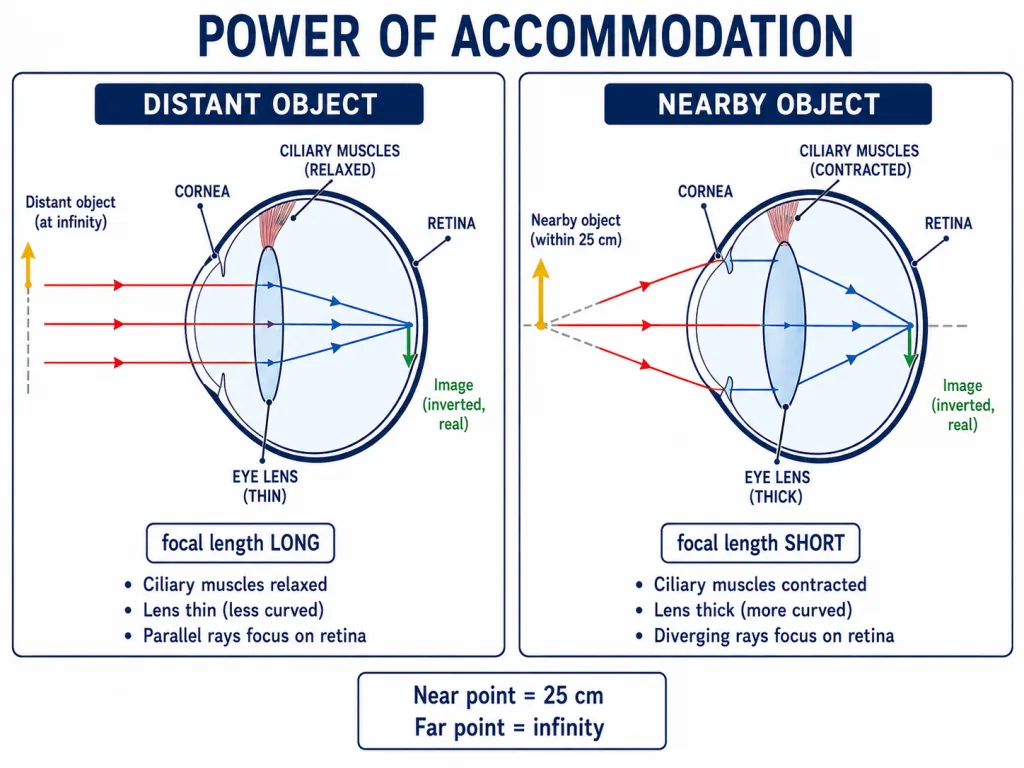
- When the ciliary muscles are relaxed, the lens becomes thin, its focal length increases, and we can see distant objects clearly.
- When the ciliary muscles contract, the curvature of the lens increases, the lens becomes thicker, its focal length decreases, and we can see nearby objects clearly.
The ability of the eye lens to adjust its focal length in this way is called the power of accommodation.
Least Distance of Distinct Vision (Near Point)
The focal length of the eye lens cannot be decreased below a certain minimum limit. If you hold a printed page very close to your eyes, the print looks blurred and you feel a strain. To see an object comfortably and distinctly, you must hold it at about 25 cm from the eye.
The minimum distance at which objects can be seen most distinctly without strain is called the least distance of distinct vision, also called the near point of the eye. For a young adult with normal vision, the near point is about 25 cm.
The farthest point up to which the eye can see objects clearly is called the far point. For a normal eye it is infinity.
Key Point: A normal eye can see clearly everything between its near point (25 cm) and its far point (infinity).
Cataract
Sometimes, in old age, the crystalline lens of the eye becomes milky and cloudy. This condition is called cataract. It causes partial or complete loss of vision because light can no longer pass clearly through the lens.
Cataract cannot be corrected by spectacles. However, vision can be restored through cataract surgery, in which the cloudy lens is replaced with an artificial lens.
[Exam Tip] Do not confuse cataract (a clouding of the lens) with the refractive defects (myopia, hypermetropia, presbyopia), which are due to the eye focusing the image at the wrong place. Cataract needs surgery; refractive defects are corrected with lenses.
Solved Examples
Example 1: Focal length while viewing near vs far
How does the focal length of the eye lens change as you shift your gaze from a distant hill to a book in your hand?
Solution: For the distant hill, the ciliary muscles relax, the lens becomes thin, and the focal length is large. For the near book, the ciliary muscles contract, the lens becomes thick, and the focal length decreases. This automatic change is the power of accommodation.
Example 2: Range of clear vision
Between what two distances can a normal human eye see objects clearly?
Solution: A normal eye can see clearly from its near point (about 25 cm) to its far point (infinity). Objects closer than 25 cm cannot be focused sharply because the eye lens cannot reduce its focal length below the minimum limit.
Example 3: Why not read at 5 cm?
Why can a normal eye not read a book held just 5 cm away?
Solution: To focus an object as close as 5 cm, the eye lens would need a focal length smaller than its minimum possible value. The ciliary muscles cannot squeeze the lens that much, so the image is not formed on the retina and the print looks blurred with eye strain. The closest comfortable distance is the near point, about 25 cm.