
Scattering of Light and the Tyndall Effect
The interplay of light with tiny particles in the atmosphere produces many beautiful phenomena - the blue colour of the sky, the colour of deep sea water, and the reddening of the Sun at sunrise and sunset.
The earth's atmosphere is a mixture of minute particles: smoke, tiny water droplets, dust and molecules of air. When a beam of light strikes such fine particles, the path of the beam becomes visible because the light is scattered (reflected diffusely) in different directions. This phenomenon of scattering of light by colloidal particles is called the Tyndall effect.
The Tyndall effect is seen when a fine beam of sunlight enters a smoke-filled room through a small hole, or when sunlight passes through a canopy of a dense forest (where tiny water droplets in the mist scatter the light).
Why the Clear Sky is Blue
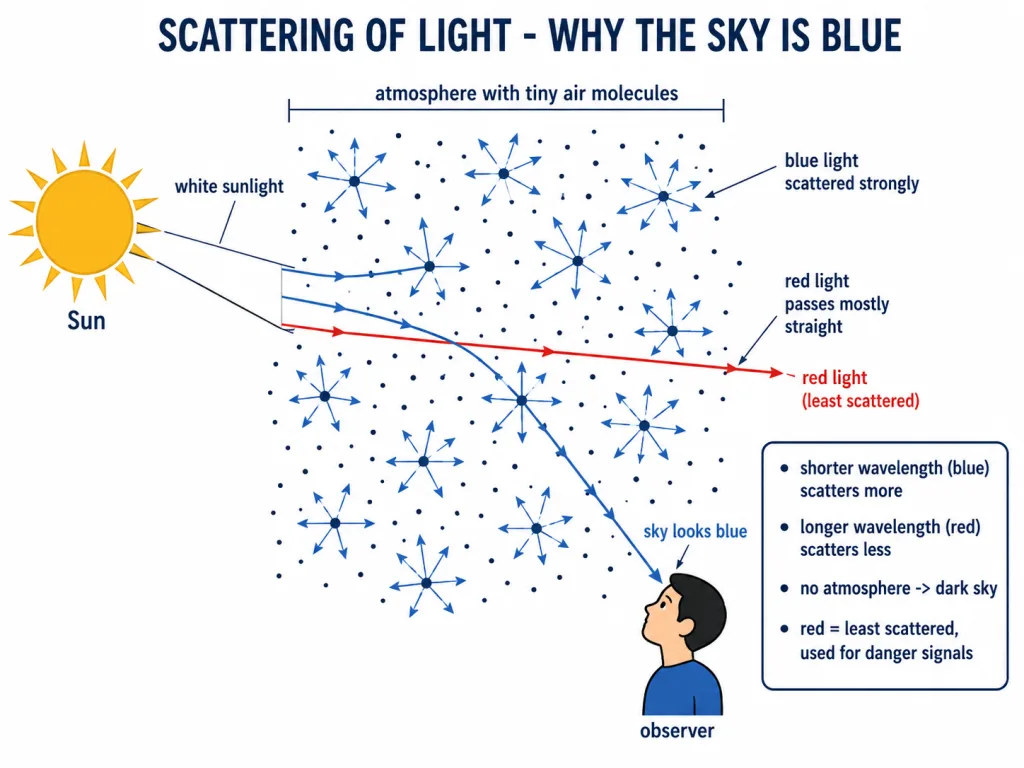
The colour of the scattered light depends on the size of the scattering particles. Very fine particles scatter mainly blue light (shorter wavelengths), while larger particles scatter light of longer wavelengths, and very large particles may scatter all colours so the light looks white.
The molecules of air and other fine particles in the atmosphere are smaller than the wavelength of visible light. They are more effective in scattering shorter wavelengths (the blue end) than the longer wavelengths (the red end). Red light has a wavelength about 1.8 times greater than blue light.
So when sunlight passes through the atmosphere, the fine particles scatter the blue colour much more strongly than red. This scattered blue light enters our eyes from all directions, and the clear sky looks blue.
If the earth had no atmosphere, there would be no scattering, and the sky would look dark. This is why the sky appears dark to astronauts and to passengers flying at very high altitudes, where scattering is not prominent.
Red Danger Signals and the Reddening of the Sun
Because red light is scattered the least by fog or smoke (it has the longest wavelength), it can travel the farthest and be seen clearly from a distance. This is why 'danger' signal lights are red - the red colour is visible even through fog and remains the same colour over long distances.
The reddening of the Sun at sunrise and sunset is also due to scattering. Near the horizon, sunlight has to travel through a much thicker layer of atmosphere, so most of the shorter (blue) wavelengths are scattered away before the light reaches us. Mostly the longer (red) wavelengths get through, so the Sun and the sky around it appear reddish. At noon, the Sun appears white because it is overhead and its light travels through the least atmosphere, so relatively little scattering occurs.
Key Point: Small particles scatter short (blue) wavelengths most → blue sky. Red is scattered least → used for danger signals and seen at sunrise/sunset.
[Exam Tip] No atmosphere → no scattering → dark sky (why space and high altitudes look black).
Solved Examples
Example 1: Why the sky is blue
Explain why the clear sky appears blue.
Solution: Air molecules are smaller than the wavelength of visible light and scatter shorter (blue) wavelengths much more strongly than longer (red) wavelengths. This scattered blue light reaches our eyes from all parts of the sky, so the clear sky looks blue.
Example 2: Dark sky for an astronaut
Why does the sky appear dark instead of blue to an astronaut?
Solution: At the height of a spacecraft there is little or no atmosphere, so there are almost no particles to scatter sunlight. With no scattering, no scattered light reaches the astronaut's eyes from the sky, and it appears dark (black).
Example 3: Red danger signals
Why are 'danger' or 'stop' signal lights made red?
Solution: Red light has the longest wavelength and is scattered the least by fog and smoke. So red light can travel long distances without much scattering and is seen clearly and in the same colour even in foggy conditions - making it ideal for danger signals.
Example 4: Reddish Sun at sunset
Why does the Sun appear red at sunrise and sunset but white at noon?
Solution: At sunrise/sunset the sunlight travels through a thick layer of atmosphere; most of the blue (shorter wavelengths) is scattered away, leaving mainly red light to reach us, so the Sun looks red. At noon the Sun is overhead and its light passes through the least atmosphere, so little scattering occurs and the Sun appears nearly white.