
Dispersion of White Light
When a narrow beam of white light (such as sunlight) passes through a glass prism, it splits into a beautiful band of seven colours. This splitting of white light into its component colours is called dispersion.

The band of colours is called the spectrum. The sequence of colours, from the least deviated to the most deviated, is remembered by the acronym VIBGYOR: Violet, Indigo, Blue, Green, Yellow, Orange, Red.
Why Does Dispersion Happen?
Different colours of light bend through different angles as they pass through the prism:
- Red light bends the least (it has the longest wavelength).
- Violet light bends the most (it has the shortest wavelength).
Because each colour travels along a slightly different path after leaving the prism, the colours emerge separated and become distinct. That is why we see a band of distinct colours - the spectrum.
Newton's experiment: Isaac Newton was the first to obtain the spectrum of sunlight using a glass prism. When he tried to split the colours further with a second prism, no new colours appeared. He then placed a second identical prism inverted with respect to the first. This recombined all the colours, and white light emerged from the far side. This proved that white light (sunlight) is made up of seven colours.
Formation of a Rainbow
A rainbow is a natural spectrum that appears in the sky after a rain shower. It is caused by the dispersion of sunlight by tiny water droplets present in the atmosphere.
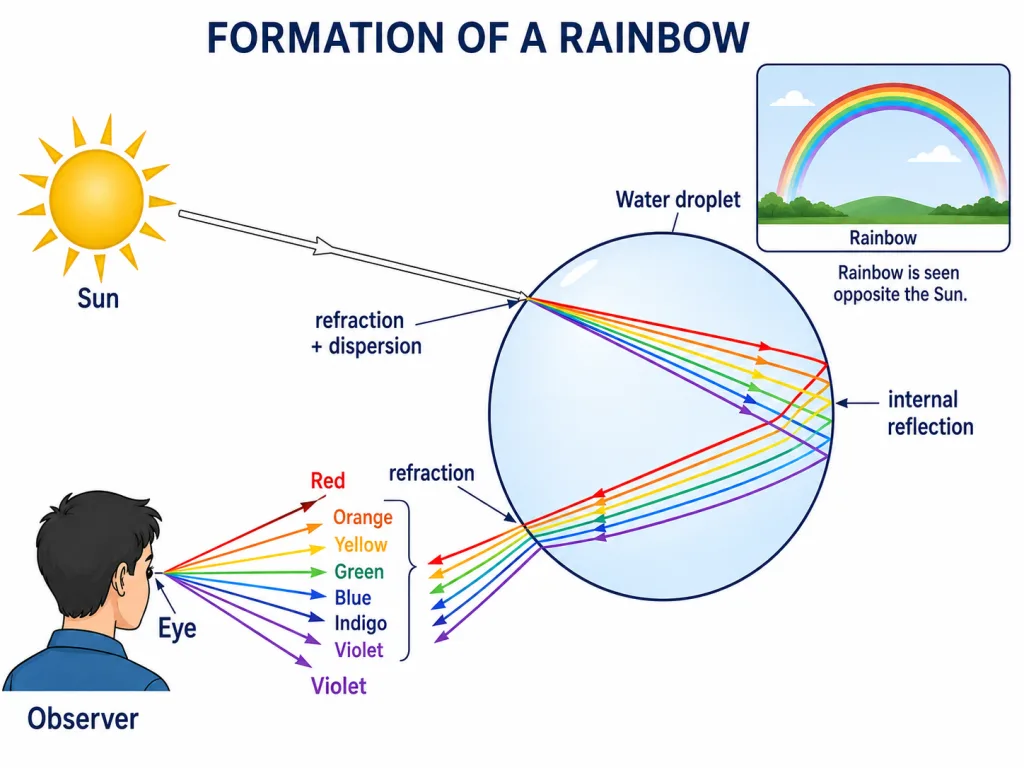
Each tiny water droplet acts like a small prism. When sunlight enters a droplet:
- it is refracted and dispersed as it enters the droplet,
- it is then internally reflected at the back inner surface of the droplet, and
- finally it is refracted again as it comes out of the droplet.
Because of dispersion and internal reflection, different colours reach the observer's eye from different droplets, forming the coloured arc. A rainbow is always formed in the direction opposite to the Sun (with the Sun behind the observer).
You can also see a rainbow on a sunny day by looking at the sky through a waterfall or a water fountain, with the Sun behind you.
[Exam Tip] Rainbow = dispersion + internal reflection + refraction in water droplets, seen opposite the Sun.
Solved Examples
Example 1: Order of colours
Write the sequence of colours in the spectrum of white light and state which bends the most and which the least.
Solution: The spectrum, remembered as VIBGYOR, is Violet, Indigo, Blue, Green, Yellow, Orange, Red. Violet bends (deviates) the most and red bends the least, because violet has the shortest and red the longest wavelength.
Example 2: Newton's two-prism experiment
What did Newton conclude by placing a second, inverted prism after the first?
Solution: When Newton placed a second, identical prism in an inverted position after the first, the separated colours recombined and emerged as white light. This showed that white light is a mixture of the seven spectral colours, and that a prism disperses (splits) but does not create the colours.
Example 3: Three steps in a rainbow
List the three optical processes occurring in a water droplet during rainbow formation.
Solution: Inside each water droplet, sunlight undergoes: (1) refraction and dispersion on entering the droplet, (2) internal reflection at the back surface, and (3) refraction again on leaving the droplet. Together these separate the colours and send them to the observer's eye.
Example 4: Direction of a rainbow
In which direction should an observer look to see a rainbow, and why?
Solution: An observer must look in the direction opposite to the Sun (with the Sun behind them). Only then do the refracted, internally reflected and dispersed rays from the water droplets reach the observer's eye to form the coloured arc.