
From Chromatin to Chromosome
You may recall that the interphase nucleus has a loose and indistinct network of nucleoprotein fibres called chromatin. But during different stages of cell division, cells show structured chromosomes in place of the nucleus.
So chromatin and chromosome are the same material in two different states. Loose and indistinct when the cell is not dividing; condensed into structured chromosomes when it is.
What chromatin is made of. Chromatin contains DNA and some basic proteins called histones, some non-histone proteins and also RNA.
- DNA
- Histones - the basic proteins
- Some non-histone proteins
- RNA
How much DNA is in there. A single human cell has approximately two metre long thread of DNA distributed among its forty six (twenty three pairs) chromosomes.
Two metres of thread folded into a nucleus a few micrometre wide - that is the packaging problem the chromosome solves.
[NEET Important] Three numbers travel together and are asked as a set: approximately two metre of DNA, forty six chromosomes, twenty three pairs. The distractor swaps forty six for twenty three by quietly dropping the word pairs. And note that histones are basic proteins - the word basic is the part that gets left out and then tested.
The Centromere and the Kinetochores
Every chromosome, visible only in dividing cells, essentially has a primary constriction or the centromere.
Read the two qualifiers in that sentence. Visible only in dividing cells - you will not see a chromosome in an interphase nucleus. Essentially has - the centromere is not optional; every chromosome has one.
On the sides of the centromere, disc shaped structures called kinetochores are present.
The centromere holds the two chromatids of a chromosome.
| Structure | What it is |
|---|---|
| Centromere | The primary constriction of the chromosome; holds the two chromatids together |
| Kinetochores | Disc shaped structures present on the sides of the centromere |
And one more constriction. Sometimes a few chromosomes have non-staining secondary constrictions at a constant location. This gives the appearance of a small fragment called the satellite.
Note the three things said about a secondary constriction: it is non-staining, it occurs at a constant location, and only a few chromosomes have one. The bit of chromosome cut off beyond it is the satellite.
[NEET Important] Do not let centromere and kinetochore blur into one word. The centromere is the primary constriction - a region of the chromosome. The kinetochores are disc shaped structures on the sides of it. And keep primary constriction = centromere apart from secondary constriction = the one that gives a satellite.
Four Types of Chromosome, by the Position of the Centromere
Based on the position of the centromere, the chromosomes can be classified into four types.
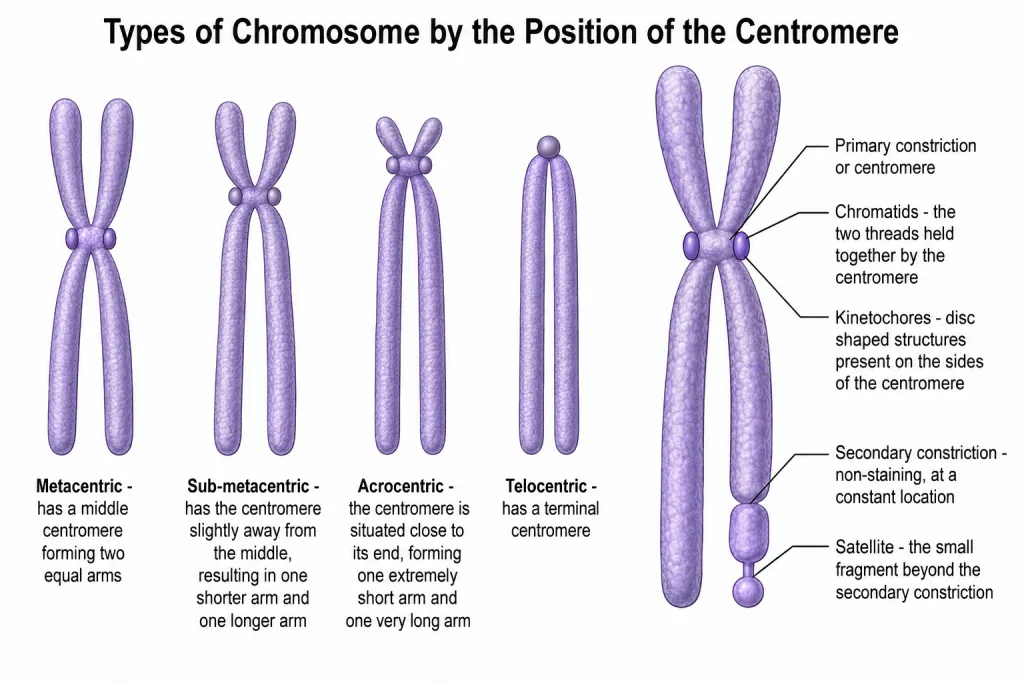
Work down the list in order, because the centromere simply slides from the middle towards the end as you go.
- Metacentric - has a middle centromere forming two equal arms of the chromosome.
- Sub-metacentric - has the centromere slightly away from the middle of the chromosome, resulting into one shorter arm and one longer arm.
- Acrocentric - the centromere is situated close to its end, forming one extremely short arm and one very long arm.
- Telocentric - has a terminal centromere.
| Type | Position of the centromere | The arms it gives |
|---|---|---|
| Metacentric | Middle | Two equal arms |
| Sub-metacentric | Slightly away from the middle | One shorter arm and one longer arm |
| Acrocentric | Close to the end | One extremely short arm and one very long arm |
| Telocentric | Terminal | Terminal centromere, so effectively a single arm |
[NEET Important] The pair that gets confused is sub-metacentric and acrocentric, because both give unequal arms. Hold on to the strength of the word: sub-metacentric is only slightly off the middle, so its short arm is still a proper arm; acrocentric is close to the end, so its short arm is extremely short. And telocentric is the extreme case - the centromere is terminal, right at the end.
Quick Recap
- The interphase nucleus has a loose and indistinct network of nucleoprotein fibres called chromatin.
- During different stages of cell division, cells show structured chromosomes in place of the nucleus.
- Chromatin contains DNA and some basic proteins called histones, some non-histone proteins and also RNA.
- A single human cell has approximately two metre long thread of DNA distributed among its forty six (twenty three pairs) chromosomes.
- Every chromosome is visible only in dividing cells.
- Every chromosome essentially has a primary constriction or the centromere.
- On the sides of the centromere, disc shaped structures called kinetochores are present.
- The centromere holds the two chromatids of a chromosome.
- Chromosomes are classified into four types based on the position of the centromere.
- Metacentric - middle centromere, two equal arms.
- Sub-metacentric - centromere slightly away from the middle, one shorter and one longer arm.
- Acrocentric - centromere close to its end, one extremely short and one very long arm.
- Telocentric - terminal centromere.
- A few chromosomes have non-staining secondary constrictions at a constant location, which give the appearance of a small fragment called the satellite.
Solved Examples
Question 1
Q. What is chromatin, and where do you see it?
Answer. It is the loose and indistinct network of nucleoprotein fibres present in the interphase nucleus - that is, in a cell that is not dividing.
Question 2
Q. When do cells show structured chromosomes instead of a nucleus?
Answer. During different stages of cell division. Outside division the same material is present as chromatin.
Question 3
Q. What does chromatin contain?
Answer. DNA, some basic proteins called histones, some non-histone proteins, and also RNA.
Question 4
Q. How long is the DNA in a single human cell, and among how many chromosomes is it distributed?
Answer. A single human cell has approximately two metre long thread of DNA, distributed among its forty six (twenty three pairs) chromosomes.
Question 5
Q. Why are chromosomes described as visible only in dividing cells?
Answer. Because outside division the material is present as highly extended, loose and indistinct chromatin fibres, which do not appear as separate bodies. Only during cell division does it condense into structured chromosomes, and only then can each one be seen and counted.
Question 6
Q. What is the primary constriction of a chromosome called?
Answer. The centromere. Every chromosome essentially has a primary constriction or the centromere.
Question 7
Q. What are kinetochores and where are they present?
Answer. They are disc shaped structures present on the sides of the centromere.
Question 8
Q. What does the centromere hold?
Answer. The centromere holds the two chromatids of a chromosome.
Question 9
Q. Name the four types of chromosome based on the position of the centromere.
Answer. Metacentric, sub-metacentric, acrocentric and telocentric.
Question 10
Q. Distinguish between a metacentric and a sub-metacentric chromosome.
Answer. The metacentric chromosome has a middle centromere forming two equal arms of the chromosome. The sub-metacentric chromosome has the centromere slightly away from the middle, which results in one shorter arm and one longer arm.
Question 11
Q. Distinguish between an acrocentric and a telocentric chromosome.
Answer. In an acrocentric chromosome the centromere is situated close to its end, forming one extremely short arm and one very long arm. A telocentric chromosome has a terminal centromere - the centromere is right at the end.
Question 12
Q. What is a satellite in a chromosome?
Answer. Sometimes a few chromosomes have non-staining secondary constrictions at a constant location. The small piece of chromosome cut off beyond such a constriction gives the appearance of a small fragment called the satellite.
Question 13
Q. What is a centromere? How does the position of centromere form the basis of classification of chromosomes? Support your answer with a diagram showing the position of centromere on different types of chromosomes. This is one of the chapter-end exercises.
Answer. What a centromere is. The centromere is the primary constriction of a chromosome. Every chromosome, visible only in dividing cells, essentially has one. On the sides of the centromere, disc shaped structures called kinetochores are present. The centromere has one clear job in the chromosome itself - it holds the two chromatids of a chromosome together.
Why its position is used to classify chromosomes. The centromere divides a chromosome into arms, one on each side of it. Where the centromere sits decides how long each arm is. If the centromere is in the middle the two arms come out equal; the further it slides towards one end, the more unequal they become. Since the arm lengths can be seen and measured under the microscope, the position of the centromere gives a simple and reliable basis for sorting chromosomes into types. Based on the position of the centromere, chromosomes can be classified into four types.
The four types.
- Metacentric - has a middle centromere forming two equal arms of the chromosome.
- Sub-metacentric - has the centromere slightly away from the middle of the chromosome, resulting into one shorter arm and one longer arm.
- Acrocentric - the centromere is situated close to its end, forming one extremely short arm and one very long arm.
- Telocentric - has a terminal centromere.
The diagram must show four chromosomes side by side, each drawn with its centromere marked, and labelled in this order: metacentric with the centromere in the middle and two equal arms; sub-metacentric with the centromere slightly off the middle, one shorter and one longer arm; acrocentric with the centromere close to the end, one extremely short and one very long arm; and telocentric with the centromere at the terminal position.