
Same Syllabus. A Different Exam.
The Solved Examples section worked this chapter the way a written paper does - describe the organelle, give its function, compare the two. NEET does not ask you to describe anything. It shows you one line about one structure and gives you four names, and you have about half a minute to pick.
The marking is +4 for a correct answer and -1 for a wrong one. In a written answer, remembering four of the five parts of an organelle still earns most of the marks. Here, a half-remembered fact is worth -1, which is five marks behind the person who skipped it.
This chapter deserves more preparation time than any other in the unit, for a simple reason: it is the densest source of pure-recall marks in the whole paper, and every one of those marks is decided before you enter the hall. Nothing here has to be worked out. Everything is a name, a number, a size, a location or a pairing.
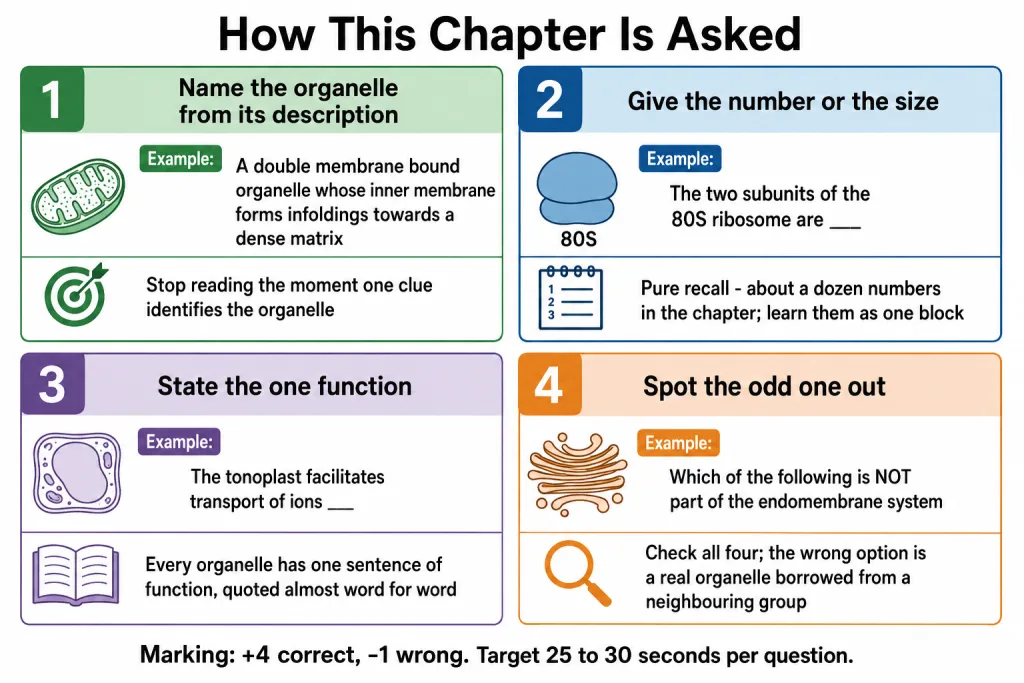
The Four Shapes This Chapter Is Asked In
Shape 1 - Name the organelle from its description. "A double membrane bound organelle whose inner membrane forms infoldings towards a dense matrix." You are given membrane count + internal detail + contents, and any one of those three is usually enough. Stop reading the moment one clue identifies the organelle.
Shape 2 - Give the number or the size. "The two subunits of the 80S ribosome are _." Pure recall, and there are only about a dozen numbers in the chapter. They are listed below as one block.
Shape 3 - State the one function. "The tonoplast facilitates transport of ions _." Every organelle in this chapter has one sentence of function that gets quoted almost word for word.
Shape 4 - The odd one out, or the incorrect statement. "Which of the following is NOT part of the endomembrane system?" Here you must check all four, so budget the extra time. The wrong option is almost never invented - it is a real organelle borrowed from a neighbouring group.
One Structure, One Address
Most of this chapter reduces to a single question: where does this thing live, and what does it do there. Fix each name to one address and the recall questions become instant.
| Structure | The one address to remember |
|---|---|
| Glycocalyx | Outermost layer of the bacterial cell envelope; slime layer if loose, capsule if thick and tough |
| Mesosome | Infolding of the prokaryotic plasma membrane - vesicles, tubules and lamellae |
| Chromatophore | Membranous extension into the cytoplasm in cyanobacteria, contains pigments |
| Plasmid | Small circular DNA outside the genomic DNA of a bacterium |
| Filament, hook, basal body | The three parts of the bacterial flagellum |
| Pili and fimbriae | Bacterial surface structures with no role in motility |
| Inclusion bodies | Free in the prokaryotic cytoplasm, not bound by any membrane |
| Integral protein | Partially or totally buried in the membrane |
| Peripheral protein | On the surface of the membrane |
| Middle lamella | Calcium pectate, glues neighbouring plant cells together |
| Plasmodesmata | Traverse the cell wall and middle lamella, connect the cytoplasm of neighbouring cells |
| Cisternae | Flat disc-shaped sacs of the golgi apparatus |
| Cristae | Infoldings of the INNER mitochondrial membrane, towards the matrix |
| Thylakoids | Flattened membranous sacs in the stroma of the chloroplast |
| Grana | Thylakoids stacked like piles of coins; site of the light reactions |
| Stroma lamellae | Flat membranous tubules connecting thylakoids of different grana |
| Stroma | Space inside the inner chloroplast membrane; site of the dark reactions |
| Tonoplast | The single membrane of the vacuole |
| Axoneme | The core of a cilium or flagellum; 9+2 |
| Basal body | The centriole-like structure a cilium or flagellum emerges from |
| Hub | Proximal centre of the centriole, joined to the triplets by radial spokes |
| Perinuclear space | 10 to 50 nanometre, between the two membranes of the nuclear envelope |
| Nucleolus | In the nucleoplasm, not membrane bound, site of ribosomal RNA synthesis |
| Kinetochore | Disc shaped, on the sides of the centromere |
| Satellite | The small fragment beyond a non-staining secondary constriction |
The rule that saves the most marks here: when a question names a sac, decide first which organelle it belongs to. Cisternae are golgi. Cristae are mitochondria. Thylakoids are chloroplast. That one triple is the basis of a chapter-end exercise and appears in the paper almost every year.
The Numbers, and the Negatives
Every number in the chapter
- Mycoplasma - 0.3 micrometre, the smallest cell. Bacteria - 3 to 5 micrometre. Human RBC - 7.0 micrometre.
- Prokaryotic ribosome - 15 nanometre by 20 nanometre, 70S = 50S + 30S.
- Eukaryotic ribosome - 80S = 60S + 40S.
- Erythrocyte membrane - about 52 per cent protein and 40 per cent lipids.
- Fluid mosaic model - Singer and Nicolson, 1972.
- Golgi cisternae - 0.5 to 1.0 micrometre in diameter.
- Vacuole - up to 90 per cent of a plant cell's volume.
- Mitochondrion - diameter 0.2 to 1.0 micrometre (average 0.5), length 1.0 to 4.1 micrometre.
- Chloroplast - length 5 to 10 micrometre, width 2 to 4 micrometre; 1 per cell in Chlamydomonas, 20 to 40 in the mesophyll.
- Axoneme - 9+2; nine radial spokes. Centriole - nine triplets, 9+0.
- Perinuclear space - 10 to 50 nanometre.
- Human cell - about two metre of DNA across forty six (twenty three pairs) chromosomes.
- Dates - Brown 1831, Schleiden 1838, Schwann 1839, Virchow 1855, Golgi 1898, Palade 1953.
Why 60S and 40S do not add to 80S. Because S is Svedberg's Unit, the sedimentation coefficient - indirectly a measure of density and size, not a mass. Subunit values never add arithmetically, and a question that offers "100S" as an option is testing exactly this.
The lists the "which is NOT" questions come from
- Endomembrane system: ER, golgi complex, lysosomes, vacuoles. (Mitochondria, chloroplast and peroxisomes are excluded by name, because their functions are not coordinated with these.)
- Non-membrane bound organelles: ribosomes (in all cells) and the centrosome (animal cells).
- Bacterial cell envelope, outside in: glycocalyx, cell wall, plasma membrane.
- Mesosome functions: cell wall formation, DNA replication and distribution to daughter cells, respiration, secretion, increasing the surface area of the plasma membrane and its enzymatic content. (Protein synthesis is the ribosome's job and is the classic wrong option here.)
- Plastid types: chloroplasts, chromoplasts, leucoplasts - and the leucoplasts are amyloplasts (starch), elaioplasts (oils and fats), aleuroplasts (proteins).
- Cytoskeleton: microtubules, microfilaments, intermediate filaments.
- Chromosome types by centromere position: metacentric, sub-metacentric, acrocentric, telocentric.
The pairs that get swapped
- Leeuwenhoek first saw a live cell; Robert Brown discovered the nucleus.
- Schleiden was the botanist; Schwann the zoologist.
- Cristae are inner-membrane infoldings; the outer membrane is the continuous limiting boundary.
- Cis face is convex and forming; trans face is concave and maturing.
- RER does protein synthesis and secretion; SER is the major site of lipid synthesis.
- 70S is prokaryotic and also mitochondrial and chloroplast; 80S is the eukaryotic cytoplasmic ribosome.
- Axoneme has nine peripheral doublets plus a central pair; the centriole has nine peripheral triplets and no central tubule.
Solved Examples at NEET Pace
Each item names the shortcut it uses, because the shortcut is the thing worth carrying into the exam hall.
Question 1
Q. Which of the following is NOT a part of the endomembrane system? (a) golgi complex (b) lysosome (c) mitochondrion (d) vacuole
Answer. (c) mitochondrion. Shortcut - recall the official four, then look for the intruder. The endomembrane system includes endoplasmic reticulum, golgi complex, lysosomes and vacuoles. Mitochondria, chloroplast and peroxisomes are excluded because their functions are not coordinated with these components. Note that the mitochondrion is membrane bound - being membrane bound and being part of the endomembrane system are two different claims, and that gap is the trap.
Question 2
Q. Cristae, cisternae and thylakoids belong respectively to (a) golgi, mitochondria, chloroplast (b) mitochondria, golgi, chloroplast (c) chloroplast, mitochondria, golgi (d) mitochondria, chloroplast, golgi
Answer. (b) mitochondria, golgi, chloroplast. Shortcut - the word "respectively" means read the order of the question before you read any option. Cristae are the infoldings of the inner mitochondrial membrane, cisternae are the flat disc-shaped sacs of the golgi apparatus, and thylakoids are the flattened membranous sacs in the stroma of the chloroplast. Every distractor here is the same three names in a different order.
Question 3
Q. The two subunits of the 80S ribosome are (a) 50S and 30S (b) 60S and 40S (c) 40S and 40S (d) 70S and 10S
Answer. (b) 60S and 40S. Shortcut - the big ribosome takes the big subunits; and never check whether the numbers add up. The eukaryotic ribosome is 80S with 60S and 40S subunits; the prokaryotic ribosome is 70S with 50S and 30S. S is Svedberg's Unit, the sedimentation coefficient, so 60 + 40 does not have to equal 80. Option (d) is offered purely to reward the student who tries to make the arithmetic work.
Question 4
Q. Which of the following is NOT a function of the mesosome? (a) cell wall formation (b) DNA replication (c) protein synthesis (d) respiration
Answer. (c) protein synthesis. Shortcut - for a "which is NOT" on an organelle, ask which organelle the odd option actually belongs to. Mesosomes help in cell wall formation, DNA replication and distribution to daughter cells, respiration, secretion processes, and increasing the surface area of the plasma membrane and its enzymatic content. Protein synthesis is the ribosome's job, and it is the option placed here every time.
Question 5
Q. In a plant cell the vacuole may occupy up to (a) 9 per cent (b) 30 per cent (c) 50 per cent (d) 90 per cent of the volume of the cell
Answer. (d) 90 per cent. Shortcut - a bare number question; either you have it or you skip it. In plant cells the vacuoles can occupy up to 90 per cent of the volume of the cell. Option (a) exists only to catch a misread of the digits.
Question 6
Q. The forming face of the golgi apparatus is (a) concave and called trans (b) convex and called cis (c) convex and called trans (d) concave and called cis
Answer. (b) convex and called cis. Shortcut - two attributes in every option means the question is testing whether you learned them as a pair. The golgi cisternae have a distinct convex cis or forming face and a concave trans or maturing face. Learn it as "cis, convex, forming, receives from the ER" against "trans, concave, maturing, releases", and all four options sort themselves out.
Question 7
Q. The axoneme of a cilium shows (a) nine peripheral triplets and no central tubule (b) nine peripheral doublets and a central pair (c) nine peripheral doublets and no central tubule (d) nine peripheral triplets and a central pair
Answer. (b) nine peripheral doublets and a central pair. Shortcut - doublets go with the axoneme, triplets go with the centriole. The axoneme usually has nine doublets of radially arranged peripheral microtubules and a pair of centrally located microtubules - the 9+2 array. The centriole, by contrast, is made up of nine evenly spaced peripheral fibrils of tubulin, each of which is a triplet, with no central tubule - a 9+0 pattern. Options (a) and (d) are the centriole's numbers offered under the axoneme's name.
Question 8
Q. Nuclear pores allow the movement of (a) RNA only, out of the nucleus (b) protein only, into the nucleus (c) RNA and protein, in both directions (d) DNA, in both directions
Answer. (c) RNA and protein, in both directions. Shortcut - the phrase "in both directions" is quoted almost word for word, so recognise it rather than reasoning about it. Nuclear pores are the passages through which movement of RNA and protein molecules takes place in both directions between the nucleus and the cytoplasm. DNA does not leave the nucleus, which rules out (d).
Question 9
Q. Which statement about the tonoplast is correct? (a) it is a double membrane (b) it moves materials only along the concentration gradient (c) it keeps solute concentration lower in the vacuole than in the cytoplasm (d) it facilitates transport of materials against concentration gradients into the vacuole
Answer. (d) it facilitates transport of materials against concentration gradients into the vacuole. Shortcut - the tonoplast is one of the few places this chapter says "against". The vacuole is bound by a single membrane called the tonoplast, and in plants the tonoplast facilitates the transport of a number of ions and other materials against concentration gradients into the vacuole, hence their concentration is significantly higher in the vacuole than in the cytoplasm. That single sentence disposes of all three distractors at once.
Question 10
Q. Chlorophyll pigments in a chloroplast are present in the (a) stroma (b) thylakoids (c) stroma lamellae (d) outer membrane
Answer. (b) thylakoids. Shortcut - pigment goes with the sac, enzyme goes with the fluid. Chlorophyll pigments are present in the thylakoids, whose stacks are the grana, the site of the light reactions. The stroma holds the enzymes required for the synthesis of carbohydrates and proteins, plus circular DNA and 70S ribosomes, and is the site of the dark reactions.
Question 11
Q. Which of the following is found in a prokaryotic cell? (a) mitochondria (b) golgi complex (c) ribosomes (d) nuclear envelope
Answer. (c) ribosomes. Shortcut - the exception is the answer. No organelles like the ones in eukaryotes are found in prokaryotic cells except for ribosomes, which are non-membrane bound and therefore survive the rule. Prokaryotic ribosomes are 70S, made of 50S and 30S subunits. The student who memorised "prokaryotes have no organelles" without the exception loses four marks here and gains a minus one.
Question 12
Q. A chromosome with a centromere close to one end, giving one extremely short and one very long arm, is (a) metacentric (b) sub-metacentric (c) acrocentric (d) telocentric
Answer. (c) acrocentric. Shortcut - walk the centromere from middle to end and name the four positions in order. Metacentric - middle centromere, two equal arms. Sub-metacentric - slightly away from the middle, one shorter and one longer arm. Acrocentric - close to its end, one extremely short and one very long arm. Telocentric - terminal centromere. Say the four in that order every time and the wording of any such question maps straight onto one of them.
A Drill Before You Move On
Decide each one before you read the verdict. Aim for 25 to 30 seconds per question.
Mark yourself honestly. A wrong answer here is worth -1 in the hall, so treat "I think it is B" as a skip, not an answer, and go back to the address table for that row.