
Discovery, and the Interphase Nucleus
Nucleus as a cell organelle was first described by Robert Brown as early as 1831. Later the material of the nucleus stained by the basic dyes was given the name chromatin by Flemming.
Two names, two different things - Brown found the organelle, Flemming named the stainable material inside it.
The interphase nucleus is the nucleus of a cell when it is not dividing. That definition matters, because what you see inside a nucleus depends entirely on whether the cell is dividing or not.
An interphase nucleus has:
- Highly extended and elaborate nucleoprotein fibres called chromatin.
- Nuclear matrix.
- One or more spherical bodies called nucleoli (singular: nucleolus).
[NEET Important] Keep Robert Brown, 1831 for the nucleus and Flemming for chromatin - the two are constantly swapped in one-line questions. And remember that chromatin is what you see in a non-dividing cell; a nucleus showing structured chromosomes is not an interphase nucleus.
The Nuclear Envelope and the Nuclear Pores
Electron microscopy has revealed that the nuclear envelope consists of two parallel membranes with a space between them, called the perinuclear space, and it forms a barrier between the materials present inside the nucleus and those of the cytoplasm.
The perinuclear space is 10 to 50 nanometre wide.
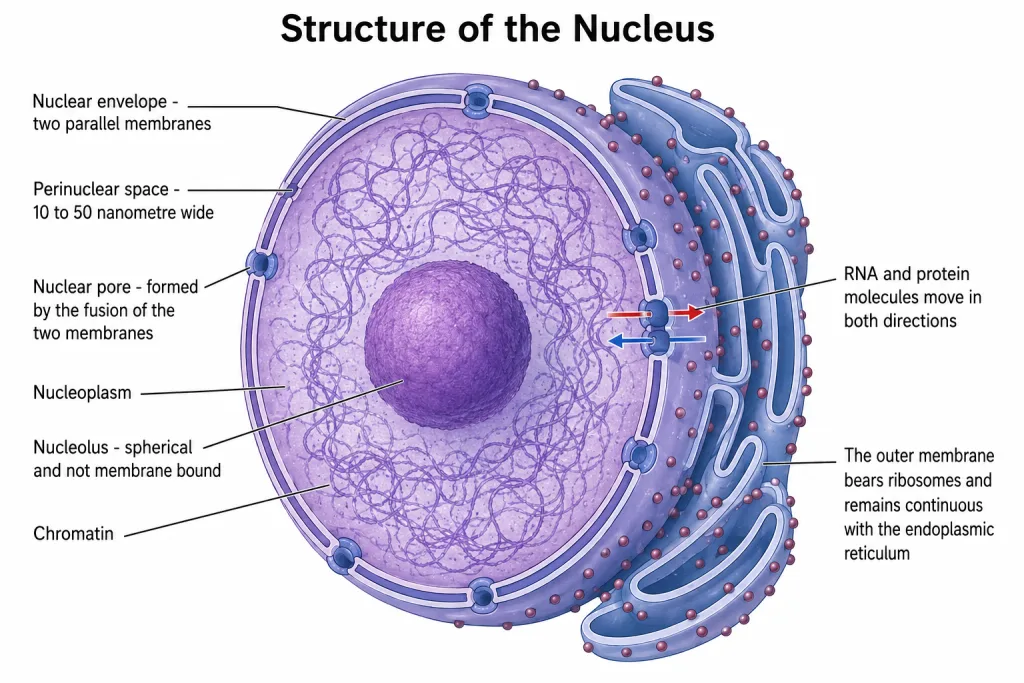
The outer membrane is the interesting one. It usually remains continuous with the endoplasmic reticulum and also bears ribosomes on it. So the nuclear envelope is not a sealed box sitting on its own - its outer face is part of the same membrane system as the rough ER.
The pores. At a number of places the nuclear envelope is interrupted by minute pores, which are formed by the fusion of its two membranes. These nuclear pores are the passages through which movement of RNA and protein molecules takes place in both directions between the nucleus and the cytoplasm.
| Part | The exact fact |
|---|---|
| Nuclear envelope | Two parallel membranes, a barrier between nuclear and cytoplasmic material |
| Perinuclear space | The space between the two membranes, 10 to 50 nanometre |
| Outer membrane | Continuous with the endoplasmic reticulum; bears ribosomes |
| Nuclear pore | Formed by the fusion of the two membranes of the envelope |
| What passes through a pore | RNA and protein molecules, in both directions |
How many nuclei? Normally there is only one nucleus per cell, but variations in the number of nuclei are also frequently observed. Some mature cells even lack a nucleus, for example erythrocytes of many mammals and sieve tube cells of vascular plants.
[NEET Important] Two details are worth guarding. The pore is made by the fusion of the two membranes, not by a break or a tear in one of them. And traffic through the pore runs in both directions - the option saying "only from nucleus to cytoplasm" is the standard trap, and it is wrong.
The Nucleoplasm and the Nucleolus
The nuclear matrix, or the nucleoplasm, contains the nucleolus and chromatin. Those are the two things suspended in it, and both are asked about by name.
The nucleoli are spherical structures present in the nucleoplasm.
The one property that decides most questions: the content of the nucleolus is continuous with the rest of the nucleoplasm, as it is not a membrane bound structure. There is no membrane around a nucleolus, so nothing separates its contents from the nucleoplasm around it.
What it does. It is a site for active ribosomal RNA synthesis. Larger and more numerous nucleoli are present in cells actively carrying out protein synthesis.
That last sentence is a piece of reasoning, not just a fact. A cell doing a lot of protein synthesis needs a lot of ribosomes; ribosomes need ribosomal RNA; ribosomal RNA is made in the nucleolus - so the nucleolus grows larger and there are more of them.
| Feature | The nucleolus |
|---|---|
| Shape | Spherical |
| Where | In the nucleoplasm |
| Membrane | Not a membrane bound structure |
| Continuity | Its content is continuous with the rest of the nucleoplasm |
| Function | Site for active ribosomal RNA synthesis |
| When larger and more numerous | In cells actively carrying out protein synthesis |
[NEET Important] The nucleolus joins the ribosome on the short list of non-membrane bound structures, and that is exactly what gets tested - an option describing it as "a membrane bound spherical body" is wrong however tempting it looks. Also note the wording of its function: ribosomal RNA synthesis, not protein synthesis itself and not DNA replication.
Quick Recap
- The nucleus as a cell organelle was first described by Robert Brown as early as 1831.
- The material of the nucleus stained by basic dyes was given the name chromatin by Flemming.
- The interphase nucleus is the nucleus of a cell when it is not dividing.
- It has highly extended and elaborate nucleoprotein fibres called chromatin, nuclear matrix, and one or more spherical bodies called nucleoli (singular: nucleolus).
- The nuclear envelope consists of two parallel membranes with a space between them.
- That space is the perinuclear space, 10 to 50 nanometre wide.
- The nuclear envelope forms a barrier between the materials inside the nucleus and those of the cytoplasm.
- The outer membrane usually remains continuous with the endoplasmic reticulum and also bears ribosomes on it.
- At a number of places the envelope is interrupted by minute pores formed by the fusion of its two membranes.
- Nuclear pores are the passages through which movement of RNA and protein molecules takes place in both directions between the nucleus and the cytoplasm.
- Normally there is only one nucleus per cell, though variations in the number of nuclei are frequently observed.
- Some mature cells lack a nucleus - erythrocytes of many mammals and sieve tube cells of vascular plants.
- The nuclear matrix, or nucleoplasm, contains the nucleolus and chromatin.
- The nucleoli are spherical structures present in the nucleoplasm.
- The content of the nucleolus is continuous with the rest of the nucleoplasm as it is NOT a membrane bound structure.
- The nucleolus is a site for active ribosomal RNA synthesis.
- Larger and more numerous nucleoli are present in cells actively carrying out protein synthesis.
Solved Examples
Question 1
Q. Who first described the nucleus as a cell organelle, and when?
Answer. Robert Brown, as early as 1831.
Question 2
Q. Who gave the name chromatin, and to what?
Answer. Flemming. He gave the name chromatin to the material of the nucleus stained by the basic dyes.
Question 3
Q. What is an interphase nucleus, and what does it contain?
Answer. It is the nucleus of a cell when it is not dividing. It has highly extended and elaborate nucleoprotein fibres called chromatin, nuclear matrix, and one or more spherical bodies called nucleoli.
Question 4
Q. Describe the nuclear envelope.
Answer. It consists of two parallel membranes with a space between them, and it forms a barrier between the materials present inside the nucleus and those of the cytoplasm.
Question 5
Q. What is the perinuclear space and how wide is it?
Answer. It is the space between the two parallel membranes of the nuclear envelope, and it is 10 to 50 nanometre wide.
Question 6
Q. What is special about the outer membrane of the nuclear envelope?
Answer. It usually remains continuous with the endoplasmic reticulum and also bears ribosomes on it. In that respect it behaves like a stretch of rough ER wrapped around the nucleus.
Question 7
Q. What are nuclear pores? State their function. This is one of the chapter-end exercises.
Answer. Nuclear pores are the minute pores that interrupt the nuclear envelope at a number of places. They are formed by the fusion of the two membranes of the nuclear envelope - the inner and the outer membrane join at the rim of each pore, so a continuous opening is created that runs right through the envelope.
Their function is to act as passages between the nucleus and the cytoplasm. Movement of RNA and protein molecules takes place through the nuclear pores in both directions.
That two-way traffic is the point of the whole arrangement. The nuclear envelope is a barrier between the material of the nucleus and that of the cytoplasm, so without pores the nucleus could not control the cell at all. Through the pores, RNA made in the nucleus can move out to the cytoplasm, and proteins made in the cytoplasm can move in to the nucleus.
Question 8
Q. How many nuclei does a cell normally have?
Answer. Normally there is only one nucleus per cell, but variations in the number of nuclei are also frequently observed.
Question 9
Q. Name two examples of mature cells that lack a nucleus.
Answer. Erythrocytes of many mammals and sieve tube cells of vascular plants.
Question 10
Q. What does the nuclear matrix contain?
Answer. The nuclear matrix, or nucleoplasm, contains the nucleolus and chromatin.
Question 11
Q. Why is the content of a nucleolus continuous with the rest of the nucleoplasm?
Answer. Because the nucleolus is not a membrane bound structure. There is no membrane around it, so nothing separates what is inside it from the nucleoplasm surrounding it.
Question 12
Q. What is the nucleolus a site for?
Answer. It is a site for active ribosomal RNA synthesis. Note the wording - it makes ribosomal RNA, it is not itself the place where proteins are assembled.
Question 13
Q. In which cells are nucleoli larger and more numerous, and why does that make sense?
Answer. Larger and more numerous nucleoli are present in cells actively carrying out protein synthesis. Such a cell needs many ribosomes, ribosomes need ribosomal RNA, and ribosomal RNA is synthesised in the nucleolus - so the demand shows up as bigger and more numerous nucleoli.
Question 14
Q. Describe the structure of the following with the help of labelled diagrams: (i) Nucleus. This is one of the chapter-end exercises.
Answer. The nucleus was first described as a cell organelle by Robert Brown as early as 1831. Describe it in the order in which the parts lie, from the outside inwards.
1. The nuclear envelope. It consists of two parallel membranes with a space between them. It forms a barrier between the materials present inside the nucleus and those of the cytoplasm.
2. The perinuclear space. The space between the two membranes, 10 to 50 nanometre wide.
3. The outer membrane. It usually remains continuous with the endoplasmic reticulum and also bears ribosomes on it.
4. The nuclear pores. At a number of places the nuclear envelope is interrupted by minute pores, which are formed by the fusion of its two membranes. They are the passages through which movement of RNA and protein molecules takes place in both directions between the nucleus and the cytoplasm.
5. The nucleoplasm, or nuclear matrix. It contains the nucleolus and chromatin.
6. The chromatin. In an interphase nucleus - the nucleus of a cell when it is not dividing - the chromatin is present as highly extended and elaborate nucleoprotein fibres.
7. The nucleolus. One or more spherical bodies present in the nucleoplasm. Its content is continuous with the rest of the nucleoplasm as it is not a membrane bound structure, and it is a site for active ribosomal RNA synthesis. Larger and more numerous nucleoli are present in cells actively carrying out protein synthesis.
The diagram must carry these labels: the nuclear envelope showing its two membranes, the perinuclear space between them, a nuclear pore where the two membranes fuse, the nucleoplasm, the nucleolus, the chromatin, and the ribosomes on the outer membrane at the point where it is continuous with the endoplasmic reticulum.