
What Every Cell Has
Recall an onion peel and a human cheek cell under the microscope.
The onion cell, a typical plant cell, has a distinct cell wall as its outer boundary, and just within it is the cell membrane. The cells of the human cheek have an outer membrane as the delimiting structure of the cell - no wall.
Inside each cell is a dense membrane bound structure called the nucleus. This nucleus contains the chromosomes, which in turn contain the genetic material, DNA.
That one structure splits every cell on Earth into two camps:
- Cells that have membrane bound nuclei are eukaryotic.
- Cells that lack a membrane bound nucleus are prokaryotic.
In both prokaryotic and eukaryotic cells, a semi-fluid matrix called cytoplasm occupies the volume of the cell. The cytoplasm is the main arena of cellular activities in both the plant and animal cells, and various chemical reactions occur in it to keep the cell in the living state.
[NEET Important] The dividing line is not "has a nucleus" but "has a membrane bound nucleus". A prokaryote does have genetic material; what it lacks is the envelope around it. Statements built on that difference are the most common trap in this section.
What Only Eukaryotes Have
Besides the nucleus, the eukaryotic cells have other membrane bound distinct structures called organelles - the endoplasmic reticulum (ER), the golgi complex, lysosomes, mitochondria, microbodies and vacuoles. The prokaryotic cells lack such membrane bound organelles.
Two organelles refuse to fit that rule, and both are asked about constantly.
- Ribosomes are non-membrane bound organelles found in all cells - both eukaryotic as well as prokaryotic. Within a eukaryotic cell, ribosomes are found not only in the cytoplasm but also within the two organelles - chloroplasts in plants and mitochondria - and on rough ER.
- Animal cells contain another non-membrane bound organelle called the centrosome, which helps in cell division.
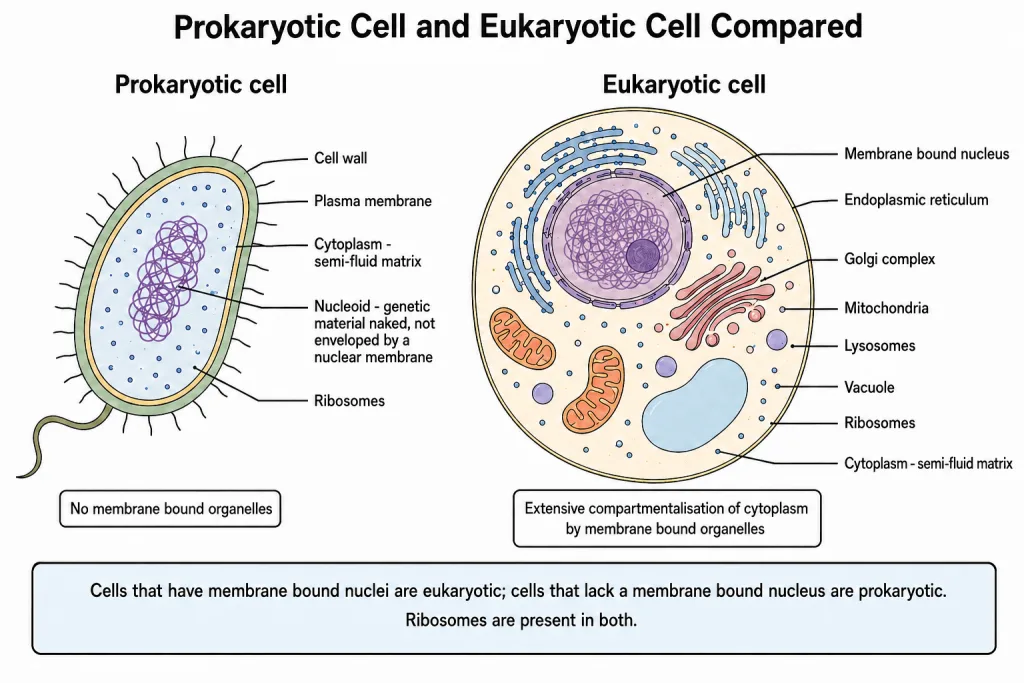
| Feature | Prokaryotic cell | Eukaryotic cell |
|---|---|---|
| Nucleus | No membrane bound nucleus | Membrane bound nucleus present |
| Membrane bound organelles | Absent | Present - ER, golgi complex, lysosomes, mitochondria, microbodies, vacuoles |
| Ribosomes | Present | Present |
| Cytoplasm | Present - semi-fluid matrix | Present - semi-fluid matrix |
| Centrosome | Absent | Present in animal cells |
[NEET Important] The sentence that decides several questions is "No organelles, like the ones in eukaryotes, are found in prokaryotic cells except for ribosomes." Learn it with the exception attached, because "prokaryotes have no organelles at all" is the wrong option that looks right.
Cells Differ Greatly in Size, Shape and Activity
Cells differ greatly in size, shape and activities.
Size.
- Mycoplasmas, the smallest cells, are only 0.3 micrometre in length.
- Bacteria could be 3 to 5 micrometre.
- The largest isolated single cell is the egg of an ostrich.
- Among multicellular organisms, human red blood cells are about 7.0 micrometre in diameter.
- Nerve cells are some of the longest cells.
Shape. Cells may be disc-like, polygonal, columnar, cuboid, thread like, or even irregular, and the shape of the cell may vary with the function they perform.
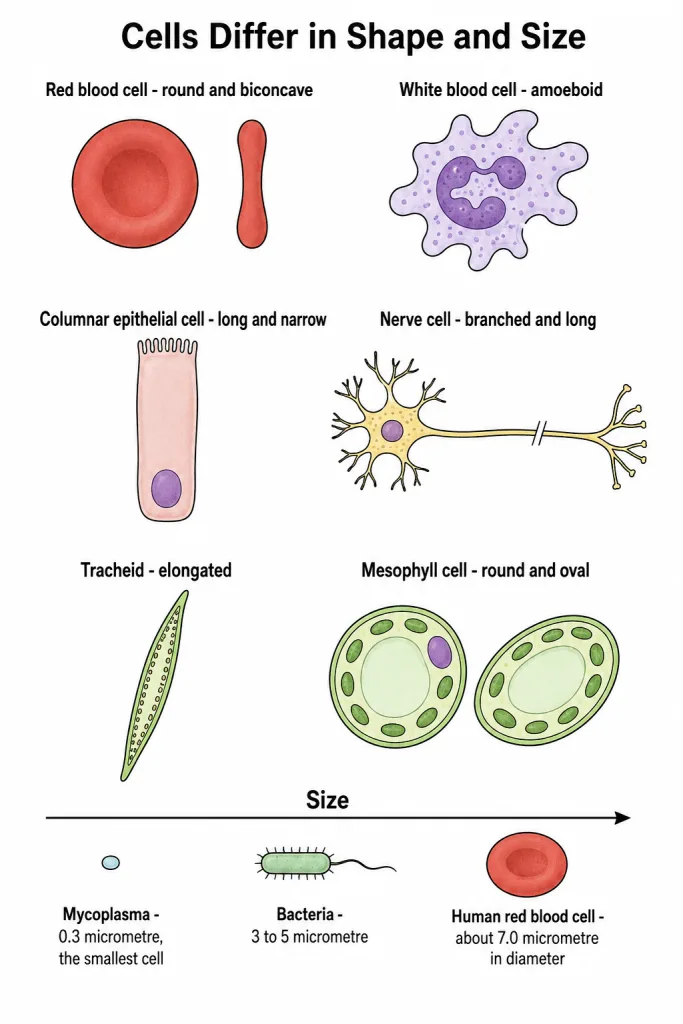
| Cell | Shape, and what it tells you |
|---|---|
| Red blood cell | Round and biconcave; about 7.0 micrometre across |
| White blood cell | Amoeboid - it changes shape to move |
| Columnar epithelial cell | Long and narrow |
| Nerve cell | Branched and long - among the longest cells |
| Tracheid | Elongated |
| Mesophyll cell | Round and oval |
[NEET Important] Three of these are asked as bare facts and are worth memorising as a set: the smallest cell is Mycoplasma at 0.3 micrometre, the largest isolated single cell is the ostrich egg, and the longest cells are nerve cells. Note the wording carefully - the ostrich egg is the largest isolated single cell, which is not the same claim as "the largest cell in any organism".
Quick Recap
- A plant cell has a distinct cell wall as its outer boundary, with the cell membrane just within it. An animal cell has only the outer membrane as its delimiting structure.
- The nucleus is a dense membrane bound structure containing the chromosomes, which contain DNA.
- Eukaryotic = membrane bound nucleus present. Prokaryotic = membrane bound nucleus absent.
- Cytoplasm, a semi-fluid matrix, occupies the volume of both kinds of cell and is the main arena of cellular activities.
- Eukaryotic organelles: ER, golgi complex, lysosomes, mitochondria, microbodies, vacuoles. Prokaryotes lack them.
- Ribosomes are non-membrane bound and are found in all cells; in eukaryotes they occur in the cytoplasm, in chloroplasts and mitochondria, and on rough ER.
- The centrosome is a non-membrane bound organelle of animal cells and helps in cell division.
- Smallest cell - Mycoplasma, 0.3 micrometre. Bacteria - 3 to 5 micrometre. Human RBC - about 7.0 micrometre. Largest isolated single cell - the ostrich egg. Longest cells - nerve cells.
- Shapes: disc-like, polygonal, columnar, cuboid, thread like or irregular; shape may vary with the function performed.
Solved Examples
Question 1
Q. What separates a eukaryotic cell from a prokaryotic one?
Answer. Cells that have membrane bound nuclei are eukaryotic; cells that lack a membrane bound nucleus are prokaryotic. Note the exact wording - a prokaryote does have genetic material, but no membrane around it.
Question 2
Q. Compare the outer boundary of an onion cell with that of a human cheek cell.
Answer. The onion cell, a typical plant cell, has a distinct cell wall as its outer boundary and just within it the cell membrane. The human cheek cell has only an outer membrane as the delimiting structure of the cell - no cell wall.
Question 3
Q. What is cytoplasm and what happens in it?
Answer. It is the semi-fluid matrix that occupies the volume of the cell, present in both prokaryotic and eukaryotic cells. It is the main arena of cellular activities, and various chemical reactions occur in it to keep the cell in the living state.
Question 4
Q. Name the membrane bound organelles of a eukaryotic cell.
Answer. The endoplasmic reticulum (ER), the golgi complex, lysosomes, mitochondria, microbodies and vacuoles. Prokaryotic cells lack all of these.
Question 5
Q. Which of the following is correct: cells of all living organisms have a nucleus; both animal and plant cells have a well defined cell wall; in prokaryotes there are no membrane bound organelles; cells are formed de novo from abiotic materials? This is one of the chapter-end exercises.
Answer. The correct statement is "In prokaryotes, there are no membrane bound organelles."
The other three fail for specific reasons. Not all cells have a nucleus - prokaryotes have no membrane bound nucleus, and some mature cells such as mammalian erythrocytes lack one too. Of animal and plant cells, only the plant cell has a well defined cell wall. And cells are never formed de novo from abiotic materials - all cells arise from pre-existing cells.
Question 6
Q. Which organelle is found in every cell, prokaryotic and eukaryotic alike?
Answer. The ribosome. It is non-membrane bound, which is why prokaryotes can have it even though they lack membrane bound organelles.
Question 7
Q. Where are ribosomes found within a eukaryotic cell?
Answer. In the cytoplasm, inside chloroplasts (in plants) and mitochondria, and on rough ER.
Question 8
Q. Name a non-membrane bound organelle found in animal cells and give its function.
Answer. The centrosome. It helps in cell division.
Question 9
Q. Give the size of the smallest cell, of bacteria, and of a human red blood cell.
Answer. Mycoplasmas, the smallest cells, are only 0.3 micrometre in length. Bacteria could be 3 to 5 micrometre. Human red blood cells are about 7.0 micrometre in diameter.
Question 10
Q. Which is the largest isolated single cell, and which are among the longest cells?
Answer. The largest isolated single cell is the egg of an ostrich. Nerve cells are some of the longest cells.
Question 11
Q. Multicellular organisms have division of labour. Explain. This is one of the chapter-end exercises.
Answer. Division of labour means that different cells of the body do different jobs instead of every cell doing everything.
A unicellular organism has no choice - it carries out all its life activities within a single cell. A multicellular organism can afford to specialise: some cells carry oxygen, some conduct impulses, some make food, some give support.
Specialising changes the cell's shape, which is why cells differ greatly in size, shape and activities and why the shape of the cell may vary with the function they perform. Red blood cells are round and biconcave for carrying gases, nerve cells are branched and long for conducting impulses over distance, columnar epithelial cells are long and narrow for lining and absorbing, and a tracheid is elongated for conducting water.
The gain is efficiency - each type of cell does one job well - and the price is dependence, since no single cell of the body can now survive on its own. Cells organise into tissues, tissues into organs and organs into organ systems, and the division of labour runs right up that ladder.
Question 12
Q. Name three cell shapes and one cell of each shape.
Answer. Round and biconcave - the red blood cell. Branched and long - the nerve cell. Long and narrow - the columnar epithelial cell. Cells may also be polygonal, cuboid, thread like or irregular.