
Lysosomes - Bags of Digestive Enzymes
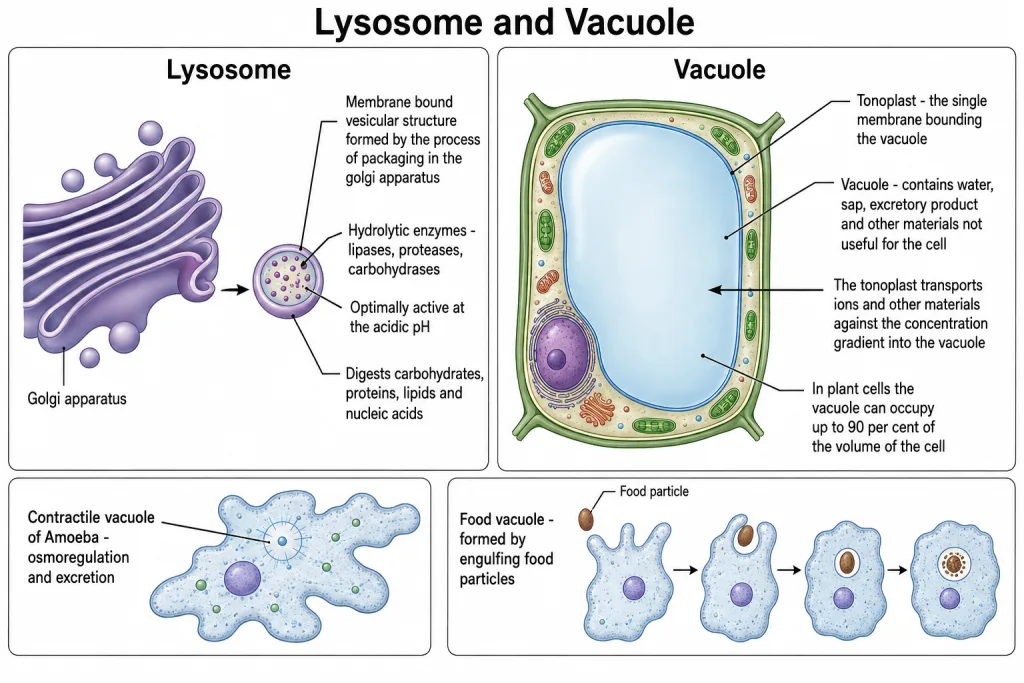
Lysosomes are membrane bound vesicular structures formed by the process of packaging in the golgi apparatus. Read that sentence as an address as much as a definition. A lysosome is a vesicle, it is bound by a membrane, and it is made by the golgi apparatus - by the very same packaging work that wraps other materials into vesicles.
The isolated lysosomal vesicles have been found to be very rich in almost all types of hydrolytic enzymes. These enzymes are the hydrolases, and three groups are named:
| Hydrolase | What it acts on |
|---|---|
| Lipases | Lipids |
| Proteases | Proteins |
| Carbohydrases | Carbohydrates |
All of them are optimally active at the acidic pH.
These enzymes are capable of digesting carbohydrates, proteins, lipids and nucleic acids - that is, all four classes of large biomolecules. Notice that nucleic acids are digested too, even though no "nucleases" appear in the list of named groups.
[NEET Important] Two words carry the marks here. The enzymes are hydrolytic, called hydrolases, and they are optimally active at the acidic pH - "alkaline pH" and "neutral pH" are the standard wrong options. Fix the origin as well: a lysosome is formed by packaging in the golgi apparatus, not by the ER and not by the mitochondrion.
The Vacuole and Its Tonoplast
The vacuole is the membrane-bound space found in the cytoplasm. It contains water, sap, excretory product and other materials not useful for the cell - so it is a store, and part of what it stores is waste the cell has no use for.
The vacuole is bound by a single membrane called the tonoplast. Count that membrane - one. That single number is what separates the vacuole from the mitochondrion and the chloroplast, which are double membrane bound.
In plant cells the vacuoles can occupy up to 90 per cent of the volume of the cell. This is why a mature plant cell looks almost empty under the microscope, with the cytoplasm and the nucleus pushed against the wall by one huge central vacuole.
| Feature | Lysosome | Vacuole |
|---|---|---|
| What it is | Membrane bound vesicular structure | Membrane-bound space in the cytoplasm |
| How it arises | By the process of packaging in the golgi apparatus | A space bound by the tonoplast |
| Its membrane | Membrane bound | A single membrane called the tonoplast |
| What is inside | Hydrolytic enzymes - lipases, proteases, carbohydrases, active at acidic pH | Water, sap, excretory product and other materials not useful for the cell |
| What it does | Digests carbohydrates, proteins, lipids and nucleic acids | Stores materials; the tonoplast pumps ions and materials in against the gradient |
| Size in a plant cell | Small vesicle | Up to 90 per cent of the volume of the cell |
[NEET Important] The name tonoplast and the figure 90 per cent are the two most asked facts of this whole subsection. Keep them attached to the right cell - the 90 per cent claim is made for plant cells, not for animal cells.
Transport into the Vacuole, and Vacuoles with a Special Job
In plants, the tonoplast facilitates the transport of a number of ions and other materials against concentration gradients into the vacuole. Two details in that line decide questions: the direction is into the vacuole, and the movement is against concentration gradients, not down them.
The result follows straight from it - their concentration is significantly higher in the vacuole than in the cytoplasm. The vacuole can therefore go on collecting a substance long after the cytoplasm has more of it than the outside.
Two vacuoles are named after the job they do.
- In Amoeba, the contractile vacuole is important for osmoregulation and excretion. It handles both - the water balance of the cell and the throwing out of wastes.
- In many cells, as in protists, food vacuoles are formed by engulfing the food particles. The cell wraps a membrane around the particle it has taken in, and that wrapped particle becomes the food vacuole.
[NEET Important] "Against concentration gradients into the vacuole" is the phrase to reproduce word for word - an option saying the tonoplast moves materials along the gradient is the built-in trap. And the contractile vacuole of Amoeba is for osmoregulation and excretion; an option offering only one of the two is incomplete.
Quick Recap
- Lysosomes are membrane bound vesicular structures formed by the process of packaging in the golgi apparatus.
- Isolated lysosomal vesicles are very rich in almost all types of hydrolytic enzymes - the hydrolases.
- The named hydrolases are lipases, proteases and carbohydrases, and all are optimally active at the acidic pH.
- Lysosomal enzymes can digest carbohydrates, proteins, lipids and nucleic acids.
- The vacuole is the membrane-bound space found in the cytoplasm.
- It contains water, sap, excretory product and other materials not useful for the cell.
- The vacuole is bound by a single membrane called the tonoplast.
- In plant cells the vacuoles can occupy up to 90 per cent of the volume of the cell.
- In plants the tonoplast facilitates the transport of a number of ions and other materials against concentration gradients into the vacuole, so their concentration is significantly higher in the vacuole than in the cytoplasm.
- In Amoeba the contractile vacuole is important for osmoregulation and excretion.
- In many cells, as in protists, food vacuoles are formed by engulfing the food particles.
Solved Examples
Question 1
Q. What are lysosomes and how are they formed?
Answer. They are membrane bound vesicular structures. They are formed by the process of packaging in the golgi apparatus - the golgi wraps material into a vesicle, and that vesicle is the lysosome.
Question 2
Q. What were isolated lysosomal vesicles found to contain?
Answer. They were found to be very rich in almost all types of hydrolytic enzymes, that is the hydrolases - lipases, proteases and carbohydrases.
Question 3
Q. At what pH are lysosomal enzymes optimally active?
Answer. At the acidic pH. This is why they are described as hydrolases optimally active at the acidic pH, and it is the detail most often replaced by "alkaline" in a wrong option.
Question 4
Q. Which biomolecules can lysosomal enzymes digest?
Answer. Carbohydrates, proteins, lipids and nucleic acids - all four classes of large biomolecules.
Question 5
Q. Define a vacuole and state what it contains.
Answer. The vacuole is the membrane-bound space found in the cytoplasm. It contains water, sap, excretory product and other materials not useful for the cell.
Question 6
Q. Name the membrane of the vacuole and say how many membranes bound it.
Answer. The vacuole is bound by a single membrane called the tonoplast. So the count is one membrane, unlike the mitochondrion and the chloroplast, which are double membrane bound.
Question 7
Q. How much of a plant cell can the vacuole occupy?
Answer. In plant cells the vacuoles can occupy up to 90 per cent of the volume of the cell.
Question 8
Q. How does the tonoplast make the vacuole a concentrated store?
Answer. In plants the tonoplast facilitates the transport of a number of ions and other materials against concentration gradients into the vacuole. Since the movement is against the gradient and inwards, their concentration is significantly higher in the vacuole than in the cytoplasm.
Question 9
Q. What is the contractile vacuole and what does it do?
Answer. In Amoeba, the contractile vacuole is important for osmoregulation and excretion. It looks after both the water balance of the cell and the removal of wastes.
Question 10
Q. What are food vacuoles and how are they formed?
Answer. In many cells, as in protists, food vacuoles are formed by engulfing the food particles. The cell takes the particle in and encloses it in a membrane, and that enclosed particle is the food vacuole.
Question 11
Q. Both lysosomes and vacuoles are endomembrane structures, yet they differ in terms of their functions. Comment. This is one of the chapter-end exercises.
Answer. They are alike in where they come from and how they are built, and different in what they are for.
What makes both of them endomembrane structures. Both are membrane bound compartments of the cytoplasm whose membranes are made and maintained by the same coordinated system of membranes as the ER and the golgi. The lysosome is the clearer case - it is formed by the process of packaging in the golgi apparatus, so it is a golgi product in the strict sense.
How their functions differ.
- The lysosome is a digestive organelle. It is very rich in almost all types of hydrolytic enzymes - hydrolases such as lipases, proteases and carbohydrases - optimally active at the acidic pH, and these enzymes are capable of digesting carbohydrates, proteins, lipids and nucleic acids. Its job is to break large molecules down.
- The vacuole is a storage compartment. It is the membrane-bound space found in the cytoplasm and it contains water, sap, excretory product and other materials not useful for the cell. Its job is to hold materials, not to break them down.
Two more differences follow from that. The vacuole is bound by a single membrane called the tonoplast, and in plant cells it can occupy up to 90 per cent of the volume of the cell, a size no lysosome reaches. And the tonoplast facilitates the transport of a number of ions and other materials against concentration gradients into the vacuole, so their concentration is significantly higher in the vacuole than in the cytoplasm - the vacuole actively concentrates what it stores.
Vacuoles can also take on special jobs: in Amoeba the contractile vacuole is important for osmoregulation and excretion, and in many cells, as in protists, food vacuoles are formed by engulfing the food particles. The lysosome has only the one job - digestion.
Question 12
Q. Why does a mature plant cell look almost empty under the microscope?
Answer. Because the vacuole can occupy up to 90 per cent of the volume of the cell. The cytoplasm and the nucleus are pushed to the edge by that one large central vacuole, leaving the middle looking empty.
Question 13
Q. A student writes that the tonoplast moves ions out of the vacuole along the concentration gradient. Correct the statement.
Answer. The direction is the opposite on both counts. The tonoplast facilitates the transport of a number of ions and other materials against concentration gradients into the vacuole. That is exactly why their concentration is significantly higher in the vacuole than in the cytoplasm.