
The Mesosome
A special membranous structure is the mesosome, which is formed by the extensions of plasma membrane into the cell. These extensions are in the form of vesicles, tubules and lamellae.
Two things make the mesosome examinable. It is a specialised differentiated form of cell membrane, and it is the characteristic of prokaryotes - no eukaryotic cell has one.
What the mesosome does:
- Helps in cell wall formation.
- Helps in DNA replication and distribution to daughter cells.
- Helps in respiration.
- Helps in secretion processes.
- Increases the surface area of the plasma membrane and its enzymatic content.
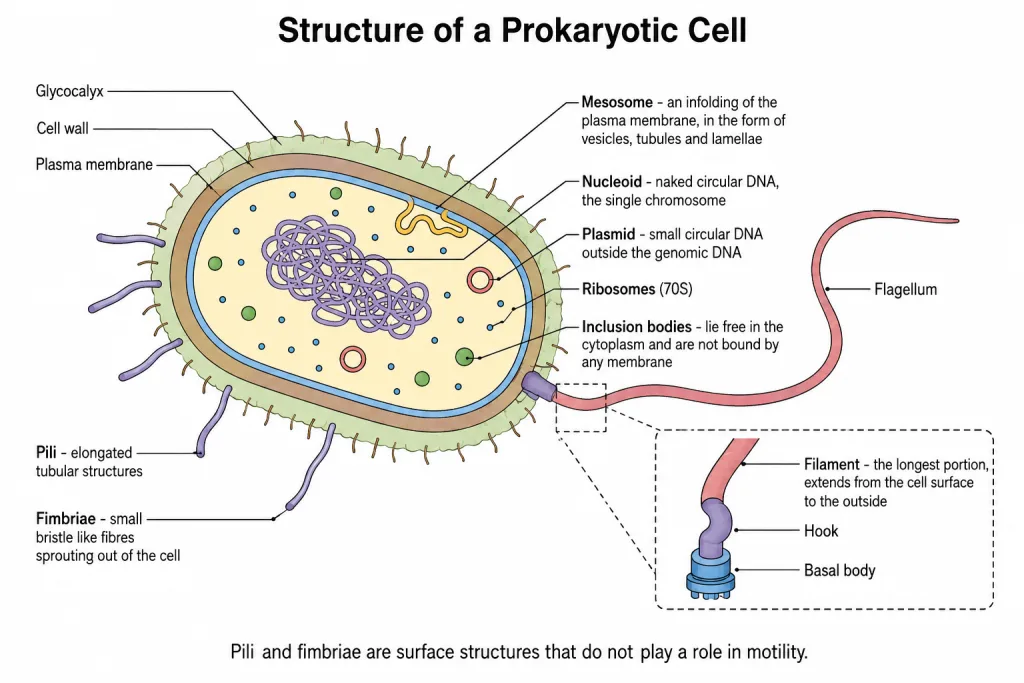
In some prokaryotes like cyanobacteria, there are other membranous extensions into the cytoplasm called chromatophores which contain pigments.
[NEET Important] The five functions are asked as a "which is NOT a function" item, so learn the list as a block. The commonest wrong option is protein synthesis, which belongs to the ribosome, not the mesosome. Keep the second membranous extension separate as well: mesosome in bacteria generally, chromatophores with pigments in cyanobacteria.
Flagella, Pili and Fimbriae
Bacterial cells may be motile or non-motile. If motile, they have thin filamentous extensions from their cell wall called flagella. Bacteria show a range in the number and arrangement of flagella.
Bacterial flagellum is composed of three parts - filament, hook and basal body. The filament is the longest portion and extends from the cell surface to the outside.
Besides flagella, pili and fimbriae are also surface structures of the bacteria but do not play a role in motility.
| Surface structure | What it is | Role in movement |
|---|---|---|
| Flagella | Thin filamentous extensions from the cell wall, made of filament, hook and basal body | The organ of motility |
| Pili | Elongated tubular structures made of a special protein | No role in motility |
| Fimbriae | Small bristle like fibres sprouting out of the cell; in some bacteria they help attach the bacteria to rocks in streams and also to the host tissues | No role in motility |
[NEET Important] The single most repeated trap in this section is treating pili and fimbriae as organs of movement. They are surface structures that do not play a role in motility. The other guaranteed one-liner is the three parts of the flagellum in order - filament, hook, basal body - with the filament the longest portion, extending from the cell surface to the outside.
Ribosomes and Polysomes
In prokaryotes, ribosomes are associated with the plasma membrane of the cell.
- They are about 15 nanometre by 20 nanometre in size.
- They are made of two subunits - 50S and 30S units, which when present together form 70S prokaryotic ribosomes.
- Ribosomes are the site of protein synthesis.
Several ribosomes may attach to a single mRNA and form a chain called polyribosomes or polysome. The ribosomes of a polysome translate the mRNA into proteins.
[NEET Important] The numbers must be exact. 50S plus 30S gives 70S, and that arithmetic looking wrong is deliberate - the S values are sedimentation coefficients, not masses, so they do not simply add up. 70S is prokaryotic; the eukaryotic figure you meet later in the chapter is different, and mixing the two is the standard error. Size: about 15 nanometre by 20 nanometre.
Inclusion Bodies
Reserve material in prokaryotic cells are stored in the cytoplasm in the form of inclusion bodies.
These are not bound by any membrane system and lie free in the cytoplasm. Examples:
- Phosphate granules.
- Cyanophycean granules.
- Glycogen granules.
Gas vacuoles are found in blue green and purple and green photosynthetic bacteria.
[NEET Important] Read the definition twice - inclusion bodies are not bound by any membrane system and lie free in the cytoplasm. Any option that gives them a single or double membrane is wrong, and that is exactly how the question is framed. Learn the three named examples together, and keep gas vacuoles attached to blue green and purple and green photosynthetic bacteria.
Quick Recap
- A specialised differentiated form of cell membrane called mesosome is the characteristic of prokaryotes.
- The mesosome is formed by the extensions of plasma membrane into the cell, in the form of vesicles, tubules and lamellae.
- Mesosome functions: cell wall formation; DNA replication and distribution to daughter cells; respiration; secretion processes; increasing the surface area of the plasma membrane and its enzymatic content.
- In some prokaryotes like cyanobacteria there are other membranous extensions into the cytoplasm called chromatophores, which contain pigments.
- Bacterial cells may be motile or non-motile. Motile ones have thin filamentous extensions from their cell wall called flagella, and bacteria show a range in the number and arrangement of flagella.
- Bacterial flagellum has three parts - filament, hook and basal body. The filament is the longest portion and extends from the cell surface to the outside.
- Pili and fimbriae are surface structures of bacteria but do not play a role in motility.
- Pili - elongated tubular structures made of a special protein.
- Fimbriae - small bristle like fibres sprouting out of the cell; in some bacteria they help attach the bacteria to rocks in streams and to the host tissues.
- In prokaryotes, ribosomes are associated with the plasma membrane, are about 15 nanometre by 20 nanometre, and are made of a 50S and a 30S subunit, which together form 70S prokaryotic ribosomes.
- Ribosomes are the site of protein synthesis.
- Several ribosomes attached to a single mRNA form a chain called polyribosomes or polysome, and the ribosomes of a polysome translate the mRNA into proteins.
- Inclusion bodies store reserve material in the cytoplasm, are not bound by any membrane system and lie free in the cytoplasm - phosphate granules, cyanophycean granules and glycogen granules.
- Gas vacuoles are found in blue green and purple and green photosynthetic bacteria.
Solved Examples
Question 1
Q. What is a mesosome in a prokaryotic cell? Mention the functions that it performs. This is one of the chapter-end exercises.
Answer. The mesosome is a special membranous structure formed by the extensions of the plasma membrane into the cell. Put simply, the cell membrane folds inwards and those infoldings make the mesosome, which is why it is called a specialised differentiated form of cell membrane and why it is the characteristic of prokaryotes - eukaryotic cells do not have one.
These extensions are in the form of vesicles, tubules and lamellae.
The functions it performs:
- It helps in cell wall formation.
- It helps in DNA replication and in the distribution of the DNA to daughter cells.
- It helps in respiration.
- It helps in secretion processes.
- It increases the surface area of the plasma membrane and its enzymatic content.
More surface with more enzymes packed on it is really the theme running through the whole list - a bacterium has no membrane bound organelles, so it gets the extra working membrane it needs by folding the one membrane it has.
Question 2
Q. What are chromatophores and where are they found?
Answer. In some prokaryotes like cyanobacteria, there are other membranous extensions into the cytoplasm called chromatophores, which contain pigments. Like the mesosome, they are extensions of the membrane into the cytoplasm, but the point of them is the pigment they carry.
Question 3
Q. What are flagella, and which bacteria have them?
Answer. Bacterial cells may be motile or non-motile. If motile, they have thin filamentous extensions from their cell wall called flagella. Bacteria show a range in the number and arrangement of flagella.
Question 4
Q. Name the three parts of a bacterial flagellum and say which is the longest.
Answer. Filament, hook and basal body. The filament is the longest portion and extends from the cell surface to the outside.
Question 5
Q. How do pili differ from fimbriae, and does either help the bacterium move?
Answer. Neither helps in movement. Besides flagella, pili and fimbriae are also surface structures of the bacteria but do not play a role in motility.
The pili are elongated tubular structures made of a special protein. The fimbriae are small bristle like fibres sprouting out of the cell, and in some bacteria they are known to help attach the bacteria to rocks in streams and also to the host tissues.
Question 6
Q. Where are ribosomes found in a prokaryotic cell, and how big are they?
Answer. In prokaryotes, ribosomes are associated with the plasma membrane of the cell. They are about 15 nanometre by 20 nanometre in size.
Question 7
Q. Which subunits make up the prokaryotic ribosome, and what is the whole ribosome called?
Answer. They are made of two subunits - 50S and 30S units, which when present together form 70S prokaryotic ribosomes.
Question 8
Q. What is the function of ribosomes?
Answer. Ribosomes are the site of protein synthesis.
Question 9
Q. What is a polysome?
Answer. Several ribosomes may attach to a single mRNA and form a chain called polyribosomes or polysome. The ribosomes of a polysome translate the mRNA into proteins.
Question 10
Q. What are inclusion bodies? Give three examples.
Answer. Reserve material in prokaryotic cells are stored in the cytoplasm in the form of inclusion bodies. These are not bound by any membrane system and lie free in the cytoplasm. Examples are phosphate granules, cyanophycean granules and glycogen granules.
Question 11
Q. Where are gas vacuoles found?
Answer. Gas vacuoles are found in blue green and purple and green photosynthetic bacteria.
Question 12
Q. How does a bacterium increase the surface area of its plasma membrane and its enzymatic content?
Answer. By forming a mesosome. Since the extensions of the plasma membrane into the cell are folded into vesicles, tubules and lamellae, a great deal of membrane is packed into a small volume, and with it the enzymes carried on that membrane.
Question 13
Q. What are the characteristics of prokaryotic cells? This is one of the chapter-end exercises.
Answer. Take the characteristics group by group.
Who they are and how big they are. The prokaryotic cells are represented by bacteria, blue-green algae, mycoplasma and PPLO (Pleuro Pneumonia Like Organisms). They are generally smaller and multiply more rapidly than the eukaryotic cells, and they may vary greatly in shape and size. The four basic shapes of bacteria are bacillus (rod like), coccus (spherical), vibrio (comma shaped) and spirillum (spiral), yet the organisation of the prokaryotic cell is fundamentally similar throughout.
The boundary. All prokaryotes have a cell wall surrounding the cell membrane except in mycoplasma. The cell envelope is a tightly bound three layered structure - the outermost glycocalyx, followed by the cell wall and then the plasma membrane - and although each layer performs a distinct function, they act together as a single protective unit. The glycocalyx may be a loose slime layer or a thick tough capsule, and the response of the envelope to the staining procedure developed by Gram separates Gram positive from Gram negative bacteria.
The genetic material. There is no well-defined nucleus. The genetic material is basically naked, not enveloped by a nuclear membrane. The genomic DNA is the single chromosome, which is circular DNA, and in addition many bacteria carry plasmids - small circular DNA outside the genomic DNA - which confer unique phenotypic characters such as resistance to antibiotics.
What is inside. The semi-fluid matrix filling the cell is the cytoplasm. No organelles, like the ones in eukaryotes, are found in prokaryotic cells except for ribosomes, and these ribosomes are 70S, made of 50S and 30S subunits, and are the site of protein synthesis. A specialised differentiated form of cell membrane called mesosome is the characteristic of prokaryotes, and in cyanobacteria there are also chromatophores containing pigments. Reserve material is stored as inclusion bodies, which are not bound by any membrane system and lie free in the cytoplasm.
On the surface. Motile bacteria have flagella - thin filamentous extensions from the cell wall, made of filament, hook and basal body. Pili and fimbriae are also surface structures but do not play a role in motility.