
Ribosomes - RNA, Protein, and No Membrane
Ribosomes are the granular structures first observed under the electron microscope as dense particles by George Palade (1953).
Two lines carry almost every question asked about what a ribosome is:
- They are composed of ribonucleic acid (RNA) and proteins.
- They are not surrounded by any membrane.
That second line is why the ribosome keeps appearing in lists of exceptions. It is an organelle, it is present in every cell, prokaryotic and eukaryotic alike, and yet it is non-membrane bound.
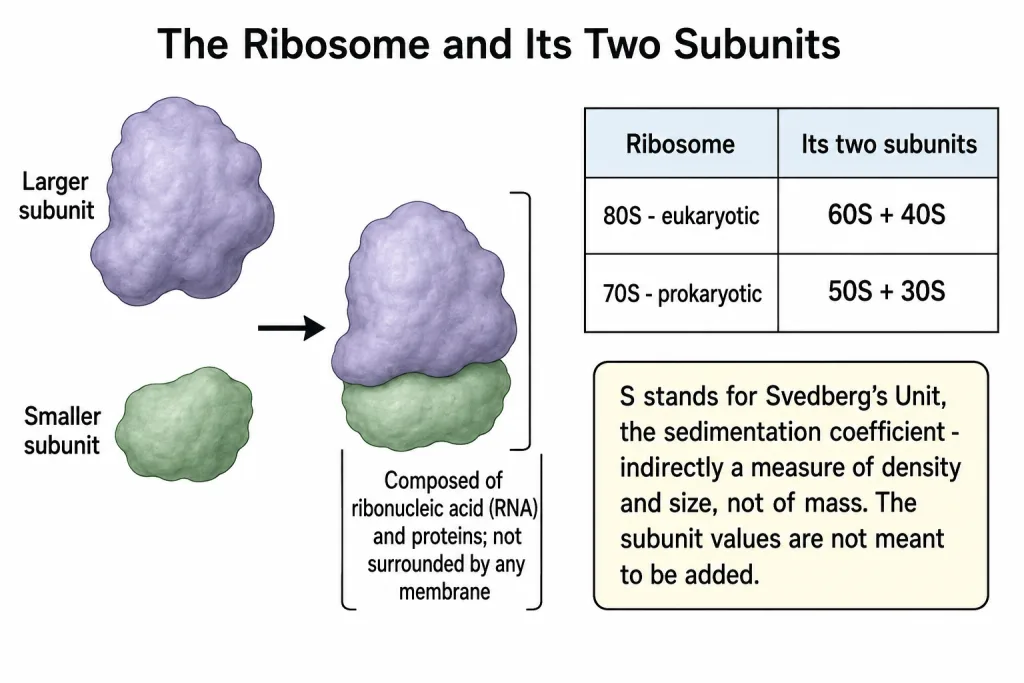
The eukaryotic ribosomes are 80S while the prokaryotic ribosomes are 70S. Each ribosome has two subunits, a larger and a smaller subunit, and both 70S and 80S ribosomes are composed of two subunits.
| Ribosome | Where it is found | Larger subunit | Smaller subunit |
|---|---|---|---|
| 80S | Eukaryotic cells | 60S | 40S |
| 70S | Prokaryotic cells | 50S | 30S |
Here "S" (Svedberg's Unit) stands for the sedimentation coefficient; it is indirectly a measure of density and size.
Now read the table once more. 60 and 40 do not add up to 80. 50 and 30 do not add up to 70. That is not a printing error. S is a sedimentation coefficient - a measure of how fast a particle settles when it is spun in a centrifuge - and it is not a mass. Two subunits joined together settle as one heavier but also differently shaped particle, so the S values of the subunits are simply not meant to be added.
[NEET Important] Fix the four subunit numbers as two pairs and never mix them: 80S goes with 60S and 40S, 70S goes with 50S and 30S. The favourite distractor pairs the eukaryotic total with prokaryotic subunits, for example "80S = 50S + 30S". Also remember that S measures density and size, not mass, which is exactly why the arithmetic does not work.
The Cytoskeleton
An elaborate network of filamentous proteinaceous structures consisting of microtubules, microfilaments and intermediate filaments present in the cytoplasm is collectively referred to as the cytoskeleton.
Take that definition apart, because each phrase in it is examinable.
- Filamentous and proteinaceous - it is made of protein threads, not of membrane and not of carbohydrate.
- Three components - microtubules, microfilaments and intermediate filaments.
- Present in the cytoplasm - it is a cytoplasmic network, not a nuclear or a wall structure.
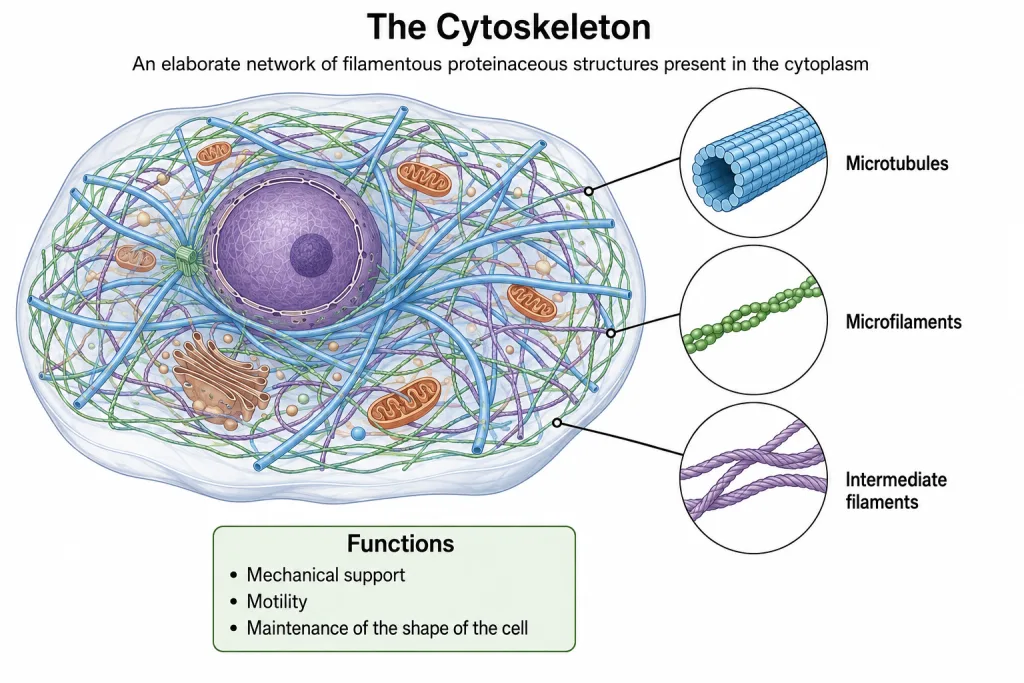
The cytoskeleton in a cell is involved in many functions such as mechanical support, motility and maintenance of the shape of the cell.
| Function | What it means for the cell |
|---|---|
| Mechanical support | Holds the cell and its contents in place, like a framework |
| Motility | Allows movement - of the cell itself and of things inside it |
| Maintenance of the shape of the cell | Keeps the cell in its characteristic shape |
[NEET Important] The name says skeleton but the material is protein, not bone and not cellulose - a cell wall gives a plant cell its rigidity, the cytoskeleton is something else entirely. Learn the three components as a set, since a question that swaps in "microvilli" or "microbodies" for intermediate filaments looks convincing at a glance.
Microbodies
Many membrane bound minute vesicles called microbodies, that contain various enzymes, are present in both plant and animal cells.
That single sentence carries three separate facts, and each one has been asked on its own:
- Microbodies are membrane bound - unlike the ribosome, they do have a membrane around them.
- They are minute vesicles that contain various enzymes.
- They are present in both plant and animal cells - not in one kind only.
One warning that is easy to miss. Microbodies are not part of the endomembrane system. The endomembrane system takes in only the endoplasmic reticulum (ER), the golgi complex, lysosomes and vacuoles, because the functions of those four are coordinated. A microbody is membrane bound but works separately, so it stays outside that list - and so do mitochondria and chloroplasts.
| Structure | Membrane bound? | Part of the endomembrane system? |
|---|---|---|
| ER, golgi complex, lysosomes, vacuoles | Yes | Yes |
| Microbodies | Yes | No |
| Mitochondria and chloroplasts | Yes | No |
| Ribosomes | No | No |
[NEET Important] The trap here is built on a true half-statement. Being membrane bound does not make an organelle part of the endomembrane system. If a question lists ER, golgi complex, lysosome and microbody and asks which one does not belong, the answer is the microbody.
Quick Recap
- Ribosomes were first observed under the electron microscope as dense particles by George Palade in 1953.
- Ribosomes are composed of ribonucleic acid (RNA) and proteins and are not surrounded by any membrane.
- Eukaryotic ribosomes are 80S; prokaryotic ribosomes are 70S.
- Each ribosome has two subunits, a larger and a smaller one. 80S = 60S + 40S. 70S = 50S + 30S.
- "S" is Svedberg's Unit, the sedimentation coefficient, and it is indirectly a measure of density and size.
- The subunit values do not add up arithmetically because S is a sedimentation coefficient, not a mass.
- The cytoskeleton is an elaborate network of filamentous proteinaceous structures in the cytoplasm.
- Its three components are microtubules, microfilaments and intermediate filaments.
- Cytoskeletal functions: mechanical support, motility and maintenance of the shape of the cell.
- Microbodies are many membrane bound minute vesicles containing various enzymes.
- Microbodies are present in both plant and animal cells.
- Microbodies are membrane bound but are NOT part of the endomembrane system, which covers only ER, golgi complex, lysosomes and vacuoles.
Solved Examples
Question 1
Q. Who first observed ribosomes, how, and in which year?
Answer. George Palade, in 1953. He saw them under the electron microscope as dense particles, which is why ribosomes are described as granular structures.
Question 2
Q. What are ribosomes made of, and are they surrounded by a membrane?
Answer. They are composed of ribonucleic acid (RNA) and proteins. They are not surrounded by any membrane - they are non-membrane bound organelles.
Question 3
Q. Give the sedimentation values of eukaryotic and prokaryotic ribosomes.
Answer. The eukaryotic ribosomes are 80S while the prokaryotic ribosomes are 70S.
Question 4
Q. Name the two subunits of an 80S ribosome and of a 70S ribosome.
Answer. Each ribosome has two subunits, a larger and a smaller one. The two subunits of 80S ribosomes are 60S and 40S, while those of 70S ribosomes are 50S and 30S.
Question 5
Q. What does the letter S stand for in 70S and 80S, and what does it measure?
Answer. "S" stands for Svedberg's Unit, the sedimentation coefficient. It is indirectly a measure of density and size.
Question 6
Q. A 70S ribosome is made of a 50S and a 30S subunit. Why is the whole not 80S?
Answer. Because S is a sedimentation coefficient and not a mass. It tells you how fast a particle settles when it is spun, which depends on density and size together. When the two subunits join, the combined particle settles at a rate of its own, so the two S values cannot simply be added. The same applies to 80S, which is made of 60S and 40S.
Question 7
Q. Prokaryotic cells have no membrane bound organelles. How then can they have ribosomes?
Answer. Because a ribosome is not surrounded by any membrane. It is a non-membrane bound organelle, so the rule about prokaryotes lacking membrane bound organelles does not exclude it. Ribosomes are found in all cells, prokaryotic as well as eukaryotic.
Question 8
Q. Define the cytoskeleton.
Answer. It is an elaborate network of filamentous proteinaceous structures present in the cytoplasm, made up of microtubules, microfilaments and intermediate filaments, and taken together they are collectively referred to as the cytoskeleton.
Question 9
Q. Name the three kinds of structure that make up the cytoskeleton.
Answer. Microtubules, microfilaments and intermediate filaments.
Question 10
Q. State three functions of the cytoskeleton.
Answer. Mechanical support, motility, and maintenance of the shape of the cell.
Question 11
Q. Is the cytoskeleton the same thing as a cell wall? Explain.
Answer. No. The cell wall is an outer boundary of plant cells made of carbohydrate material, whereas the cytoskeleton is an internal network of protein filaments lying in the cytoplasm. The cytoskeleton gives support, motility and shape from inside the cell, and it is present in animal cells too, which have no cell wall at all.
Question 12
Q. What are microbodies?
Answer. They are many membrane bound minute vesicles that contain various enzymes. They are present in both plant and animal cells.
Question 13
Q. Are microbodies a part of the endomembrane system? Give a reason.
Answer. No. The endomembrane system includes only the endoplasmic reticulum (ER), the golgi complex, lysosomes and vacuoles, because the functions of those four are coordinated with one another. A microbody is membrane bound but functions separately, so it is left out - just as mitochondria and chloroplasts are left out. Being membrane bound is not enough to belong to the endomembrane system.