
Plastids and Their Three Types
Plastids are found in all plant cells and in euglenoides. That second word matters - euglenoides are the one group of protists carrying plastids, so "plants only" is not a safe answer.
These are easily observed under the microscope as they are large. Compare that with the mitochondrion, which is not easily visible unless specifically stained - the two organelles behave in opposite ways on the slide.
They bear some specific pigments, thus imparting specific colours to the plants. Based on the type of pigments, plastids can be classified into chloroplasts, chromoplasts and leucoplasts.
| Plastid | Pigments it carries | Colour and role |
|---|---|---|
| Chloroplast | Chlorophyll and carotenoid pigments | Responsible for trapping light energy essential for photosynthesis |
| Chromoplast | Fat soluble carotenoid pigments like carotene, xanthophylls and others | Gives the part of the plant a yellow, orange or red colour |
| Leucoplast | None - colourless | Colourless plastids of varied shapes and sizes with stored nutrients |
The leucoplasts are named after what they store.
| Leucoplast | What it stores | Example |
|---|---|---|
| Amyloplasts | Carbohydrates (starch) | Potato |
| Elaioplasts | Oils and fats | - |
| Aleuroplasts | Proteins | - |
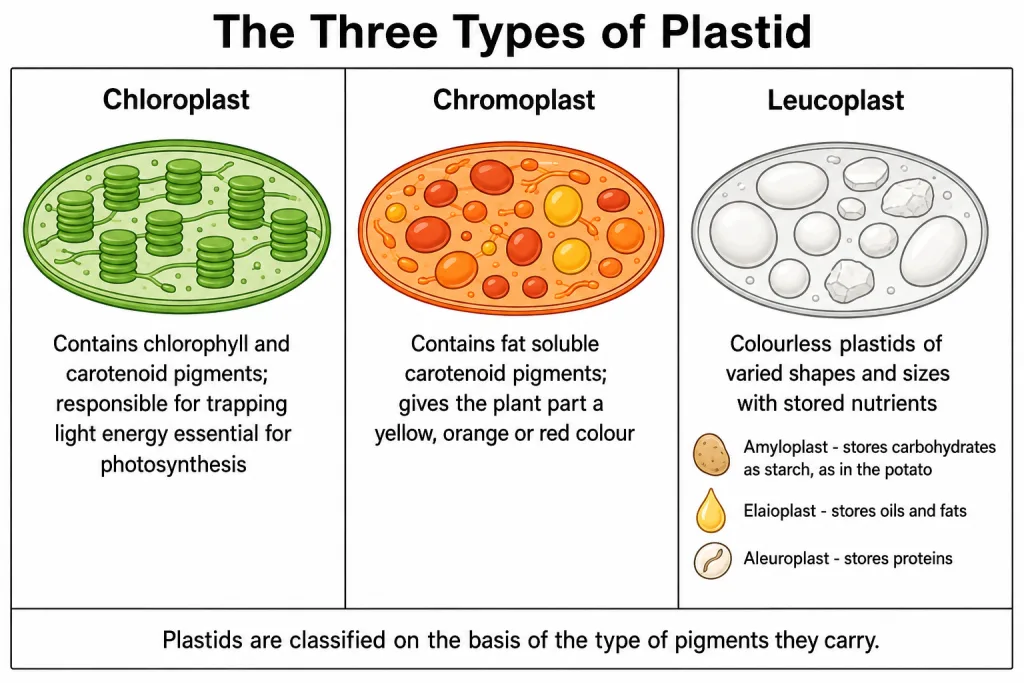
[NEET Important] The three leucoplasts are asked as a straight matching item, and the names are close enough to be swapped. Fix them by their first sound - amyloplast with amylum (starch), elaioplast with oil, aleuroplast with aleurone (protein). Also remember that the classification is based on the type of pigments, not on size or shape.
The Chloroplast - Where It Is, and How It Is Built
Majority of the chloroplasts of the green plants are found in the mesophyll cells of the leaves. The leaf is where the light is, and the mesophyll is the tissue that catches it.
Shape and size. They are lens-shaped, oval, spherical, discoid or even ribbon-like organelles, with variable length of 5 to 10 micrometre and width of 2 to 4 micrometre.
Number. It varies from 1 per cell in Chlamydomonas, a green alga, to 20 to 40 per cell in the mesophyll.
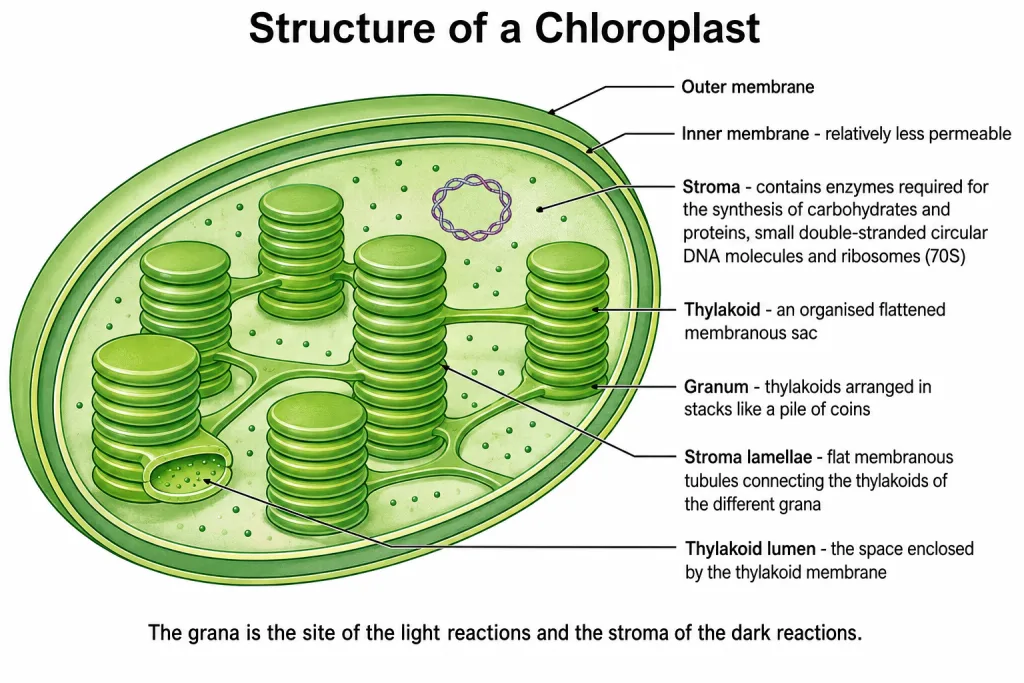
Membranes. Like mitochondria, the chloroplasts are also double membrane bound. Of the two, the inner chloroplast membrane is relatively less permeable.
| Feature | The chloroplast |
|---|---|
| Where | Mesophyll cells of the leaves |
| Shape | Lens-shaped, oval, spherical, discoid or even ribbon-like |
| Length | 5 to 10 micrometre |
| Width | 2 to 4 micrometre |
| Number | 1 per cell in Chlamydomonas, a green alga, to 20 to 40 per cell in the mesophyll |
| Membranes | Double membrane bound; the inner membrane is relatively less permeable |
[NEET Important] Two size sets are constantly mixed up. The chloroplast is 5 to 10 micrometre long and 2 to 4 micrometre wide, while the mitochondrion is 1.0 to 4.1 micrometre long with a diameter of 0.2 to 1.0 micrometre. And it is the inner chloroplast membrane that is relatively less permeable - not the outer.
Inside the Chloroplast - Stroma, Thylakoids and Grana
The space limited by the inner membrane of the chloroplast is called the stroma. Everything below sits in that space.
- A number of organised flattened membranous sacs called the thylakoids are present in the stroma.
- Thylakoids are arranged in stacks like the piles of coins called grana (singular: granum), or lie separately as the intergranal thylakoids.
- In addition, there are flat membranous tubules called the stroma lamellae connecting the thylakoids of the different grana.
- The membrane of the thylakoids encloses a space called a lumen.
What the stroma contains. The stroma of the chloroplast contains enzymes required for the synthesis of carbohydrates and proteins. It also contains small, double-stranded circular DNA molecules and ribosomes.
Where the pigments are. Chlorophyll pigments are present in the thylakoids - in the membranes of those stacked sacs, not loose in the stroma.
The ribosomes. The ribosomes of the chloroplasts are smaller (70S) than the cytoplasmic ribosomes (80S).
Dividing the work. The grana, in the plastid, is the site of the light reactions and the stroma of the dark reactions. That split follows the structure exactly - the pigments sit in the thylakoids of the grana, so light is trapped there, while the enzymes for synthesis sit in the stroma, so the sugar chemistry happens there.
| Part | What it is | What it does |
|---|---|---|
| Stroma | The space limited by the inner membrane | Holds enzymes for synthesis of carbohydrates and proteins, circular DNA and ribosomes; site of the dark reactions |
| Thylakoid | An organised flattened membranous sac | Carries the chlorophyll pigments; its membrane encloses a lumen |
| Granum | A stack of thylakoids like a pile of coins | Site of the light reactions |
| Stroma lamellae | Flat membranous tubules | Connect the thylakoids of different grana |
| Lumen | The space enclosed by the thylakoid membrane | The inner space of the thylakoid |
[NEET Important] Grana - light reactions. Stroma - dark reactions. Reversing that pair is the single most common error in this section. Two more one-liners are worth memorising: the chloroplast DNA is small, double-stranded and circular, and the chloroplast ribosome is 70S while the cytoplasmic ribosome is 80S.
Quick Recap
- Plastids are found in all plant cells and in euglenoides, and are easily observed under the microscope as they are large.
- They bear specific pigments, thus imparting specific colours to the plants, and are classified on the basis of the type of pigments into chloroplasts, chromoplasts and leucoplasts.
- Chloroplasts contain chlorophyll and carotenoid pigments, responsible for trapping light energy essential for photosynthesis.
- Chromoplasts contain fat soluble carotenoid pigments like carotene and xanthophylls, giving the part of the plant a yellow, orange or red colour.
- Leucoplasts are colourless plastids of varied shapes and sizes with stored nutrients - amyloplasts store carbohydrates (starch), for example potato; elaioplasts store oils and fats; aleuroplasts store proteins.
- Majority of the chloroplasts of green plants are found in the mesophyll cells of the leaves.
- They are lens-shaped, oval, spherical, discoid or even ribbon-like, length 5 to 10 micrometre, width 2 to 4 micrometre.
- Number varies from 1 per cell in Chlamydomonas, a green alga, to 20 to 40 per cell in the mesophyll.
- Like mitochondria, the chloroplasts are also double membrane bound, and the inner chloroplast membrane is relatively less permeable.
- The space limited by the inner membrane is the stroma.
- Organised flattened membranous sacs called thylakoids are present in the stroma, stacked like piles of coins to form grana (singular: granum), or present as intergranal thylakoids.
- Flat membranous tubules called stroma lamellae connect the thylakoids of different grana.
- The membrane of the thylakoids encloses a space called a lumen.
- The stroma contains enzymes required for the synthesis of carbohydrates and proteins, and small, double-stranded circular DNA molecules and ribosomes.
- Chlorophyll pigments are present in the thylakoids.
- The ribosomes of the chloroplasts are smaller (70S) than the cytoplasmic ribosomes (80S).
- The grana is the site of the light reactions and the stroma of the dark reactions.
Solved Examples
Question 1
Q. Where are plastids found, and why are they easy to see?
Answer. Plastids are found in all plant cells and in euglenoides. They are easily observed under the microscope as they are large - unlike mitochondria, which are not easily visible unless specifically stained.
Question 2
Q. On what basis are plastids classified, and what are the three types?
Answer. They are classified based on the type of pigments they bear. The three types are chloroplasts, chromoplasts and leucoplasts.
Question 3
Q. What pigments does a chloroplast carry and what do they do?
Answer. Chloroplasts contain chlorophyll and carotenoid pigments, which are responsible for trapping light energy essential for photosynthesis.
Question 4
Q. What is a chromoplast?
Answer. A plastid in which fat soluble carotenoid pigments like carotene, xanthophylls and others are present. This gives the part of the plant a yellow, orange or red colour.
Question 5
Q. Define leucoplasts and name the three kinds with what each stores.
Answer. Leucoplasts are the colourless plastids of varied shapes and sizes with stored nutrients. Amyloplasts store carbohydrates (starch), for example in the potato. Elaioplasts store oils and fats. Aleuroplasts store proteins.
Question 6
Q. Where are most chloroplasts of a green plant located?
Answer. Majority of the chloroplasts of the green plants are found in the mesophyll cells of the leaves.
Question 7
Q. Give the shape, length, width and number of chloroplasts.
Answer. They are lens-shaped, oval, spherical, discoid or even ribbon-like, with variable length of 5 to 10 micrometre and width of 2 to 4 micrometre. Their number varies from 1 per cell in Chlamydomonas, a green alga, to 20 to 40 per cell in the mesophyll.
Question 8
Q. How many membranes does a chloroplast have, and which of them is less permeable?
Answer. Like mitochondria, the chloroplasts are also double membrane bound. Of the two, the inner chloroplast membrane is relatively less permeable.
Question 9
Q. What is the stroma, and what does it contain?
Answer. The stroma is the space limited by the inner membrane of the chloroplast. It contains enzymes required for the synthesis of carbohydrates and proteins, and also small, double-stranded circular DNA molecules and ribosomes.
Question 10
Q. Describe thylakoids, grana, stroma lamellae and the lumen.
Answer. Thylakoids are organised flattened membranous sacs present in the stroma. They are arranged in stacks like the piles of coins called grana (singular: granum), or occur as intergranal thylakoids. Flat membranous tubules called the stroma lamellae connect the thylakoids of the different grana. The membrane of the thylakoids encloses a space called a lumen.
Question 11
Q. Where exactly are the chlorophyll pigments held?
Answer. Chlorophyll pigments are present in the thylakoids - inside the membranes of those flattened sacs, which is why the grana, the stacks of thylakoids, do the light trapping.
Question 12
Q. Which part of the chloroplast carries out the light reactions and which the dark reactions?
Answer. The grana, in the plastid, is the site of the light reactions and the stroma of the dark reactions. The structure explains the split - the chlorophyll pigments are in the thylakoids of the grana, while the enzymes for the synthesis of carbohydrates and proteins are in the stroma.
Question 13
Q. Compare the ribosomes of a chloroplast with those of the cytoplasm.
Answer. The ribosomes of the chloroplasts are smaller (70S) than the cytoplasmic ribosomes (80S). The mitochondrion carries the same 70S type.
Question 14
Q. A plant organelle is described as double membrane bound, containing circular DNA and 70S ribosomes, and holding stacks of membranous sacs. Name it and justify.
Answer. It is the chloroplast. It is double membrane bound like the mitochondrion, its stroma contains small, double-stranded circular DNA molecules and ribosomes, those ribosomes are 70S, and the stacks of flattened membranous sacs are the grana, made of thylakoids.
Question 15
Q. Why does a ripening tomato turn red while the leaf stays green?
Answer. Because different plastids carry different pigments. The leaf cells hold chloroplasts with chlorophyll and carotenoid pigments, which look green and trap light energy essential for photosynthesis. The fruit holds chromoplasts, in which fat soluble carotenoid pigments like carotene and xanthophylls are present, and this gives the part of the plant a yellow, orange or red colour.