
Passive Transport - Moving Without Spending Energy
One of the most important functions of the plasma membrane is the transport of the molecules across it. The membrane is selectively permeable to some molecules present on either side of it - it lets some things through and stops others.
Many molecules can move across the membrane without any requirement of energy, and this is called passive transport.
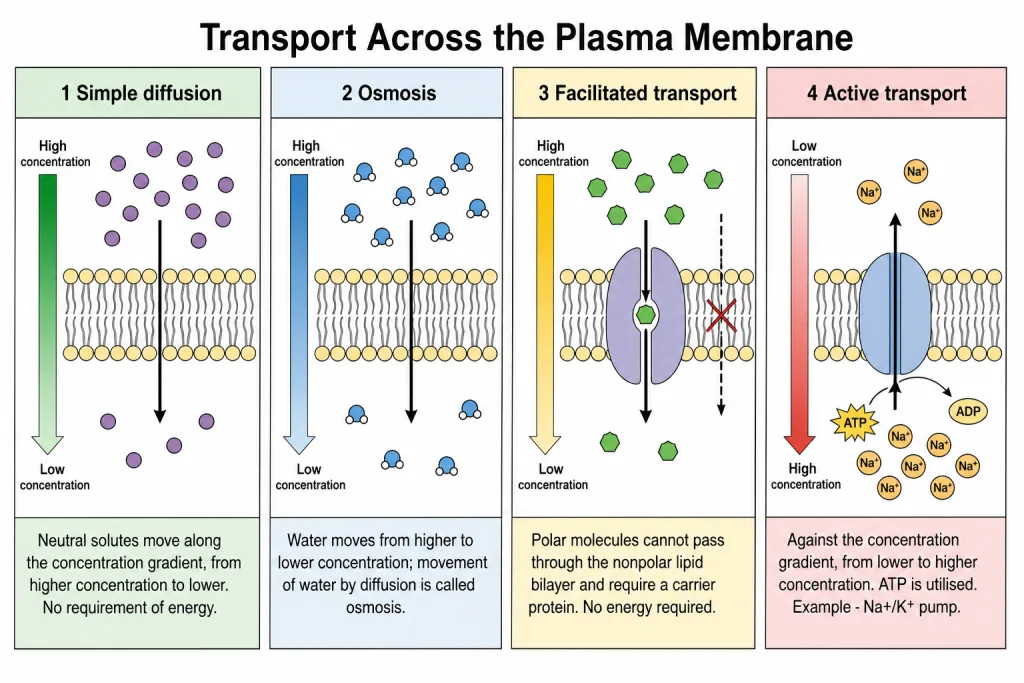
Simple diffusion. Neutral solutes may move across the membrane by the process of simple diffusion along the concentration gradient, that is, from higher concentration to the lower. Nothing pushes them; they simply spread out.
Osmosis. Water may also move across this membrane from higher to lower concentration. Movement of water by diffusion is called osmosis.
Facilitated transport for polar molecules. As the polar molecules cannot pass through the nonpolar lipid bilayer, they require a carrier protein of the membrane to facilitate their transport across the membrane. The direction is still down the gradient and no energy is spent - only the doorway is different.
[NEET Important] Sort the passengers before you sort the process. Neutral solutes go by simple diffusion; water by osmosis; polar molecules need a carrier protein. The reason a polar molecule needs help is chemical and gets asked directly - the lipid bilayer is nonpolar, so a polar molecule cannot pass through it on its own.
Active Transport - Moving Uphill With ATP
Some substances have to be moved the wrong way, and that costs energy.
A few ions or molecules are transported across the membrane against their concentration gradient, that is, from lower to the higher concentration. Such a transport is an energy dependent process, in which ATP is utilised, and is called active transport. An example is the Na+/K+ pump.
| Feature | Passive transport | Active transport |
|---|---|---|
| Energy | No requirement of energy | Energy dependent - ATP is utilised |
| Direction | Along the concentration gradient - higher to lower | Against the concentration gradient - lower to higher |
| What moves | Neutral solutes by simple diffusion; water by osmosis; polar molecules through a carrier protein | A few ions or molecules |
| Example | Simple diffusion, osmosis | Na+/K+ pump |
[NEET Important] The single word that separates the two columns is gradient. Passive - along the gradient, no energy. Active - against the gradient, ATP utilised. The named example, the Na+/K+ pump, is asked as a one-line recall, and its trap is being offered as an example of facilitated or passive transport.
The Cell Wall
A non-living rigid structure called the cell wall forms an outer covering for the plasma membrane of fungi and plants. It lies outside the membrane, so anything entering the cell crosses the wall first and the membrane after.
What it does.
- Gives shape to the cell.
- Protects the cell from mechanical damage and infection.
- Helps in cell-to-cell interaction.
- Provides a barrier to undesirable macromolecules.
What it is made of. Algae have a cell wall made of cellulose, galactans, mannans and minerals like calcium carbonate, while in other plants it consists of cellulose, hemicellulose, pectins and proteins.
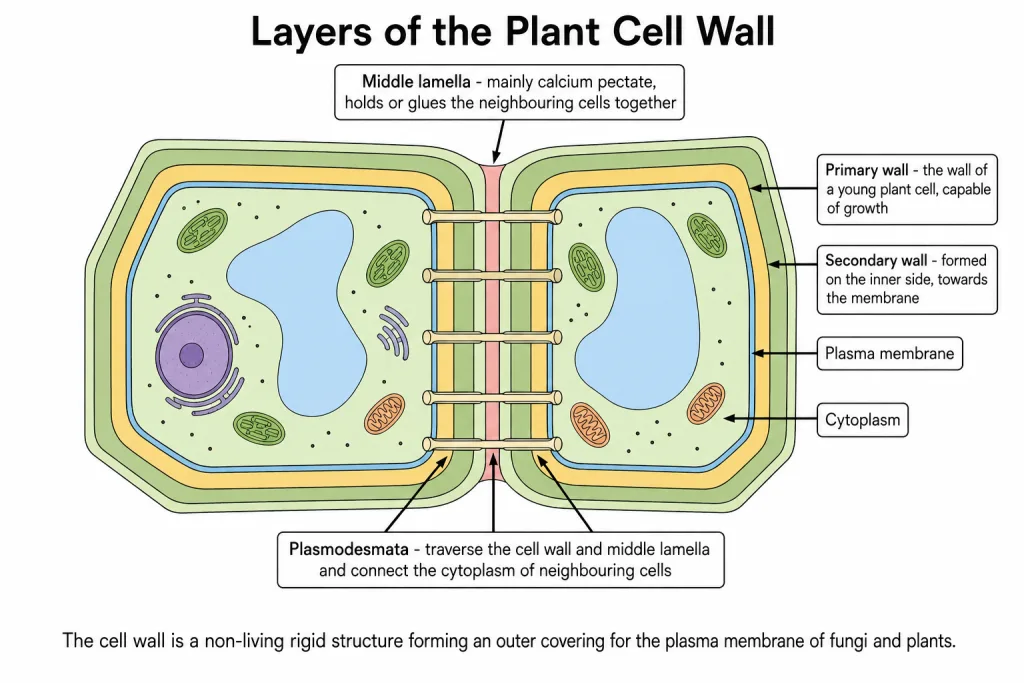
How it is layered. The cell wall of a young plant cell, the primary wall, is capable of growth, which gradually diminishes as the cell matures and the secondary wall is formed on the inner side, towards the membrane.
The middle lamella is a layer mainly of calcium pectate which holds or glues the different neighbouring cells together. The cell wall and middle lamellae may be traversed by plasmodesmata, which connect the cytoplasm of neighbouring cells.
| Layer | What it is |
|---|---|
| Middle lamella | Mainly calcium pectate; glues neighbouring cells together |
| Primary wall | Wall of a young cell; capable of growth, which diminishes as the cell matures |
| Secondary wall | Formed on the inner side, towards the membrane |
[NEET Important] Two composition facts are asked almost every year. The middle lamella is mainly calcium pectate - not cellulose - and the algal wall alone carries galactans, mannans and minerals like calcium carbonate. Also fix the growth fact in the right place: it is the primary wall that is capable of growth, and the secondary wall that forms later on the inner side.
Quick Recap
- One of the most important functions of the plasma membrane is the transport of molecules across it, and the membrane is selectively permeable.
- Passive transport - movement across the membrane without any requirement of energy.
- Neutral solutes move by simple diffusion along the concentration gradient, from higher to lower concentration.
- Water also moves from higher to lower concentration; movement of water by diffusion is called osmosis.
- Polar molecules cannot pass through the nonpolar lipid bilayer and require a carrier protein of the membrane to facilitate their transport.
- Active transport - a few ions or molecules are moved against their concentration gradient, from lower to higher; it is energy dependent and ATP is utilised. Example - the Na+/K+ pump.
- The cell wall is a non-living rigid structure forming an outer covering for the plasma membrane of fungi and plants.
- It gives shape to the cell, protects it from mechanical damage and infection, helps in cell-to-cell interaction and provides a barrier to undesirable macromolecules.
- Algal cell wall - cellulose, galactans, mannans and minerals like calcium carbonate. Other plants - cellulose, hemicellulose, pectins and proteins.
- The primary wall of a young cell is capable of growth, which gradually diminishes as the cell matures; the secondary wall is formed on the inner side, towards the membrane.
- The middle lamella is a layer mainly of calcium pectate which holds or glues neighbouring cells together.
- Plasmodesmata traverse the cell wall and middle lamella and connect the cytoplasm of neighbouring cells.
Solved Examples
Question 1
Q. State one of the most important functions of the plasma membrane and explain what "selectively permeable" means.
Answer. One of the most important functions of the plasma membrane is the transport of the molecules across it. The membrane is selectively permeable to some molecules present on either side of it - it allows certain substances through while holding others back.
Question 2
Q. What is passive transport?
Answer. It is the movement of molecules across the membrane without any requirement of energy. Simple diffusion and osmosis are examples.
Question 3
Q. How do neutral solutes move across the plasma membrane? Can the polar molecules also move across it in the same way? If not, then how are these transported across the membrane? This is one of the chapter-end exercises.
Answer. Neutral solutes move across the plasma membrane by the process of simple diffusion. They travel along the concentration gradient, that is, from a region of higher concentration to a region of lower concentration. No energy is required, which is why this comes under passive transport. The membrane itself does nothing except stand there - the solute simply spreads out until the concentration is even on both sides. Water behaves the same way; movement of water by diffusion is called osmosis.
No, polar molecules cannot move across the membrane in the same way. The reason is the make-up of the membrane. The lipids are arranged in a bilayer with the polar heads on the outer sides and the hydrophobic tails towards the inner part, so the interior of the membrane is nonpolar. As polar molecules cannot pass through the nonpolar lipid bilayer, they are stopped at that oily core.
Polar molecules are therefore transported with the help of a carrier protein of the membrane, which facilitates their transport across the membrane. The carrier protein provides a polar path through the membrane, so the molecule never has to touch the hydrophobic interior. This is still a passive process - the molecule moves down its concentration gradient and no ATP is spent.
One more route exists for a few substances. A few ions or molecules are transported against their concentration gradient, from lower to higher concentration. Such transport is an energy dependent process in which ATP is utilised and is called active transport, for example the Na+/K+ pump.
Question 4
Q. Define osmosis.
Answer. Water may move across the membrane from higher to lower concentration, and this movement of water by diffusion is called osmosis.
Question 5
Q. What is active transport? Give an example.
Answer. A few ions or molecules are transported across the membrane against their concentration gradient, from lower to the higher concentration. Such a transport is an energy dependent process in which ATP is utilised and is called active transport. Example - the Na+/K+ pump.
Question 6
Q. Give the differences between passive and active transport.
Answer. Passive transport needs no energy and moves substances along the concentration gradient, from higher to lower concentration; simple diffusion and osmosis are examples. Active transport is energy dependent, uses ATP, and moves a few ions or molecules against their concentration gradient, from lower to higher concentration; the Na+/K+ pump is the example.
Question 7
Q. What is the cell wall, and which organisms have one?
Answer. The cell wall is a non-living rigid structure that forms an outer covering for the plasma membrane of fungi and plants. Being outside the membrane, it is the first layer anything entering the cell meets.
Question 8
Q. List the functions of the cell wall.
Answer. It gives shape to the cell, protects the cell from mechanical damage and infection, helps in cell-to-cell interaction and provides a barrier to undesirable macromolecules.
Question 9
Q. Compare the composition of the cell wall in algae with that in other plants.
Answer. Algae have a cell wall made of cellulose, galactans, mannans and minerals like calcium carbonate. In other plants it consists of cellulose, hemicellulose, pectins and proteins.
Question 10
Q. Distinguish between the primary wall and the secondary wall of a plant cell.
Answer. The primary wall is the cell wall of a young plant cell and is capable of growth, but this capacity gradually diminishes as the cell matures. The secondary wall is formed on the inner side of the cell, towards the membrane.
Question 11
Q. What is the middle lamella and what is it made of?
Answer. The middle lamella is a layer mainly of calcium pectate which holds or glues the different neighbouring cells together.
Question 12
Q. What are plasmodesmata and what do they do?
Answer. Plasmodesmata are channels that traverse the cell wall and the middle lamella and connect the cytoplasm of neighbouring cells, so neighbouring cells stay in living contact through their walls.
Question 13
Q. Arrange the middle lamella, the primary wall and the secondary wall in order from the outside of a plant cell inwards.
Answer. Middle lamella, then primary wall, then secondary wall. The middle lamella lies outermost, between two neighbouring cells, and glues them together. Inside it lies the primary wall of the young cell, and the secondary wall is formed last, on the inner side, towards the membrane.