
Seeing a Mitochondrion - Number, Shape and Size
Mitochondria (singular: mitochondrion), unless specifically stained, are not easily visible under the microscope. They are there in the living cell all along; without a stain they simply do not stand out from the cytoplasm.
The number of mitochondria per cell is variable, depending on the physiological activity of the cells. A cell that works hard and burns a lot of energy carries more of them; a quiet cell carries fewer. So the number is not fixed by the species, it is set by how active the cell is.
In terms of shape and size also, a considerable degree of variability is observed. Still, a typical description exists:
| Feature | Typical value |
|---|---|
| Shape | Sausage-shaped or cylindrical |
| Diameter | 0.2 to 1.0 micrometre, average 0.5 micrometre |
| Length | 1.0 to 4.1 micrometre |
[NEET Important] The examiner's favourite line here is "the number of mitochondria per cell is variable depending on the physiological activity of the cells" - not on the age of the cell and not on the number of nuclei. Keep the two size figures apart as well: 0.2 to 1.0 micrometre is the diameter, with 0.5 micrometre as the average, while 1.0 to 4.1 micrometre is the length.
Two Membranes, Two Compartments
Each mitochondrion is a double membrane-bound structure. The outer membrane and the inner membrane divide its lumen distinctly into two aqueous compartments - the outer compartment and the inner compartment.
The inner compartment is filled with a dense homogeneous substance called the matrix.
The two membranes do different jobs:
- The outer membrane forms the continuous limiting boundary of the organelle. It is the smooth outer wall, unbroken all the way round.
- The inner membrane forms a number of infoldings called the cristae (singular: crista) towards the matrix. The cristae increase the surface area.
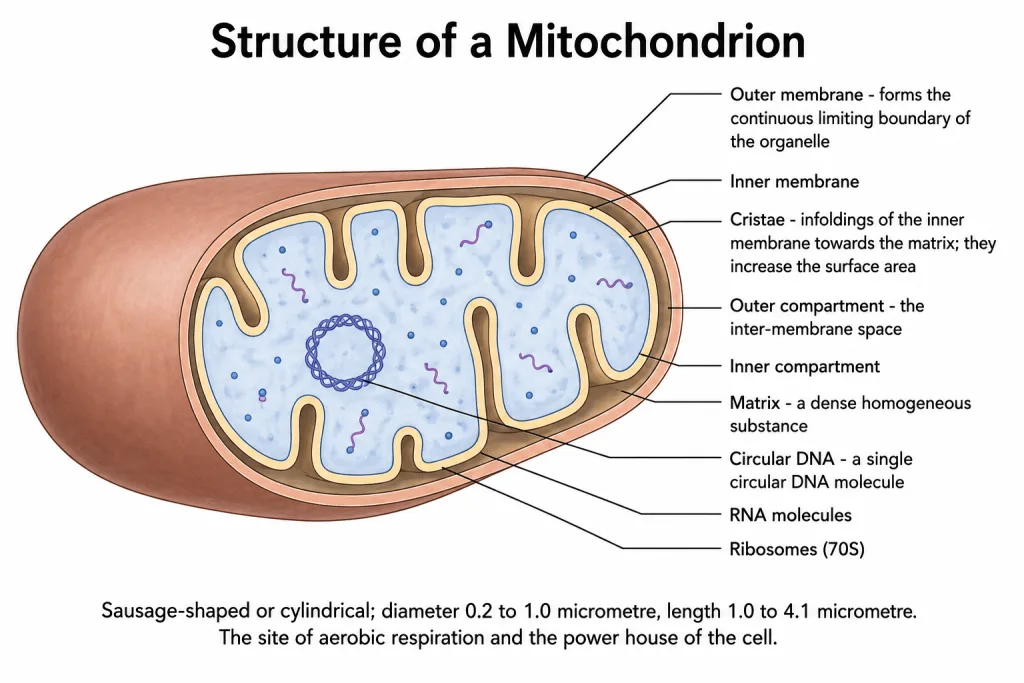
The two membranes have their own specific enzymes associated with the mitochondrial function. So the membranes are not just partitions - each carries its own set of enzymes.
| Part | What it is | Point to remember |
|---|---|---|
| Outer membrane | The continuous limiting boundary of the organelle | Smooth and unbroken |
| Inner membrane | Throws out infoldings called cristae towards the matrix | Cristae increase the surface area |
| Outer compartment | The aqueous space between the two membranes | Also called the inter-membrane space |
| Inner compartment | The space inside the inner membrane | Filled with the matrix |
| Matrix | A dense homogeneous substance | Holds the DNA, RNA and ribosomes |
[NEET Important] The trap is written into the wording: the cristae are infoldings of the INNER membrane, projecting towards the matrix, and the outer membrane is the continuous limiting boundary. Swap those two and the whole answer goes. Also note that the folding has a purpose - the cristae increase the surface area.
The Power House, and Its Own DNA
Mitochondria are the sites of aerobic respiration. They produce cellular energy in the form of ATP, hence they are called the 'power houses' of the cell.
That nickname is earned by a specific chemistry - aerobic respiration, the oxygen-using breakdown of food - and the currency handed out is ATP.
The matrix also possesses:
- a single circular DNA molecule,
- a few RNA molecules,
- ribosomes (70S), and
- the components required for the synthesis of proteins.
Put together, that is a working protein-making kit inside the organelle. The mitochondria divide by fission - a new mitochondrion is made by an existing one splitting, not by being built afresh from the golgi.
[NEET Important] Three details are asked as one cluster: the DNA is single and circular, the ribosomes are 70S (the prokaryotic size, not the 80S of the cytoplasm), and the organelle divides by fission. An option offering "linear DNA" or "80S ribosomes" for the mitochondrion is wrong on both counts.
Quick Recap
- Mitochondria (singular: mitochondrion), unless specifically stained, are not easily visible under the microscope.
- The number of mitochondria per cell is variable, depending on the physiological activity of the cells.
- Considerable variability is seen in shape and size; typically sausage-shaped or cylindrical.
- Diameter 0.2 to 1.0 micrometre, average 0.5 micrometre. Length 1.0 to 4.1 micrometre.
- Each mitochondrion is a double membrane-bound structure; the outer and inner membranes divide the lumen distinctly into two aqueous compartments - the outer compartment and the inner compartment.
- The inner compartment is filled with a dense homogeneous substance called the matrix.
- The outer membrane forms the continuous limiting boundary of the organelle.
- The inner membrane forms a number of infoldings called the cristae (singular: crista) towards the matrix, and the cristae increase the surface area.
- The two membranes have their own specific enzymes associated with the mitochondrial function.
- Mitochondria are the sites of aerobic respiration and produce cellular energy in the form of ATP, hence they are the 'power houses' of the cell.
- The matrix possesses a single circular DNA molecule, a few RNA molecules, ribosomes (70S) and the components required for the synthesis of proteins.
- The mitochondria divide by fission.
Solved Examples
Question 1
Q. Why are mitochondria hard to see in an ordinary preparation?
Answer. Because unless they are specifically stained, mitochondria are not easily visible under the microscope. They are present in the living cell, but without a stain they do not stand out from the cytoplasm.
Question 2
Q. What decides the number of mitochondria in a cell?
Answer. The number of mitochondria per cell is variable, depending on the physiological activity of the cells. A more active cell needs more energy and carries more mitochondria.
Question 3
Q. Give the typical shape and size of a mitochondrion.
Answer. It is typically sausage-shaped or cylindrical, with a diameter of 0.2 to 1.0 micrometre, the average being 0.5 micrometre, and a length of 1.0 to 4.1 micrometre. Considerable variability in shape and size is observed.
Question 4
Q. How is the lumen of a mitochondrion divided?
Answer. The outer membrane and the inner membrane divide the lumen distinctly into two aqueous compartments - the outer compartment and the inner compartment. The inner compartment is filled with a dense homogeneous substance called the matrix.
Question 5
Q. State one job each for the outer and the inner mitochondrial membrane.
Answer. The outer membrane forms the continuous limiting boundary of the organelle. The inner membrane forms a number of infoldings called the cristae towards the matrix, and the cristae increase the surface area.
Question 6
Q. What are cristae and why do they matter?
Answer. Cristae (singular: crista) are the infoldings formed by the inner membrane towards the matrix. They matter because they increase the surface area, giving the mitochondrion more membrane on which its work can be done.
Question 7
Q. Do the two mitochondrial membranes carry enzymes?
Answer. Yes. The two membranes have their own specific enzymes associated with the mitochondrial function. Each membrane has its own set, not a shared one.
Question 8
Q. Why is the mitochondrion called the power house of the cell?
Answer. Because mitochondria are the sites of aerobic respiration and they produce cellular energy in the form of ATP. Since the cell's usable energy is handed out from here, they are called the 'power houses' of the cell.
Question 9
Q. What does the mitochondrial matrix contain besides being a dense homogeneous substance?
Answer. It possesses a single circular DNA molecule, a few RNA molecules, ribosomes (70S) and the components required for the synthesis of proteins. In short, the organelle carries its own kit for making proteins.
Question 10
Q. How do mitochondria multiply?
Answer. The mitochondria divide by fission. A new mitochondrion comes from an existing one splitting into two, not from being packaged by the golgi apparatus.
Question 11
Q. Name two cell-organelles that are double membrane bound. What are the characteristics of these two organelles? State their functions and draw labelled diagrams of both. This is one of the chapter-end exercises.
Answer. The two double membrane bound organelles are the mitochondrion and the chloroplast. (The chloroplast is treated in full in the next section, on plastids.)
Characteristics of the mitochondrion.
- It is not easily visible under the microscope unless specifically stained, and the number per cell is variable, depending on the physiological activity of the cell.
- It is typically sausage-shaped or cylindrical, diameter 0.2 to 1.0 micrometre (average 0.5 micrometre) and length 1.0 to 4.1 micrometre.
- It is a double membrane-bound structure. The outer and inner membranes divide the lumen distinctly into two aqueous compartments, the outer compartment and the inner compartment.
- The outer membrane forms the continuous limiting boundary of the organelle; the inner membrane forms infoldings called cristae towards the matrix, and the cristae increase the surface area.
- The inner compartment is filled with a dense homogeneous substance called the matrix, which possesses a single circular DNA molecule, a few RNA molecules, ribosomes (70S) and the components required for the synthesis of proteins.
- The two membranes have their own specific enzymes, and the mitochondria divide by fission.
Characteristics of the chloroplast.
- It is a plastid, found in all plant cells and in euglenoides, and easily observed under the microscope as it is large.
- Majority of the chloroplasts of green plants are found in the mesophyll cells of the leaves. They are lens-shaped, oval, spherical, discoid or even ribbon-like, with length 5 to 10 micrometre and width 2 to 4 micrometre, and 1 per cell in Chlamydomonas to 20 to 40 per cell in the mesophyll.
- It too is double membrane bound, and of the two, the inner chloroplast membrane is relatively less permeable.
- The space limited by the inner membrane is called the stroma. In it lie organised flattened membranous sacs called thylakoids, arranged in stacks like piles of coins called grana, joined by flat membranous tubules called the stroma lamellae. The membrane of the thylakoids encloses a space called a lumen.
- The stroma contains enzymes required for the synthesis of carbohydrates and proteins, and also small double-stranded circular DNA molecules and ribosomes. The ribosomes of the chloroplasts are smaller (70S) than the cytoplasmic ribosomes (80S). Chlorophyll pigments are present in the thylakoids.
Their functions.
- The mitochondrion is the site of aerobic respiration and produces cellular energy in the form of ATP, hence it is called the 'power house' of the cell.
- The chloroplast traps light energy essential for photosynthesis through its chlorophyll and carotenoid pigments. The grana is the site of the light reactions and the stroma of the dark reactions.
The labelled diagrams.
- For the mitochondrion, draw a longitudinal section of a sausage-shaped organelle and label: outer membrane, inner membrane, inter-membrane space, matrix and cristae.
- For the chloroplast, draw a sectional view of a lens-shaped organelle and label: outer membrane, inner membrane, stroma, thylakoid, granum, stroma lamellae and lumen.
Question 12
Q. Compare the DNA and ribosomes of the mitochondrion with those of the cytoplasm.
Answer. The mitochondrial matrix carries a single circular DNA molecule and ribosomes of 70S, while the cytoplasm of a eukaryotic cell has 80S ribosomes. So the mitochondrion runs on the smaller, prokaryotic-sized ribosome.
Question 13
Q. A diagram shows folds projecting inward from the smooth outer wall of a mitochondrion. What is wrong with it?
Answer. The folds are on the wrong membrane. The outer membrane forms the continuous limiting boundary of the organelle and stays smooth; it is the inner membrane that forms the infoldings called cristae towards the matrix.
Question 14
Q. Which two aqueous compartments does a mitochondrion have, and what fills the inner one?
Answer. The outer compartment and the inner compartment, separated by the two membranes. The inner compartment is filled with the matrix, a dense homogeneous substance.