
What Makes a Cell Eukaryotic
The eukaryotes include all the protists, plants, animals and fungi. Everything in the rest of this chapter - the organelles, the nucleus, the cytoskeleton - belongs to this group.
Four features define the eukaryotic cell:
- In eukaryotic cells there is an extensive compartmentalisation of cytoplasm through the presence of membrane bound organelles.
- Eukaryotic cells possess an organised nucleus with a nuclear envelope.
- Eukaryotic cells have a variety of complex locomotory and cytoskeletal structures.
- Their genetic material is organised into chromosomes.
All eukaryotic cells are not identical. A plant cell and an animal cell are both eukaryotic, but they are built differently.
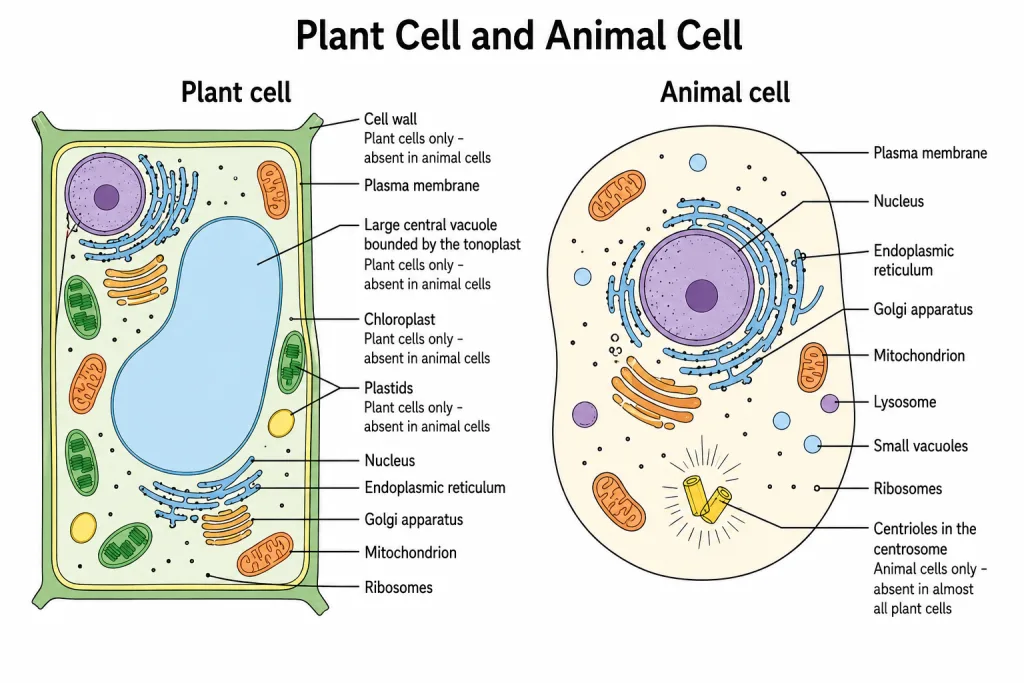
| Structure | Plant cell | Animal cell |
|---|---|---|
| Cell wall | Present | Absent |
| Plastids | Present | Absent |
| Large central vacuole | Present | Absent |
| Centrioles | Absent in almost all plant cells | Present |
Plant cells possess cell walls, plastids and a large central vacuole which are absent in animal cells. Animal cells have centrioles which are absent in almost all plant cells.
[NEET Important] The three plant-only structures are asked as a set - cell wall, plastids and a large central vacuole - so learn them together rather than one at a time. Also copy the hedge in the centriole line exactly: centrioles are absent in almost all plant cells, not in all of them. An option that reads "centrioles are absent in all plant cells" is the standard trap.
What the Cell Membrane Is Made Of
The detailed structure of the membrane was studied only after the advent of the electron microscope in the 1950s. Before that, chemical studies on the cell membrane, especially in human red blood cells (RBCs), enabled the scientists to deduce the possible structure of the plasma membrane.
These studies showed that the cell membrane is mainly composed of lipids and proteins.
The lipids. The major lipids are phospholipids that are arranged in a bilayer. The lipids are arranged within the membrane with the polar head towards the outer sides and the hydrophobic tails towards the inner part. This ensures that the nonpolar tail of saturated hydrocarbons is protected from the aqueous environment. In addition to phospholipids, the membrane also contains cholesterol.
The proteins and sugars. Later biochemical investigation clearly revealed that the cell membranes also possess protein and carbohydrate. The ratio of protein and lipid varies considerably in different cell types. In human beings, the membrane of the erythrocyte has approximately 52 per cent protein and 40 per cent lipids.
Two classes of membrane protein. Depending on the ease of extraction, membrane proteins can be classified as integral and peripheral.
| Type of protein | Where it sits |
|---|---|
| Peripheral proteins | Lie on the surface of the membrane - easily extracted |
| Integral proteins | Partially or totally buried in the membrane - hard to extract |
[NEET Important] Two numbers and one word decide most questions from this block. The numbers are 52 per cent protein and 40 per cent lipids in the human erythrocyte membrane - options routinely swap the two figures. The word is extraction: proteins are classed as integral or peripheral depending on the ease of extraction, not on their size, charge or function.
The Fluid Mosaic Model
An improved model of the structure of the cell membrane was proposed by Singer and Nicolson in 1972, widely accepted as the fluid mosaic model.
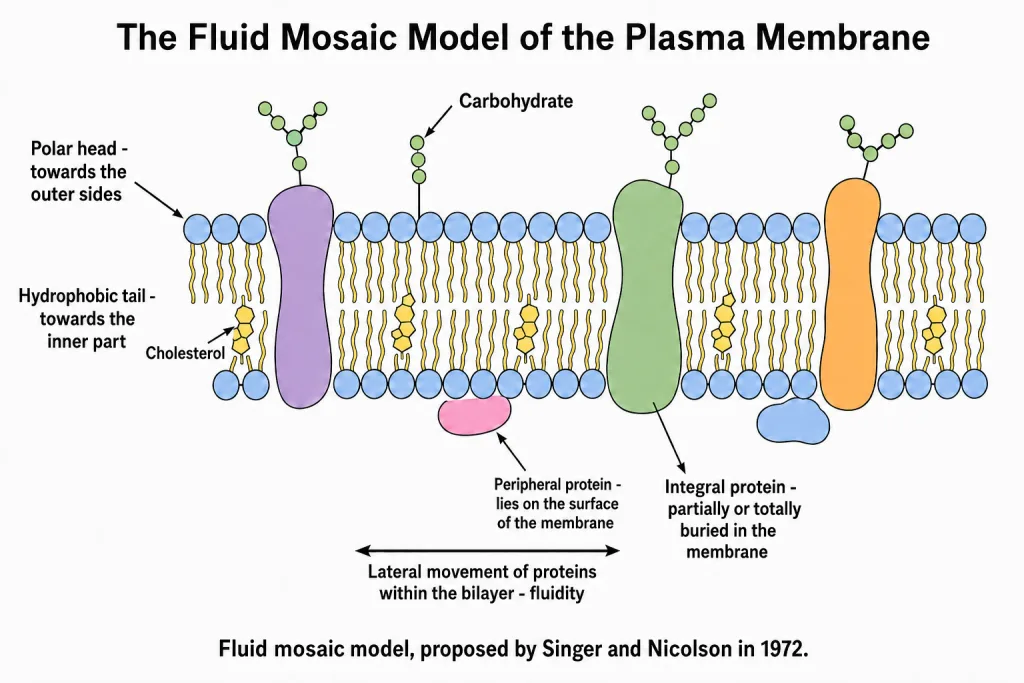
The model rests on one idea. According to this model, the quasi-fluid nature of lipid enables lateral movement of proteins within the overall bilayer. The membrane is not a fixed wall - the phospholipid bilayer behaves like a thin sheet of liquid, and the proteins float and slide about in it like tiles in a moving mosaic.
This ability to move within the membrane is measured as its fluidity.
The fluid nature of the membrane is also important from the point of view of functions like cell growth, formation of intercellular junctions, secretion, endocytosis and cell division. A rigid membrane could not stretch as the cell grows, could not pinch inward to take material in, and could not be pulled apart when the cell divides.
[NEET Important] Remember the pairing Singer and Nicolson, 1972, fluid mosaic model - the name and the year are asked directly, and Camillo Golgi (1898) from a later section is the usual decoy. Also keep fluidity as a measured property: it is the measure of the lateral movement of proteins within the bilayer, and it is the fluid nature that makes cell growth, intercellular junctions, secretion, endocytosis and cell division possible.
Quick Recap
- The eukaryotes include all the protists, plants, animals and fungi.
- Eukaryotic cells show extensive compartmentalisation of cytoplasm through membrane bound organelles, an organised nucleus with a nuclear envelope, complex locomotory and cytoskeletal structures, and genetic material organised into chromosomes.
- Plant cells possess cell walls, plastids and a large central vacuole, which are absent in animal cells.
- Animal cells have centrioles, which are absent in almost all plant cells.
- The detailed structure of the membrane was studied only after the electron microscope arrived in the 1950s; before that, chemical studies especially on human red blood cells let scientists deduce its possible structure.
- The cell membrane is mainly composed of lipids and proteins. The major lipids are phospholipids arranged in a bilayer.
- Polar heads face the outer sides and hydrophobic tails face the inner part, so that the nonpolar tail of saturated hydrocarbons is protected from the aqueous environment.
- Cholesterol is also present, and the membrane also possesses protein and carbohydrate.
- The ratio of protein and lipid varies considerably in different cell types; the human erythrocyte membrane has approximately 52 per cent protein and 40 per cent lipids.
- Depending on the ease of extraction, membrane proteins are integral (partially or totally buried in the membrane) or peripheral (lying on the surface).
- Singer and Nicolson (1972) proposed the fluid mosaic model. The quasi-fluid nature of lipid enables lateral movement of proteins within the bilayer, and this ability is measured as fluidity.
- Fluidity matters for cell growth, formation of intercellular junctions, secretion, endocytosis and cell division.
Solved Examples
Question 1
Q. Which groups of organisms are eukaryotes?
Answer. The eukaryotes include all the protists, plants, animals and fungi.
Question 2
Q. State the features that characterise a eukaryotic cell.
Answer. There are four.
- Extensive compartmentalisation of cytoplasm through the presence of membrane bound organelles.
- An organised nucleus with a nuclear envelope.
- A variety of complex locomotory and cytoskeletal structures.
- Genetic material organised into chromosomes.
Question 3
Q. How does a plant cell differ from an animal cell?
Answer. All eukaryotic cells are not identical. Plant cells possess cell walls, plastids and a large central vacuole, which are absent in animal cells. Animal cells have centrioles, which are absent in almost all plant cells.
Question 4
Q. Why is the wording "absent in almost all plant cells" used for centrioles instead of "absent in all plant cells"?
Answer. Because the statement is deliberately hedged. Centrioles are a feature of animal cells and are absent in almost all plant cells - the word almost leaves room for the few plant groups that do have them. In an examination, the option that drops the word and claims centrioles are absent in all plant cells is the wrong one.
Question 5
Q. How did scientists arrive at the structure of the plasma membrane?
Answer. In two stages. The detailed structure of the membrane was studied only after the advent of the electron microscope in the 1950s. Before that, chemical studies on the cell membrane, especially in human red blood cells (RBCs), enabled the scientists to deduce the possible structure of the plasma membrane.
Question 6
Q. What is the cell membrane mainly composed of?
Answer. It is mainly composed of lipids and proteins. The major lipids are phospholipids, and biochemical work later showed that the membrane also possesses protein and carbohydrate.
Question 7
Q. Describe how the lipids are arranged in the membrane and explain why the arrangement matters.
Answer. The phospholipids are arranged in a bilayer, with the polar head towards the outer sides and the hydrophobic tails towards the inner part.
The reason is chemical. The heads are polar and are happy in water, so they face the watery surroundings on both sides. The tails are nonpolar and are not, so they are tucked inward. This ensures that the nonpolar tail of saturated hydrocarbons is protected from the aqueous environment.
Question 8
Q. Apart from phospholipids, what else is found in the plasma membrane?
Answer. Cholesterol is present among the lipids, and the membrane also possesses protein and carbohydrate.
Question 9
Q. Give the protein and lipid content of the human erythrocyte membrane, and say whether this figure holds for every cell.
Answer. In human beings the membrane of the erythrocyte has approximately 52 per cent protein and 40 per cent lipids. It does not hold for every cell - the ratio of protein and lipid varies considerably in different cell types.
Question 10
Q. On what basis are membrane proteins classified, and what are the two classes?
Answer. They are classified depending on the ease of extraction. Peripheral proteins lie on the surface of the membrane, so they come off easily. Integral proteins are partially or totally buried in the membrane, so they are far harder to pull out.
Question 11
Q. Who proposed the fluid mosaic model, in which year, and what does the model say?
Answer. It was proposed by Singer and Nicolson in 1972. According to it, the quasi-fluid nature of lipid enables lateral movement of proteins within the overall bilayer - the lipid layer behaves like a liquid sheet and the proteins move about within it, giving the pattern of a shifting mosaic.
Question 12
Q. What is meant by the fluidity of a membrane?
Answer. Fluidity is the measure of the ability of proteins to move laterally within the membrane, which is possible because of the quasi-fluid nature of the lipid bilayer.
Question 13
Q. Name the cell functions that depend on the fluid nature of the membrane.
Answer. Cell growth, formation of intercellular junctions, secretion, endocytosis and cell division. A rigid membrane could not stretch, fold inward or split, so none of these would be possible.