
Why Some Organelles Are Grouped Together
Each of the membranous organelles is distinct in terms of its structure and function. Even so, many of these are considered together as an endomembrane system because their functions are coordinated. They work as one supply line - material made in one is passed to the next, packed there, and sent on.
The endomembrane system includes:
- Endoplasmic reticulum (ER)
- Golgi complex
- Lysosomes
- Vacuoles
Since the functions of the mitochondria, chloroplast and peroxisomes are not coordinated with the above components, these are not considered as part of the endomembrane system. They are membrane bound, but they run their own business.
| In the endomembrane system | Left out of it |
|---|---|
| Endoplasmic reticulum | Mitochondria |
| Golgi complex | Chloroplast |
| Lysosomes | Peroxisomes |
| Vacuoles |
[NEET Important] The reason for the grouping is asked as often as the list itself. It is not that these organelles are membrane bound - mitochondria and chloroplast are membrane bound too. The reason is that their functions are coordinated, and the reason for excluding the other three is that their functions are not coordinated with these components.
The Endoplasmic Reticulum
Electron microscopic studies of eukaryotic cells reveal the presence of a network or reticulum of tiny tubular structures scattered in the cytoplasm that is called the endoplasmic reticulum (ER).
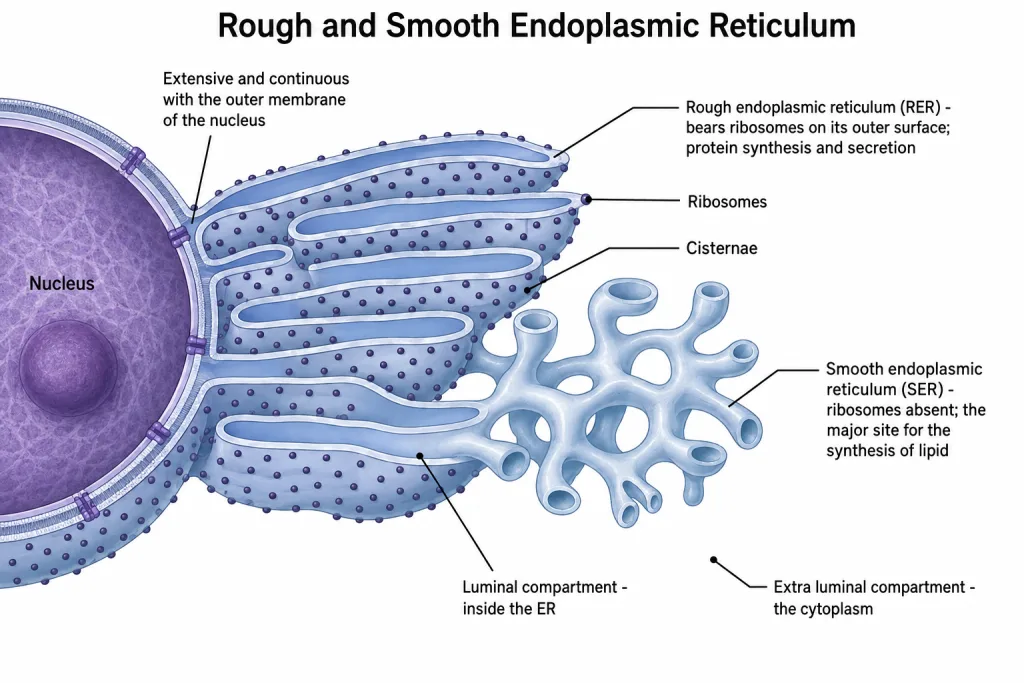
Two compartments. Because the ER is a closed network of tubes, it divides the intracellular space into two distinct compartments - luminal (inside ER) and extra luminal (cytoplasm) compartments.
Two kinds of ER. The ER often shows ribosomes attached to their outer surface.
| Rough ER (RER) | Smooth ER (SER) | |
|---|---|---|
| Ribosomes | Bears ribosomes on its outer surface | Ribosomes absent - so it appears smooth |
| Found in | Cells actively involved in protein synthesis and secretion | Cells making lipids |
| Continuity | Extensive and continuous with the outer membrane of the nucleus | - |
| Main job | Protein synthesis and secretion | The major site for synthesis of lipid |
In animal cells, lipid-like steroidal hormones are synthesised in SER.
[NEET Important] The two compartment names are pure recall and are easily reversed - luminal means inside the ER and extra luminal means the cytoplasm. The other favourite is the continuity fact: it is the RER, not the SER, that is continuous with the outer membrane of the nucleus, which fits neatly with ribosomes handing over newly made protein.
The Golgi Apparatus
Camillo Golgi (1898) first observed densely stained reticular structures near the nucleus. These were later named Golgi bodies after him.
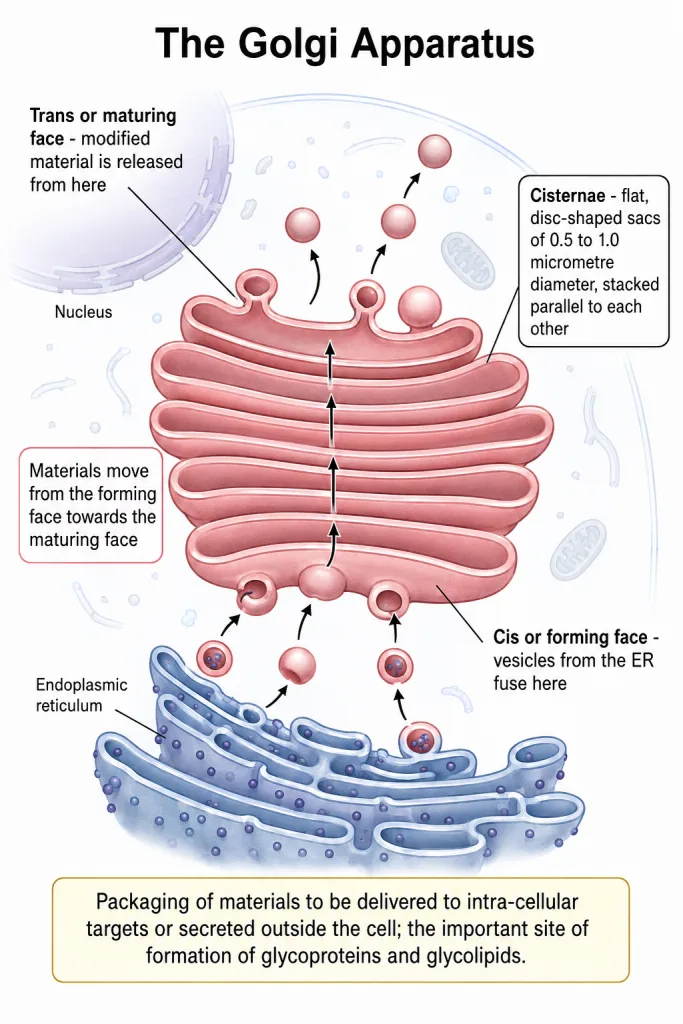
Structure. They consist of many flat, disc-shaped sacs or cisternae of 0.5 to 1.0 micrometre diameter. These are stacked parallel to each other, and a varied number of cisternae are present in a golgi complex.
The two faces. The golgi cisternae are concentrically arranged near the nucleus with a distinct convex cis or forming face and a concave trans or maturing face. The cis and the trans faces of the organelle are entirely different, but interconnected.
| Face | Shape | Other name | What happens there |
|---|---|---|---|
| Cis face | Convex | Forming face | Vesicles from the ER fuse here |
| Trans face | Concave | Maturing face | Modified material is released from here |
Function. The golgi apparatus principally performs the function of packaging materials, to be delivered either to the intra-cellular targets or secreted outside the cell.
Materials to be packaged in the form of vesicles from the ER fuse with the cis face of the golgi apparatus and move towards the maturing face. This explains why the golgi apparatus remains in close association with the endoplasmic reticulum.
A number of proteins synthesised by ribosomes on the endoplasmic reticulum are modified in the cisternae of the golgi apparatus before they are released from its trans face. Golgi apparatus is the important site of formation of glycoproteins and glycolipids.
[NEET Important] Keep the traffic flowing in one direction: ER, then cis or forming face (convex), then trans or maturing face (concave), then out. Questions reverse the pair, or attach convex to the trans face. The two products - glycoproteins and glycolipids - are asked as a one-line recall, and the distractor is hydrolytic enzymes, which belong to the lysosome.
Quick Recap
- Membranous organelles are distinct in structure and function, but many are considered together as an endomembrane system because their functions are coordinated.
- The endomembrane system includes the endoplasmic reticulum (ER), golgi complex, lysosomes and vacuoles.
- Mitochondria, chloroplast and peroxisomes are not part of it because their functions are not coordinated with these components.
- Electron microscopy reveals a network or reticulum of tiny tubular structures scattered in the cytoplasm called the endoplasmic reticulum.
- The ER divides the intracellular space into two compartments - luminal (inside ER) and extra luminal (cytoplasm).
- ER bearing ribosomes on its outer surface is rough ER (RER); in the absence of ribosomes it appears smooth and is smooth ER (SER).
- RER is frequently observed in cells actively involved in protein synthesis and secretion, and is extensive and continuous with the outer membrane of the nucleus.
- SER is the major site for synthesis of lipid; in animal cells lipid-like steroidal hormones are synthesised in SER.
- Camillo Golgi (1898) first observed densely stained reticular structures near the nucleus, later named Golgi bodies.
- The golgi consists of many flat, disc-shaped sacs or cisternae of 0.5 to 1.0 micrometre diameter, stacked parallel to each other, with a varied number of cisternae per complex.
- Cisternae are concentrically arranged near the nucleus with a convex cis or forming face and a concave trans or maturing face, which are entirely different but interconnected.
- The golgi principally performs the function of packaging materials, to be delivered to intra-cellular targets or secreted outside the cell.
- Vesicles from the ER fuse with the cis face and move towards the maturing face, which explains why the golgi remains in close association with the ER.
- Proteins synthesised by ribosomes on the ER are modified in the cisternae of the golgi before release from its trans face.
- The golgi apparatus is the important site of formation of glycoproteins and glycolipids.
Solved Examples
Question 1
Q. Why are certain organelles grouped together as an endomembrane system, and which organelles are included?
Answer. Each of these membranous organelles is distinct in terms of structure and function, but many of them are considered together as an endomembrane system because their functions are coordinated. The system includes the endoplasmic reticulum (ER), the golgi complex, lysosomes and vacuoles.
Question 2
Q. Why are mitochondria, chloroplast and peroxisomes left out of the endomembrane system?
Answer. Because their functions are not coordinated with the components of the endomembrane system. Being membrane bound is not enough - all three are membrane bound, yet they work independently of the ER to golgi supply line.
Question 3
Q. What is the endoplasmic reticulum, and how was it discovered?
Answer. Electron microscopic studies of eukaryotic cells revealed a network or reticulum of tiny tubular structures scattered in the cytoplasm, and this is called the endoplasmic reticulum (ER).
Question 4
Q. Which two compartments does the ER create inside the cell?
Answer. The luminal compartment, which is the space inside the ER, and the extra luminal compartment, which is the cytoplasm.
Question 5
Q. Distinguish between rough ER and smooth ER.
Answer. The ER often shows ribosomes attached to their outer surface, and ER bearing ribosomes on its surface is called rough endoplasmic reticulum (RER). In the absence of ribosomes the membranes appear smooth and are called smooth endoplasmic reticulum (SER).
Their jobs differ too. RER is frequently observed in cells actively involved in protein synthesis and secretion, while SER is the major site for synthesis of lipid.
Question 6
Q. In which cells is RER abundant, and which structure is it continuous with?
Answer. RER is frequently observed in the cells actively involved in protein synthesis and secretion. These membranes are extensive and continuous with the outer membrane of the nucleus.
Question 7
Q. State the function of the smooth endoplasmic reticulum.
Answer. The smooth endoplasmic reticulum is the major site for synthesis of lipid. In animal cells, lipid-like steroidal hormones are synthesised in SER.
Question 8
Q. Who first observed the golgi bodies, in which year, and what did he see?
Answer. Camillo Golgi, in 1898. He first observed densely stained reticular structures near the nucleus, and these were later named Golgi bodies after him.
Question 9
Q. Describe the structure of the golgi apparatus.
Answer. It consists of many flat, disc-shaped sacs or cisternae of 0.5 to 1.0 micrometre diameter, which are stacked parallel to each other. A varied number of cisternae are present in a golgi complex, and the cisternae are concentrically arranged near the nucleus.
Question 10
Q. Name and describe the two faces of the golgi apparatus.
Answer. There is a distinct convex cis or forming face and a concave trans or maturing face. The two faces are entirely different, but interconnected.
Question 11
Q. What is the principal function of the golgi apparatus?
Answer. The golgi apparatus principally performs the function of packaging materials, to be delivered either to the intra-cellular targets or secreted outside the cell.
Question 12
Q. Trace the path of a material from the ER through the golgi, and explain why the two organelles lie close together.
Answer. Materials to be packaged leave the ER in the form of vesicles. These vesicles fuse with the cis face of the golgi apparatus and move towards the maturing face, and the finished material is released from the trans face. Since every batch has to be handed over this way, the golgi apparatus remains in close association with the endoplasmic reticulum.
Question 13
Q. What happens to proteins made on the ER once they reach the golgi, and which two classes of molecule are formed there?
Answer. A number of proteins synthesised by ribosomes on the endoplasmic reticulum are modified in the cisternae of the golgi apparatus before they are released from its trans face. The golgi apparatus is the important site of formation of glycoproteins and glycolipids.