
What Is a Cell?
Unicellular organisms are capable of two things: independent existence, and performing the essential functions of life. That pairing is the whole argument of this chapter, because anything less than a complete structure of a cell does not ensure independent living.
Hence the cell is the fundamental structural and functional unit of all living organisms.
Read that definition as two claims joined together. Structural - every organism is built out of cells, nothing smaller counts as a building block. Functional - every process that keeps an organism alive happens inside a cell, and a piece of a cell cannot run those processes on its own.
Who saw what.
- Antonie Von Leeuwenhoek first saw and described a live cell.
- Robert Brown later discovered the nucleus.
- The invention of the microscope, and its improvement leading to the electron microscope, revealed all the structural details of the cell.
[NEET Important] The two names above are constantly swapped in questions. Leeuwenhoek saw the cell. Brown discovered the nucleus. One of the chapter-end exercises is built on exactly that swap - it offers "Robert Brown discovered the cell" as the statement that is not correct.
The Cell Theory
The theory was not written by one person in one go. It was assembled by three, over seventeen years, and each name owns a specific piece of it.
Matthias Schleiden (1838), a German botanist, examined a large number of plants and observed that all plants are composed of different kinds of cells which form the tissues of the plant.
Theodore Schwann (1839), a German zoologist, studied different types of animal cells and reported that cells had a thin outer layer which is today known as the plasma membrane. From his studies on plant tissues he also concluded that the presence of a cell wall is a unique character of the plant cells. On this basis he proposed the hypothesis that the bodies of animals and plants are composed of cells and products of cells.
Schleiden and Schwann together formulated the cell theory. But this theory did not explain how new cells were formed.
Rudolf Virchow (1855) filled that gap. He first explained that cells divided and new cells are formed from pre-existing cells - Omnis cellula-e cellula. He modified the hypothesis of Schleiden and Schwann to give the cell theory a final shape.
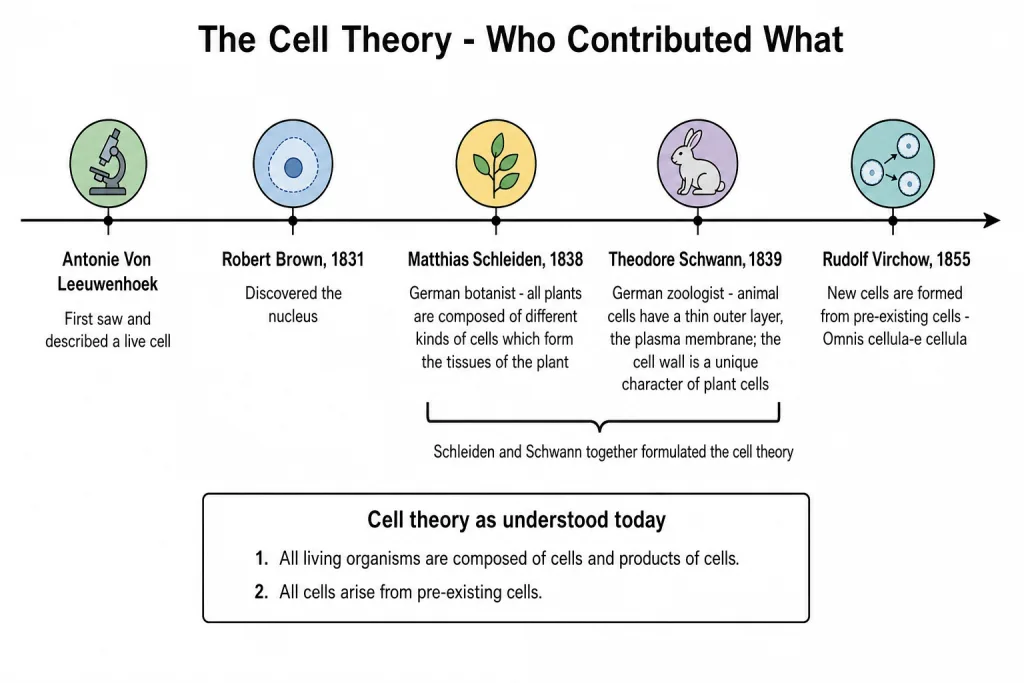
Cell theory as understood today:
- All living organisms are composed of cells and products of cells.
- All cells arise from pre-existing cells.
| Name | Year | The exact contribution |
|---|---|---|
| Antonie Von Leeuwenhoek | - | First saw and described a live cell |
| Robert Brown | 1831 | Discovered the nucleus |
| Matthias Schleiden | 1838 | Botanist; all plants are composed of different kinds of cells |
| Theodore Schwann | 1839 | Zoologist; animal cells have a thin outer layer, the plasma membrane; the cell wall is unique to plant cells; bodies of animals and plants are composed of cells and products of cells |
| Rudolf Virchow | 1855 | New cells are formed from pre-existing cells - Omnis cellula-e cellula |
[NEET Important] Three details separate the top scorers here. Schleiden was a botanist and Schwann a zoologist - not the other way round. Schwann is the one who named the plasma membrane and who noticed that the cell wall is unique to plants. And the piece Schleiden and Schwann could not explain is how new cells arise, which is precisely the piece Virchow supplied.
Quick Recap
- Unicellular organisms show independent existence and perform the essential functions of life; anything less than a complete cell does not ensure independent living.
- The cell is the fundamental structural and functional unit of all living organisms.
- Leeuwenhoek - first saw and described a live cell. Robert Brown - discovered the nucleus.
- The microscope, and later the electron microscope, revealed the structural details of the cell.
- Schleiden, 1838, botanist - all plants are composed of different kinds of cells forming tissues.
- Schwann, 1839, zoologist - animal cells have a thin outer layer, now called the plasma membrane; a cell wall is a unique character of plant cells; bodies of animals and plants are composed of cells and products of cells.
- Schleiden and Schwann together formulated the cell theory, which did not explain how new cells were formed.
- Virchow, 1855 - cells divide and new cells are formed from pre-existing cells, Omnis cellula-e cellula.
- Cell theory today: (i) all living organisms are composed of cells and products of cells; (ii) all cells arise from pre-existing cells.
Solved Examples
Question 1
Q. What two abilities does a unicellular organism show, and what do they prove about the cell?
Answer. It shows independent existence and it performs the essential functions of life. Since anything less than a complete structure of a cell does not ensure independent living, the cell must be the fundamental structural and functional unit of all living organisms.
Question 2
Q. Cell is the basic unit of life. Discuss in brief. This is one of the chapter-end exercises.
Answer. The cell is the basic unit of life in two senses at once.
Structurally, all living organisms are composed of cells and products of cells. Some organisms are made of a single cell and are called unicellular, while others are multicellular. Either way, there is no smaller unit out of which a body is built.
Functionally, every process that keeps an organism alive - taking in materials, releasing energy, responding, growing, reproducing - happens inside a cell. A unicellular organism carries out all its life activities within a single cell, which shows that a cell alone is enough for life, and anything less than a complete cell is not.
Add to this the second half of the cell theory - all cells arise from pre-existing cells - and the cell becomes the unit of continuity as well: life passes on only from cell to cell.
Question 3
Q. Who first saw and described a live cell, and who discovered the nucleus?
Answer. Antonie Von Leeuwenhoek first saw and described a live cell. Robert Brown discovered the nucleus.
Question 4
Q. What did Schleiden observe, and in which year?
Answer. In 1838 the German botanist Matthias Schleiden examined a large number of plants and observed that all plants are composed of different kinds of cells which form the tissues of the plant.
Question 5
Q. State the two conclusions Schwann drew, and the hypothesis he proposed.
Answer. He found that animal cells had a thin outer layer, today known as the plasma membrane, and that the presence of a cell wall is a unique character of the plant cells. On that basis he proposed that the bodies of animals and plants are composed of cells and products of cells.
Question 6
Q. What did the cell theory of Schleiden and Schwann fail to explain?
Answer. It did not explain how new cells were formed.
Question 7
Q. What did Virchow add, and what is his statement called?
Answer. He first explained that cells divided and that new cells are formed from pre-existing cells, summed up as Omnis cellula-e cellula. With this he gave the cell theory its final shape.
Question 8
Q. State the cell theory as it is understood today.
Answer. (i) All living organisms are composed of cells and products of cells. (ii) All cells arise from pre-existing cells.
Question 9
Q. New cells generate from bacterial fermentation, regeneration of old cells, pre-existing cells or abiotic materials? This is one of the chapter-end exercises.
Answer. From pre-existing cells. This is the second part of the cell theory, contributed by Virchow in 1855. Cells are never formed anew from non-living material, which is what "abiotic materials" would mean.
Question 10
Q. Which of these is not correct: Robert Brown discovered the cell; Schleiden and Schwann formulated the cell theory; Virchow explained that cells are formed from pre-existing cells; a unicellular organism carries out its life activities within a single cell? This is one of the chapter-end exercises.
Answer. The statement that is not correct is "Robert Brown discovered the cell". Robert Brown discovered the nucleus, not the cell; it was Leeuwenhoek who first saw and described a live cell. The other three statements are all correct as written.
Question 11
Q. Why is the electron microscope important to this chapter?
Answer. Because the invention of the microscope and its improvement leading to the electron microscope revealed all the structural details of the cell. Almost everything described in the rest of the chapter - the membrane, the organelles, the axoneme - was seen only after it arrived.