
Who the Prokaryotes Are
The prokaryotic cells are represented by bacteria, blue-green algae, mycoplasma and PPLO (Pleuro Pneumonia Like Organisms).
Two comparisons with eukaryotic cells are worth fixing straight away. Prokaryotes are generally smaller and multiply more rapidly than the eukaryotic cells. They may vary greatly in shape and size.
The four basic shapes of bacteria are the ones you are expected to name on sight.
| Shape | What the cell looks like |
|---|---|
| Bacillus | Rod like |
| Coccus | Spherical |
| Vibrio | Comma shaped |
| Spirillum | Spiral |
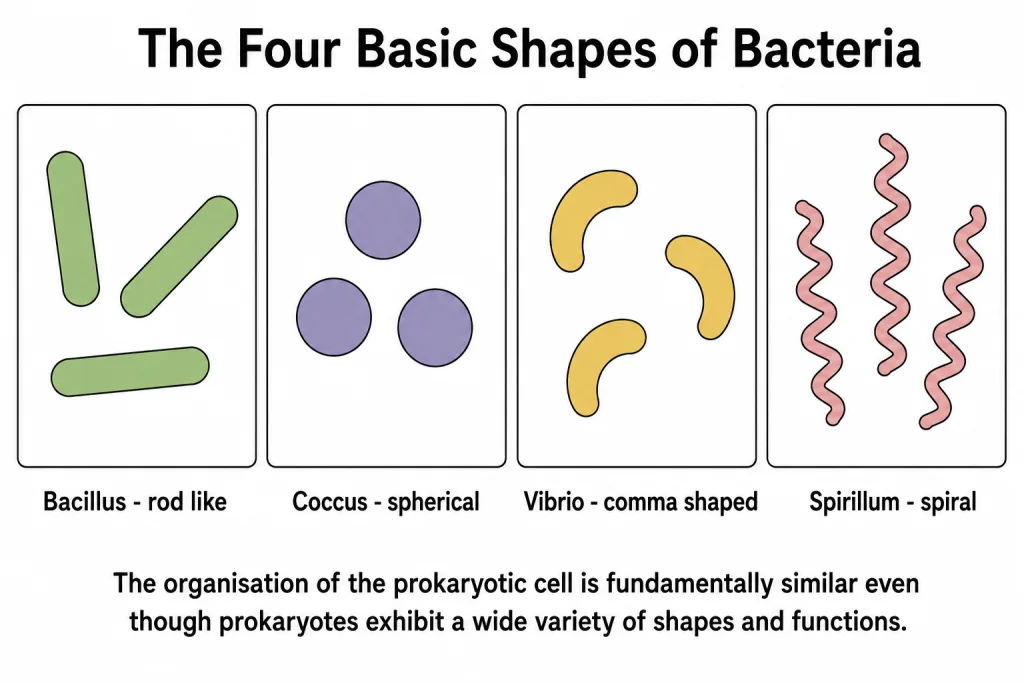
Variety on the outside does not mean variety on the inside. The organisation of the prokaryotic cell is fundamentally similar even though prokaryotes exhibit a wide variety of shapes and functions. That single sentence is why one description of a bacterial cell serves for all of them.
[NEET Important] The shape list is asked as a straight matching item, and vibrio is where marks are lost - vibrio is comma shaped, spirillum is spiral. Also learn PPLO in full as Pleuro Pneumonia Like Organisms, and remember that mycoplasma is a prokaryote even though it is the smallest cell you met in the last section.
Wall, Cytoplasm and Naked DNA
All prokaryotes have a cell wall surrounding the cell membrane except in mycoplasma. That exception is the whole point of the sentence - do not learn the first half alone.
The semi-fluid matrix filling the cell is the cytoplasm.
There is no well-defined nucleus. The genetic material is basically naked, not enveloped by a nuclear membrane. The DNA is there; the envelope around it is not. Nuclear membrane is found in eukaryotes.
The DNA of a bacterium comes in two forms.
- Genomic DNA - the single chromosome, which is circular DNA.
- Plasmids - many bacteria have small circular DNA outside the genomic DNA, and these smaller DNA are called plasmids.
The plasmid DNA confers certain unique phenotypic characters to such bacteria. One such character is resistance to antibiotics. This plasmid DNA is also used to monitor bacterial transformation with foreign DNA.
No organelles, like the ones in eukaryotes, are found in prokaryotic cells except for ribosomes. Prokaryotes also have something unique in the form of inclusions, and a specialised differentiated form of cell membrane called mesosome is the characteristic of prokaryotes - both are taken up in the next section.
[NEET Important] Three near-miss statements are set here every year. A prokaryote is not without genetic material - it is without a nuclear membrane around it. Mycoplasma is the one prokaryote with no cell wall. And antibiotic resistance rides on the plasmid, not on the genomic DNA - the option that credits the single chromosome for it is the trap.
The Cell Envelope and its Modifications
Most prokaryotic cells, particularly the bacterial cells, have a chemically complex cell envelope.
The cell envelope consists of a tightly bound three layered structure - the outermost glycocalyx, followed by the cell wall, and then the plasma membrane. Although each layer of the envelope performs a distinct function, they act together as a single protective unit.
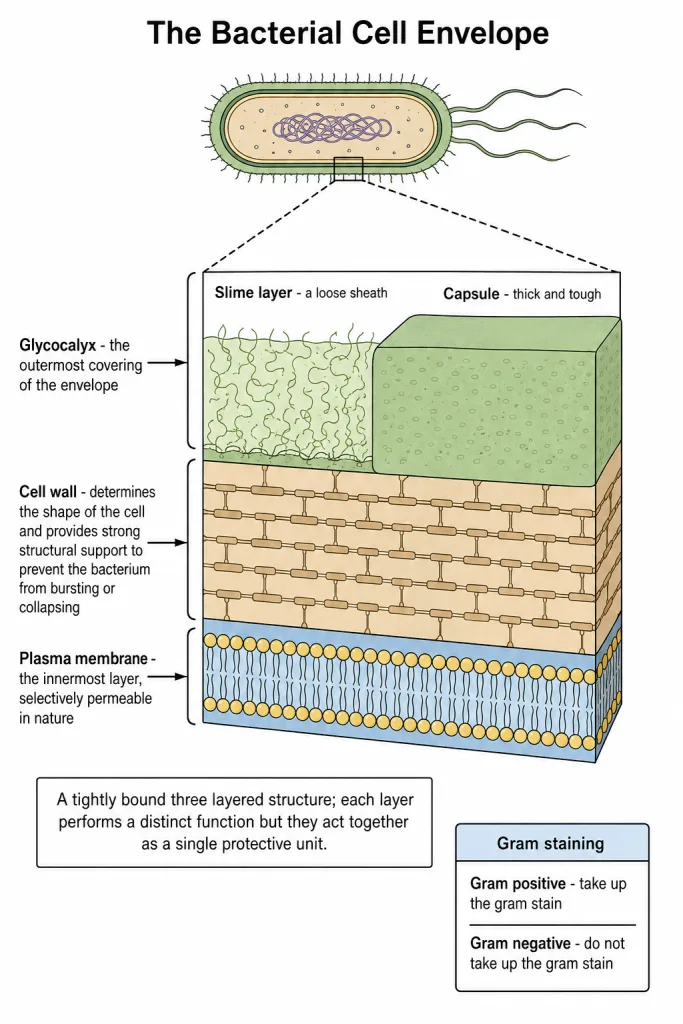
| Layer, outside inwards | What it is | What it does |
|---|---|---|
| Glycocalyx | Differs in composition and thickness among different bacteria; a loose sheath called the slime layer in some, thick and tough, called the capsule in others | The outermost covering of the envelope |
| Cell wall | The middle layer, absent only in mycoplasma | Determines the shape of the cell and provides a strong structural support to prevent the bacterium from bursting or collapsing |
| Plasma membrane | The innermost layer, similar structurally to that of the eukaryotes | Selectively permeable in nature and interacts with the outside world |
Bacteria can be classified into two groups on the basis of the differences in the cell envelopes and the manner in which they respond to the staining procedure developed by Gram.
- Those that take up the gram stain are Gram positive.
- The others that do not are called Gram negative bacteria.
[NEET Important] Keep the order of the three layers in the direction the book gives it - glycocalyx outside, cell wall in the middle, plasma membrane inside - because the reversed order is the standard distractor. Two more one-liners are almost guaranteed: the slime layer is the loose glycocalyx and the capsule is the thick tough one, and it is the cell wall, not the capsule, that determines the shape of the cell and stops it bursting or collapsing.
Quick Recap
- Prokaryotes are represented by bacteria, blue-green algae, mycoplasma and PPLO (Pleuro Pneumonia Like Organisms).
- They are generally smaller and multiply more rapidly than eukaryotic cells and may vary greatly in shape and size.
- Four basic shapes of bacteria: bacillus (rod like), coccus (spherical), vibrio (comma shaped), spirillum (spiral).
- The organisation of the prokaryotic cell is fundamentally similar even though prokaryotes exhibit a wide variety of shapes and functions.
- All prokaryotes have a cell wall surrounding the cell membrane except in mycoplasma.
- The semi-fluid matrix filling the cell is the cytoplasm.
- There is no well-defined nucleus; the genetic material is basically naked, not enveloped by a nuclear membrane. Nuclear membrane is found in eukaryotes.
- Genomic DNA = the single chromosome, circular DNA.
- Plasmids = small circular DNA outside the genomic DNA; they confer unique phenotypic characters such as resistance to antibiotics and are used to monitor bacterial transformation with foreign DNA.
- No organelles, like the ones in eukaryotes, are found in prokaryotic cells except for ribosomes.
- Cell envelope = a tightly bound three layered structure - glycocalyx, then cell wall, then plasma membrane; each layer performs a distinct function but they act together as a single protective unit.
- Gram positive bacteria take up the gram stain; Gram negative bacteria do not - the staining procedure was developed by Gram.
- Glycocalyx differs in composition and thickness - a loose sheath called the slime layer, or a thick and tough capsule.
- The cell wall determines the shape of the cell and provides strong structural support to prevent the bacterium from bursting or collapsing.
- The plasma membrane is selectively permeable, interacts with the outside world, and is structurally similar to that of eukaryotes.
Solved Examples
Question 1
Q. Which organisms are counted as prokaryotes?
Answer. The prokaryotic cells are represented by bacteria, blue-green algae, mycoplasma and PPLO, where PPLO stands for Pleuro Pneumonia Like Organisms.
Question 2
Q. How do prokaryotic cells compare with eukaryotic cells in size and in the rate at which they multiply?
Answer. They are generally smaller and multiply more rapidly than the eukaryotic cells. They also vary greatly in shape and size among themselves.
Question 3
Q. Name the four basic shapes of bacteria and describe each in one word.
Answer. Bacillus - rod like. Coccus - spherical. Vibrio - comma shaped. Spirillum - spiral.
Question 4
Q. Prokaryotes look very different from one another. What can still be said about the way they are built?
Answer. The organisation of the prokaryotic cell is fundamentally similar even though prokaryotes exhibit a wide variety of shapes and functions. The outside varies; the basic plan inside does not.
Question 5
Q. Do all prokaryotes have a cell wall?
Answer. No. All prokaryotes have a cell wall surrounding the cell membrane except in mycoplasma. Mycoplasma is the one prokaryote without a cell wall.
Question 6
Q. Describe the nuclear region of a prokaryotic cell.
Answer. There is no well-defined nucleus. The genetic material is basically naked, not enveloped by a nuclear membrane. The nuclear membrane is found in eukaryotes only. The semi-fluid matrix filling the cell is the cytoplasm, and the naked genetic material lies in it.
Question 7
Q. What form does the genomic DNA of a bacterium take?
Answer. It is the single chromosome, which is circular DNA.
Question 8
Q. What is a plasmid, and why does it matter?
Answer. Many bacteria have small circular DNA outside the genomic DNA, and these smaller DNA are called plasmids.
They matter for two reasons. The plasmid DNA confers certain unique phenotypic characters to such bacteria - one such character is resistance to antibiotics. And plasmid DNA is used to monitor bacterial transformation with foreign DNA.
Question 9
Q. Which organelle is present in a prokaryotic cell?
Answer. The ribosome. No organelles, like the ones in eukaryotes, are found in prokaryotic cells except for ribosomes.
Question 10
Q. What is the cell envelope? Name its layers in order.
Answer. Most prokaryotic cells, particularly the bacterial cells, have a chemically complex cell envelope. It is a tightly bound three layered structure - the outermost glycocalyx, followed by the cell wall, and then the plasma membrane. Although each layer performs a distinct function, they act together as a single protective unit.
Question 11
Q. On what basis is a bacterium called Gram positive or Gram negative?
Answer. Bacteria can be classified into two groups on the basis of the differences in the cell envelopes and the manner in which they respond to the staining procedure developed by Gram. Those that take up the gram stain are Gram positive, and the others that do not are called Gram negative bacteria.
Question 12
Q. How does the glycocalyx differ from one bacterium to another?
Answer. Glycocalyx differs in composition and thickness among different bacteria. In some it is a loose sheath called the slime layer, while in others it is thick and tough, called the capsule.
Question 13
Q. What does the cell wall do for a bacterium, and how is the plasma membrane described?
Answer. The cell wall determines the shape of the cell and provides a strong structural support to prevent the bacterium from bursting or collapsing.
The plasma membrane is selectively permeable in nature and interacts with the outside world, and this membrane is similar structurally to that of the eukaryotes.