
Read This First
This section sits outside the current syllabus.
Root, stem and leaf modifications were taken out of the rationalised chapter, and the chapter you are examined on no longer teaches them. They are here for two reasons: the chapter summary still refers to roots getting modified for storage, mechanical support and respiration, and older question banks, school tests and reference books lean on these terms heavily.
So treat this section as background, not as core revision. Do the twelve sections before this one first, and come back here only if you have time, or if your school is teaching from an older book. Nothing in the NEET blocks of this chapter depends on it.
Modifications of the Root
Roots change shape when they take on a job other than absorption. Three jobs, and each one has its own set of names.
For storage of food. The root swells and stores. The shape is what gets asked.
| Shape | What it looks like | Example |
|---|---|---|
| Fusiform | Swollen in the middle, tapering at both ends | Radish |
| Napiform | Swollen and almost spherical, then sharply tapering below | Turnip, beet |
| Conical | Broad at the base, tapering smoothly to the tip | Carrot |
| Tuberous | Swollen with no definite shape; these are adventitious roots | Sweet potato |
For mechanical support.
- Prop roots - hanging roots that grow down from branches, reach the soil and thicken into pillars that hold up the spreading crown. The banyan tree is the example.
- Stilt roots - roots that grow out of the lower nodes of the stem and brace the plant at an angle. Maize and sugarcane.
For respiration.
- Pneumatophores - in swampy, waterlogged ground the soil holds almost no air, so roots grow vertically upward out of the mud and take in oxygen through pores. Seen in mangrove plants such as Rhizophora.
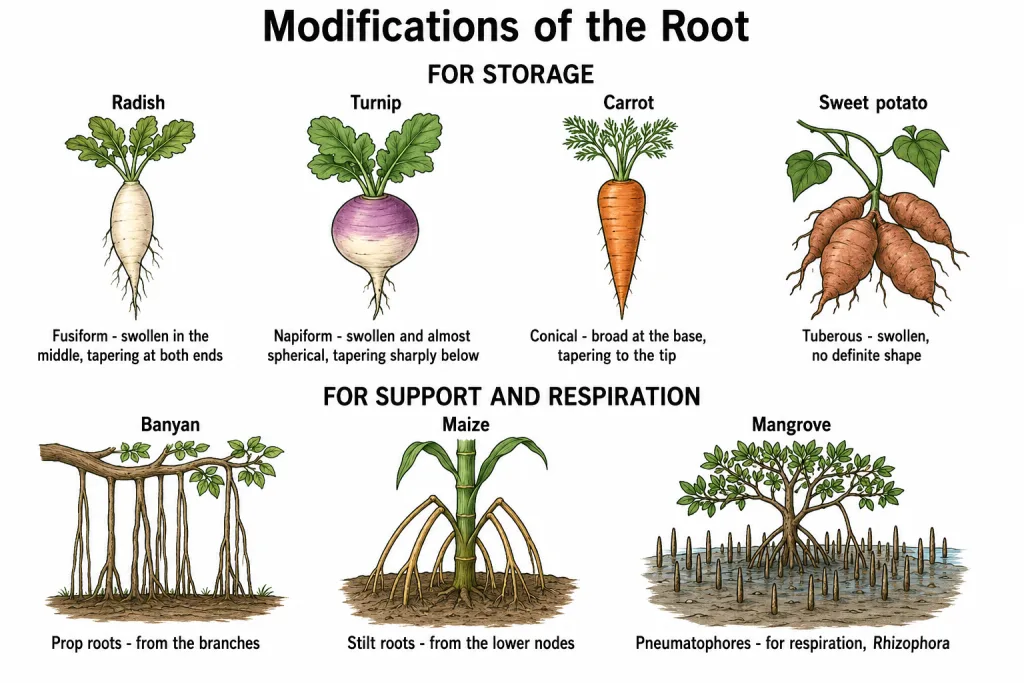
[NEET Important] If this material is on your paper, the shape names are what get asked, and they are easy to mix up. Hold them by outline: radish is a spindle, turnip is a ball, carrot is a cone. And keep the two support roots apart - prop roots come down from branches, stilt roots come out of the lower nodes.
Modifications of the Stem
The test for a stem is always the same: does it have nodes, internodes, buds or scale leaves? If it does, it is a stem, however little it looks like one.
Underground stems store food and carry the plant through an unfavourable season.
| Modification | What it is | Example |
|---|---|---|
| Rhizome | A thick horizontal underground stem with nodes, internodes and scale leaves | Ginger |
| Tuber | A swollen tip of an underground branch, with eyes that are nodes bearing buds | Potato |
| Corm | A short, thick, vertical underground stem | Colocasia |
| Bulb | A reduced disc-like stem carrying fleshy scale leaves | Onion |
Subaerial stems run along or just under the surface and are the plant's way of spreading vegetatively.
- Runner - grows horizontally along the ground, rooting at the nodes. Grass.
- Stolon - a slender lateral branch that arches out from the base and takes root. Jasmine, mint.
- Offset - a short thick runner of one internode, found in aquatic plants. Water hyacinth, Pistia.
- Sucker - grows from an underground part of the stem and comes up as a new shoot. Banana, pineapple, chrysanthemum.
Aerial stem modifications take over a job normally done by leaves.
- Stem tendrils - slender, spirally coiled branches that help the plant climb. Gourds such as cucumber, pumpkin and watermelon, and the grapevine.
- Thorns - woody, straight and pointed branches, used for protection. Citrus, Bougainvillea.
- Flattened or fleshy stems - in dry habitats the stem itself goes green and takes over photosynthesis and stores water, while the leaves shrink to spines. Flattened in Opuntia, fleshy and cylindrical in Euphorbia.
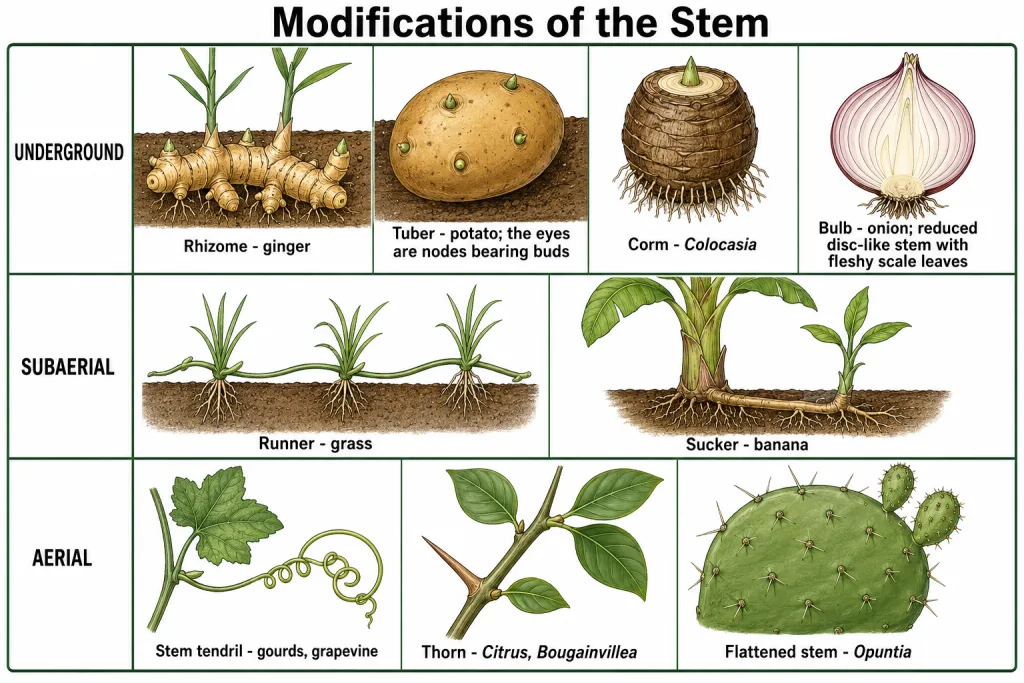
[NEET Important] Every one of these is asked as "why is this a stem and not a root or a leaf?", and the answer never changes: it bears nodes, internodes, buds or scale leaves. The potato's eyes are nodes with buds - that single fact is what makes a potato a stem.
Modifications of the Leaf
- Leaf tendrils - the leaf or part of it becomes a thin coiled thread for climbing. In pea the leaflets are modified into tendrils; in Gloriosa it is the leaf tip.
- Spines - leaves become hard, sharp spines, which cut water loss and deter grazing. Opuntia.
- Fleshy storage leaves - the leaves themselves become thick and store food. Onion, garlic.
- Phyllode - the petiole flattens, turns green and takes over the work of the blade, while the true leaflets fall away. Australian Acacia.
- Insectivorous leaves - the leaf becomes a trap for insects, from which the plant gets nitrogen it cannot obtain from poor soil. Pitcher plant (Nepenthes) and the Venus fly trap.
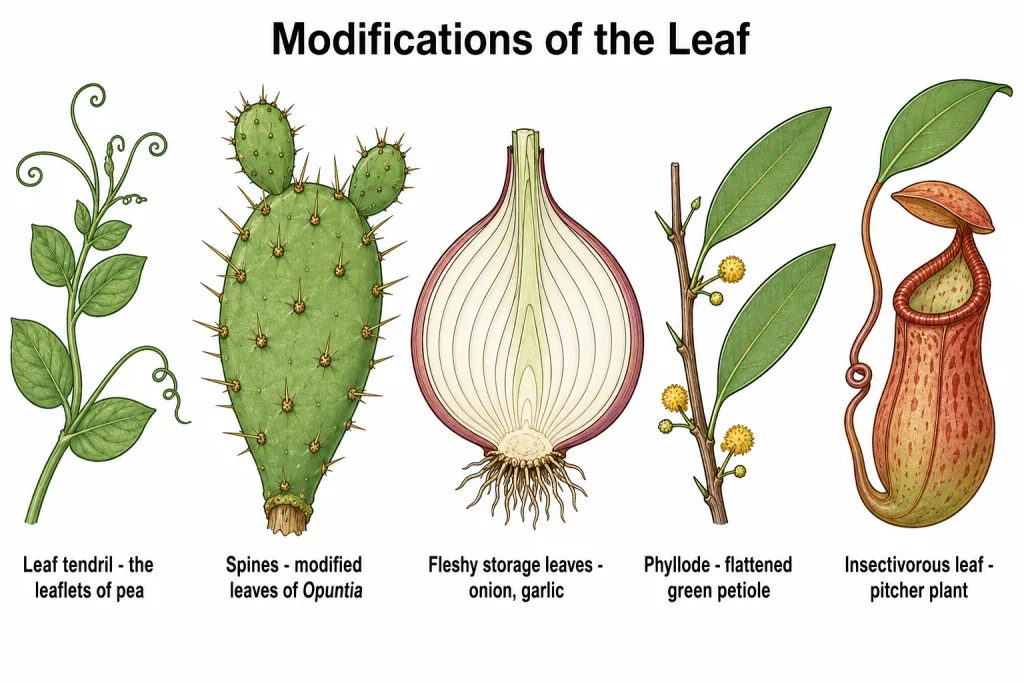
| Modification | What changes | Purpose | Example |
|---|---|---|---|
| Tendril | Leaflets or the leaf tip | Climbing | Pea, Gloriosa |
| Spine | The whole leaf | Protection, less water loss | Opuntia |
| Fleshy leaf | The leaf blade | Storage | Onion, garlic |
| Phyllode | The petiole | Photosynthesis in place of the blade | Australian Acacia |
| Insectivorous trap | The whole leaf | Catching insects for nitrogen | Pitcher plant, Venus fly trap |
[NEET Important] The pair worth being careful with is the tendril. A stem tendril comes from an axillary bud and belongs to the gourds and the grapevine; a leaf tendril is the leaflet or leaf tip and belongs to pea and Gloriosa. Same word, two different organs, and the question is usually about which.
Quick Recap
Root
- Storage: fusiform (radish), napiform (turnip, beet), conical (carrot), tuberous (sweet potato, adventitious).
- Support: prop roots (banyan, from branches), stilt roots (maize, sugarcane, from lower nodes).
- Respiration: pneumatophores (mangroves such as Rhizophora), growing vertically upward.
Stem - identify it by nodes, internodes, buds or scale leaves.
- Underground: rhizome (ginger), tuber (potato, eyes are nodes with buds), corm (Colocasia), bulb (onion).
- Subaerial: runner (grass), stolon (jasmine, mint), offset (water hyacinth, Pistia), sucker (banana, pineapple, chrysanthemum).
- Aerial: stem tendrils (gourds, grapevine), thorns (Citrus, Bougainvillea), flattened stem (Opuntia), fleshy cylindrical stem (Euphorbia).
Leaf
- Tendril - leaflets in pea, leaf tip in Gloriosa.
- Spine - Opuntia.
- Fleshy storage leaf - onion, garlic.
- Phyllode - flattened petiole; Australian Acacia.
- Insectivorous - pitcher plant, Venus fly trap.
Solved Examples
Question 1
Q. Name the four storage shapes of a tap root with an example of each.
Answer. Fusiform - radish. Napiform - turnip and beet. Conical - carrot. Tuberous - sweet potato, which is an adventitious root rather than a tap root.
Question 2
Q. How is a prop root different from a stilt root?
Answer. A prop root grows downward from a branch, reaches the soil and thickens into a pillar - the banyan tree. A stilt root grows out of the lower nodes of the stem and braces the plant at an angle - maize and sugarcane. One comes from above, the other from the base.
Question 3
Q. What are pneumatophores and why do they form?
Answer. Roots that grow vertically upward out of the mud, seen in mangroves such as Rhizophora. Swampy soil is waterlogged and holds almost no air, so these roots come up to take in oxygen.
Question 4
Q. How would you prove that a potato is a stem and not a root?
Answer. By its eyes. Each eye is a node bearing a bud, and nodes, internodes and buds belong to stems. A root has none of them.
Question 5
Q. Name the four underground stems with an example of each.
Answer. Rhizome - ginger. Tuber - potato. Corm - Colocasia. Bulb - onion.
Question 6
Q. Name the four subaerial stems used for vegetative propagation.
Answer. Runner - grass. Stolon - jasmine, mint. Offset - water hyacinth, Pistia. Sucker - banana, pineapple, chrysanthemum.
Question 7
Q. Why do desert plants like Opuntia have green flattened stems?
Answer. Because their leaves have been reduced to spines to cut water loss, so the stem itself turns green and takes over photosynthesis, and it also stores water. Euphorbia does the same thing with a fleshy cylindrical stem.
Question 8
Q. A gourd climbs using a thin coiled thread, and so does a pea. Are the two structures the same?
Answer. No. The gourd uses a stem tendril, which develops from an axillary bud. The pea uses a leaf tendril, made from its leaflets. They do the same job but come from different organs, and that is exactly what a question on this asks.
Question 9
Q. What is a phyllode, and which plant has one?
Answer. A petiole that has flattened, turned green and taken over the work of the leaf blade. The true leaflets are lost. The Australian Acacia is the example.
Question 10
Q. Why do insectivorous plants trap insects?
Answer. They grow in poor soil that cannot supply enough nitrogen, so the leaf is modified into a trap and the plant gets its nitrogen from the insects it catches. The pitcher plant and the Venus fly trap are the examples.
Question 11
Q. An onion and a potato both store food underground. Are they the same kind of organ?
Answer. Both are stems, but of different kinds. The onion is a bulb - a reduced disc-like stem carrying fleshy scale leaves, and it is those leaves that hold the food. The potato is a tuber - a swollen tip of an underground branch, and the stem itself holds the food.
Question 12
Q. Give one root, one stem and one leaf modification that all serve the same purpose of storage.
Answer. Root - the fusiform root of radish. Stem - the tuber of potato. Leaf - the fleshy leaves of onion. Three different organs solving the same problem.