
The Chapter in One Read
Morphology asks you to name things. A flowering plant is two systems - the root system below and the shoot system of stem, leaves, flowers and fruits above - and the chapter walks from the root tip to the finished seed, giving a term to every structure and a plant to every term.
The root comes from the radicle and grows as a tap root in dicots such as mustard, or is replaced by a fibrous system from the base of the stem in monocots such as wheat; anything arising from something other than the radicle is adventitious. The root absorbs, anchors, stores and synthesises plant growth regulators, and its tip runs root cap, meristematic, elongation, maturation - the last of these carrying the root hairs that actually do the absorbing.
The stem comes from the plumule and carries nodes, internodes and buds. The leaf is borne at a node with a bud in its axil, and it is built from leaf base, petiole and lamina, with stipules, a sheathing base in monocots, a pulvinus in some legumes and a midrib down the blade. Its veins are reticulate in dicots and parallel in monocots; it is simple if the incisions stop short of the midrib and compound if they reach it, pinnately on a rachis in neem or palmately from the petiole tip in silk cotton; and its arrangement on the stem is alternate, opposite or whorled.
Then the flower, which is where the marks are. A flower is a modified shoot with a condensed axis, and its arrangement on the floral axis is racemose with acropetal flowers or cymose with basipetal ones. Four whorls sit on the thalamus - calyx and corolla as accessory, androecium and gynoecium as reproductive - and every variation has a name. Symmetry is actinomorphic, zygomorphic or asymmetric. Insertion is hypogynous with a superior ovary, perigynous with a half inferior one or epigynous with an inferior one. Sepals and petals are united or free, and arranged in the bud as valvate, twisted, imbricate or vexillary. Stamens stick to the petals (epipetalous) or the perianth (epiphyllous), and to each other in one, two or more than two bundles. Carpels are free (apocarpous) or fused (syncarpous), and the ovules inside sit in one of five placentations.
Finally the fruit as a ripened ovary with its epicarp, mesocarp and endocarp, the dicot seed with its testa, tegmen, hilum and micropyle, the monocot seed with its scutellum, aleurone layer, coleoptile and coleorhiza, the floral diagram and formula that compress the whole flower into a line of symbols, and the family Solanaceae described in the fixed semi-technical order.
Nothing in this chapter has to be worked out. All of it has to be known exactly.
Master Quick Recap
Root
- Tap - from the radicle; dicots; mustard. Fibrous - from the base of the stem; monocots; wheat. Adventitious - from anything but the radicle; grass, Monstera, banyan.
- Functions: absorption, anchorage, storage of reserve food, synthesis of plant growth regulators.
- Regions from the tip: root cap (protects) - meristematic (divides) - elongation (growth in length) - maturation (root hairs).
Stem and leaf
- Stem from the plumule; nodes, internodes, terminal and axillary buds.
- Leaf parts: leaf base, petiole, lamina; stipules; sheathing base in monocots; pulvinus in legumes; midrib.
- Reticulate dicot, parallel monocot.
- Simple - incisions do not reach the midrib. Compound - they do. Bud in the axil of the petiole, never of a leaflet.
- Pinnately compound - rachis; neem. Palmately compound - tip of the petiole; silk cotton.
- Alternate (china rose, mustard, sunflower), opposite (Calotropis, guava), whorled (Alstonia).
Inflorescence
- Racemose - axis grows on, flowers acropetal, oldest at the base.
- Cymose - axis ends in a flower, flowers basipetal, oldest at the top.
Flower
- Four whorls on the thalamus; calyx and corolla accessory, androecium and gynoecium reproductive; perianth in lily.
- Actinomorphic - any plane; mustard, datura, chilli. Zygomorphic - one plane; pea, gulmohur, bean, Cassia. Asymmetric - no plane; canna.
- Bracteate with a bract, ebracteate without; trimerous / tetramerous / pentamerous for multiples of 3, 4, 5.
- Hypogynous - superior (mustard, china rose, brinjal); perigynous - half inferior (plum, rose, peach); epigynous - inferior (guava, cucumber, ray florets of sunflower).
- Gamo- united, poly- free, for both sepals and petals.
- Aestivation: valvate (Calotropis), twisted (china rose, lady's finger, cotton), imbricate (Cassia, gulmohur), vexillary (pea, bean - standard, wings, keel).
- Androecium: stamen = filament + anther, anther bilobed with two pollen-sacs per lobe; staminode is sterile; epipetalous (brinjal), epiphyllous (lily); monoadelphous (china rose), diadelphous (pea), polyadelphous (citrus).
- Gynoecium: carpel = stigma + style + ovary; ovules on a cushion-like placenta; apocarpous (lotus, rose), syncarpous (mustard, tomato).
Fruit and seed
- Fruit = ripened ovary; parthenocarpic without fertilisation; epicarp, mesocarp, endocarp.
- Drupe - mango (fleshy edible mesocarp), coconut (fibrous mesocarp); both monocarpellary, superior, one seeded.
- Dicot seed - testa, tegmen, hilum, micropyle, two cotyledons, radicle and plumule; castor endospermic, bean, gram, pea non-endospermous.
- Monocot seed - coat fused to fruit wall, bulky endosperm, aleurone layer, scutellum, coleoptile over the plumule, coleorhiza over the radicle; orchids non-endospermic.
The Five Words That All Mean "Arrangement"
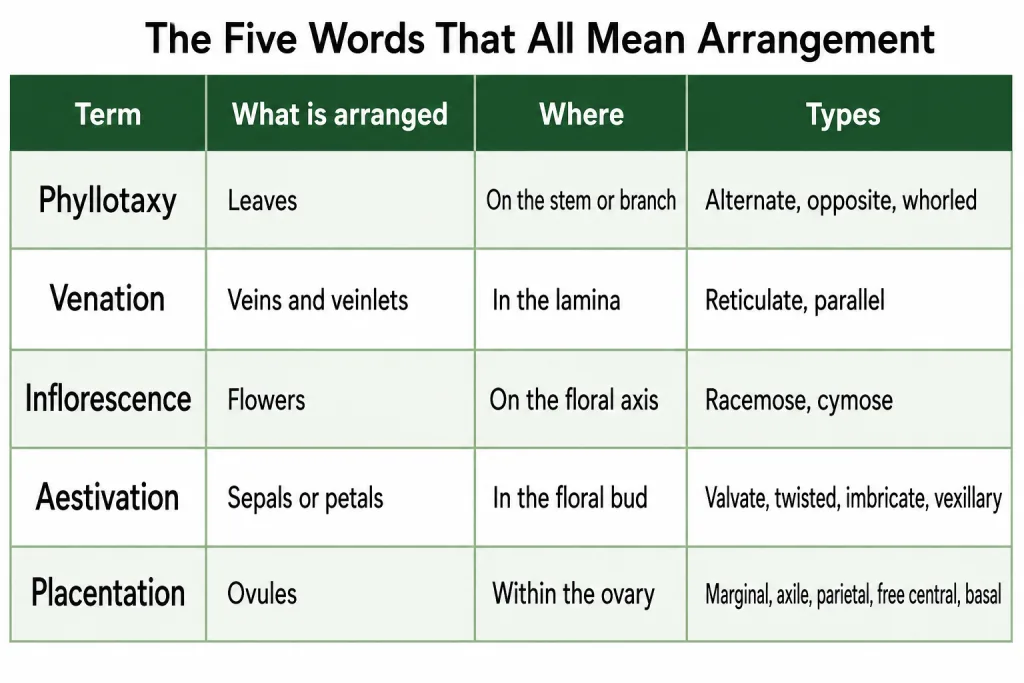
| Term | What is arranged | Where | Types |
|---|---|---|---|
| Phyllotaxy | Leaves | On the stem or branch | Alternate, opposite, whorled |
| Venation | Veins and veinlets | In the lamina | Reticulate, parallel |
| Inflorescence | Flowers | On the floral axis | Racemose, cymose |
| Aestivation | Sepals or petals | In the floral bud, against others of the same whorl | Valvate, twisted, imbricate, vexillary |
| Placentation | Ovules | Within the ovary | Marginal, axile, parietal, free central, basal |
If you learn only one table from this chapter, learn this one. A large share of the questions are simply testing whether you can attach the right arrangement word to the right organ, and every one of them becomes trivial once this table is in place.
The Flower, Variation by Variation
| Character | Options | Examples |
|---|---|---|
| Sexuality | Bisexual / unisexual | Both androecium and gynoecium / only one of them |
| Symmetry | Actinomorphic / zygomorphic / asymmetric | Mustard, datura, chilli / pea, gulmohur, bean, Cassia / canna |
| Merosity | Trimerous / tetramerous / pentamerous | Appendages in multiples of 3 / 4 / 5 |
| Bract | Bracteate / ebracteate | With / without a reduced leaf at the base of the pedicel |
| Insertion | Hypogynous / perigynous / epigynous | Mustard, china rose, brinjal / plum, rose, peach / guava, cucumber, sunflower ray florets |
| Ovary | Superior / half inferior / inferior | Follows directly from the insertion above |
| Calyx | Gamosepalous / polysepalous | Sepals united / free |
| Corolla | Gamopetalous / polypetalous | Petals united / free |
| Corolla shape | Tubular, bell-shaped, funnel-shaped, wheel-shaped | - |
| Aestivation | Valvate / twisted / imbricate / vexillary | Calotropis / china rose, lady's finger, cotton / Cassia, gulmohur / pea, bean |
| Stamen adhesion | Epipetalous / epiphyllous | Brinjal / lily |
| Stamen cohesion | Polyandrous / monoadelphous / diadelphous / polyadelphous | Free / china rose / pea / citrus |
| Carpels | Apocarpous / syncarpous | Lotus, rose / mustard, tomato |
| Placentation | Marginal / axile / parietal / free central / basal | Pea / china rose, tomato, lemon / mustard, Argemone / Dianthus, primrose / sunflower, marigold |
How this table is examined. One row at a time. An examiner takes a single cell and asks it as a one-mark question or a NEET item, so read it column by column - all the examples together, then all the terms together - rather than trying to hold whole flowers in your head.
Index of Plants Named in the Chapter
Root - mustard (tap), wheat (fibrous), grass, Monstera, banyan (adventitious).
Leaf - neem (pinnately compound, rachis), silk cotton (palmately compound), china rose, mustard, sunflower (alternate phyllotaxy), Calotropis, guava (opposite), Alstonia (whorled).
Symmetry - mustard, datura, chilli (actinomorphic); pea, gulmohur, bean, Cassia (zygomorphic); canna (asymmetric).
Perianth - lily.
Insertion on the thalamus - mustard, china rose, brinjal (hypogynous, superior); plum, rose, peach (perigynous, half inferior); guava, cucumber, ray florets of sunflower (epigynous, inferior).
Aestivation - Calotropis (valvate); china rose, lady's finger, cotton (twisted); Cassia, gulmohur (imbricate); pea, bean (vexillary).
Androecium - brinjal (epipetalous); lily (epiphyllous); china rose (monoadelphous); pea (diadelphous); citrus (polyadelphous); Salvia, mustard (varying filament length).
Gynoecium - lotus, rose (apocarpous); mustard, tomato (syncarpous).
Placentation - pea (marginal); china rose, tomato, lemon (axile); mustard, Argemone (parietal); Dianthus, primrose (free central); sunflower, marigold (basal).
Fruit - mango, coconut (drupes).
Seed - wheat, maize (one cotyledon); gram, pea (two cotyledons); castor (endospermic); bean, gram, pea (non-endospermous); maize (monocot seed structure); orchids (non-endospermic monocots).
Solanaceae - Solanum nigrum, Solanum tuberosum (potato), tomato, brinjal, chilli, belladonna, ashwagandha, tobacco, petunia.
Plants that appear more than once, and are therefore the best value to learn: mustard (seven entries), china rose (four), pea (five), sunflower (three), tomato (three).
Writing the Chapter-End Exercises Well
Class 11 has no board paper, but the chapter-end exercises and your school tests are still written answers, and a written answer is marked on what you put down rather than on what you recognise. Everything below is about writing, not about choosing.
What gets asked. Definitions with an example, two-point differences, a labelled diagram, one family description, and the ten chapter-end exercises. Almost nothing else.
Five rules that turn knowledge into marks.
- Every definition gets its example. The exercise asking you to define seven terms is worth seven marks, and each mark expects the term plus one named plant.
- Comparisons go in a table, the same characters in the same order on both sides.
- Label the diagram, then check the labels. For the gram seed and the maize seed the drawing carries almost no marks; the testa, tegmen, hilum, micropyle, cotyledons, radicle, plumule and the scutellum, aleurone layer, coleoptile, coleorhiza carry all of them.
- Keep the semi-technical order. Habit, vegetative characters, floral characters, then floral diagram and formula. Facts in the wrong order lose marks.
- Finish the Solanaceae answer with the floral formula. K(5) C(5) A5 G(2) is a mark on its own, and so is the note that the ovary is superior and the stamens epipetalous.
The exercises to be able to write from memory: the seven definitions, the placentation types, the parts of a flower, the semi-technical description of Solanaceae, and the two labelled seeds. Those five carry the heaviest weight in the chapter.
NEET Strategy
What the paper asks. One term, one example, one distractor drawn from the neighbouring term.
How to prepare for exactly that.
- Learn the five arrangement words first. Phyllotaxy, venation, inflorescence, aestivation, placentation. A large share of the questions test only whether you can match the word to the organ.
- Drill the pairs that get swapped. Twisted against imbricate (direction of overlap). Axile against free central (septa). Coleoptile against coleorhiza (plumule against radicle). Prop against stilt roots (branch against node), if you are covering the bonus section.
- Learn each example with its term, not as a list. "Canna" on its own is worthless; "canna - asymmetric" is a mark.
- Watch the hedge words. Dicots generally have reticulate venation; parallel is the characteristic of most monocotyledons; monocot seeds are generally endospermic, except orchids.
- Answer the ovary questions in two steps. Read where the other parts sit, name the flower, then read off the ovary. Guessing the ovary directly is where students lose the mark.
- Do not shorten a definition. A simple leaf may be deeply incised - what matters is that the incisions do not touch the midrib. Half a definition is a wrong answer here.
Time discipline. These are one-line recall items. If a question takes more than 40 seconds, you do not know the fact and rereading the options will not create it.
The Mistakes That Cost the Most Marks
- An arrangement word attached to the wrong organ. Aestivation is sepals or petals in the bud, not ovules; placentation is ovules in the ovary, not petals.
- Simple leaf defined as "not incised". A simple leaf may be deeply incised; the incisions simply do not reach the midrib.
- The bud test forgotten. A bud sits in the axil of a petiole, never in the axil of a leaflet.
- Racemose and cymose directions swapped. Racemose is acropetal, cymose is basipetal.
- Perigynous left out. Students remember superior and inferior and forget the half inferior ovary of a perigynous flower.
- Twisted and imbricate confused. The difference is only direction - twisted overlaps regularly, imbricate does not.
- Cohesion mistaken for adhesion. Mono-, di- and polyadelphous are stamens joined to each other; epipetalous and epiphyllous are stamens joined to another whorl.
- Axile and free central confused. Septa present means axile and a multilocular ovary; septa absent means free central.
- The false septum given to the wrong placentation. It belongs to parietal, and to nothing else.
- Coleoptile and coleorhiza swapped. Coleorhiza and radicle both point down to the root.
- Coconut given a fleshy mesocarp. It is fibrous; the fleshy edible one is mango.
- Castor called non-endospermous. Castor is endospermic; bean, gram and pea are not.
- A fruit defined as a ripened ovule. A fruit is a ripened ovary; the ovule becomes the seed.
- Solanaceae gynoecium called pentacarpellary. Everything in that flower is five except the gynoecium, which is bicarpellary and obliquely placed.
A Short Revision Plan
First pass - ninety minutes. Read sections 1 to 11 straight through, marking only the term and its example in the margin. Do not attempt the questions yet.
Second pass - one hour. Cover the flower variation table and rebuild it from memory, row by row: sexuality, symmetry, merosity, bract, insertion, ovary, calyx, corolla, aestivation, adhesion, cohesion, carpels, placentation. Check, and rewrite only the rows you missed.
Third pass - forty minutes. The index of plants. Read it aloud as pairs - "canna, asymmetric", "Alstonia, whorled", "Argemone, parietal" - then cover the terms and recover them from the plant names. This is the highest-return forty minutes in the chapter.
Fourth pass - one hour. Write the ten chapter-end exercises out in full. The two seed diagrams should be drawn and labelled from memory, and the Solanaceae description written without looking.
Fifth pass - one hour. The 40 NEET-pattern questions under time. Then go back only to the questions where you were choosing between two options, and reread the paragraph each of those two options came from.
The day before - fifteen minutes. The five-arrangements table and the list of mistakes. Nothing else. By then the chapter is either in place or it is not, and the swapped pairs are what slip first.