
Same Syllabus. A Different Exam.
The Solved Examples section worked this chapter the way a textbook does - define, differentiate, describe, draw. NEET does not ask you to describe anything. It hands you one line, four options and about half a minute, and it wants the right one.
So this section covers the same syllabus with a different question in mind: not "can you write this out?" but "can you recognise the term, and the plant that goes with it, fast enough to throw out the other three?"
The marking is what forces the change. A correct answer is +4 and a wrong one is -1, so a guess you are not sure of costs you a mark and the time you spent on it as well. Morphology is a pure vocabulary chapter - no mechanism, no calculation - so every mark in it is available at speed. The only ways to lose one are to confuse two terms that sound alike, or to hang the wrong plant on the right term.
Key Point: Nothing here has to be worked out. Every question is a lookup - a term against its organ, a plant against its term, or a formula against its family. If you catch yourself reasoning, you have slipped into the textbook version of the question and you are spending three times what it is worth.
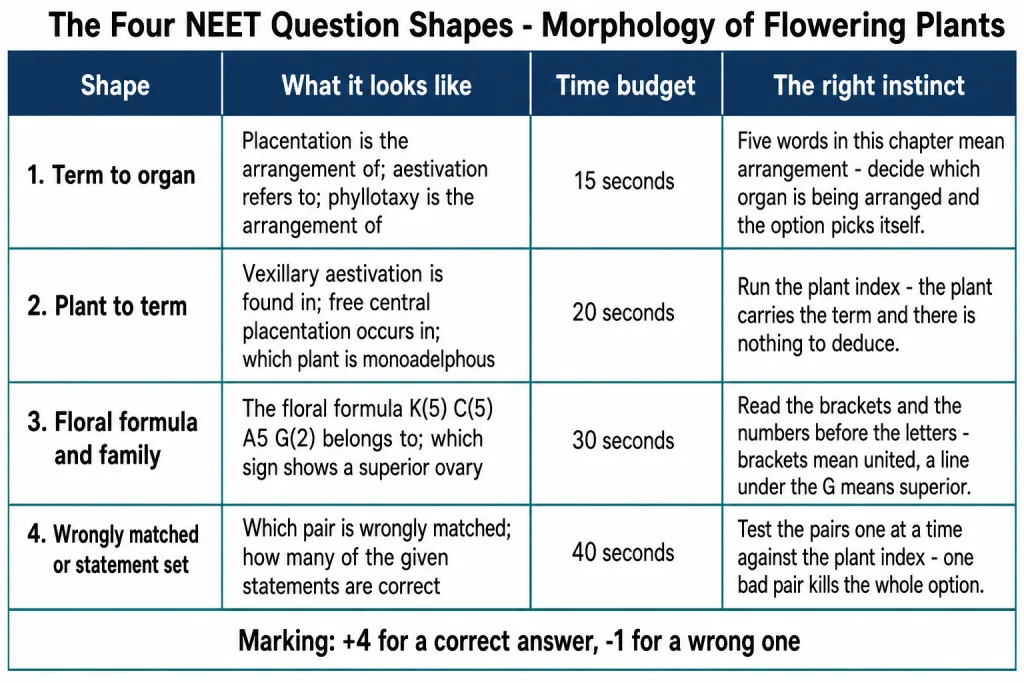
The four shapes, and what each should cost you
| Shape | What it looks like | Budget | The right instinct |
|---|---|---|---|
| 1. Term to organ | "Placentation is the arrangement of …" "Aestivation refers to …" | 15 seconds | Five words in this chapter mean arrangement. Decide which organ is being arranged and the option picks itself. |
| 2. Plant to term | "Vexillary aestivation is found in" "Free central placentation occurs in" | 20 seconds | Run the plant index. The plant carries the term - there is nothing to deduce. |
| 3. Floral formula and family | "The floral formula K(5) C(5) A5 G(2) belongs to" "Which sign shows a superior ovary" | 30 seconds | Read the brackets and the numbers before the letters. Brackets mean united; a line under the G means superior. |
| 4. Wrongly matched or statement set | "Which pair is wrongly matched" "How many of the given statements are correct" | 40 seconds | Test the pairs one at a time against the plant index. One bad pair kills the whole option. |
What this section repeats, and what it does not
It does not re-explain the chapter. It gives you the five arrangement words as one table, the plant index that answers most of these questions on its own, the Solanaceae card with its formula, and the confusable pairs the distractors are cut from - and then drills them at speed.
The Five Words That All Mean "Arrangement"
This is the single highest-yielding table in the chapter. Five different words all mean arrangement, and every one of them gets asked. The only thing that separates them is which organ is being arranged.
| Term | What is arranged | Where | The types to have ready |
|---|---|---|---|
| Phyllotaxy | Leaves | On the stem or branch | Alternate, opposite, whorled |
| Venation | Veins and veinlets | In the lamina of the leaf | Reticulate, parallel |
| Inflorescence | Flowers | On the floral axis | Racemose, cymose |
| Aestivation | Sepals or petals | In the floral bud, with respect to the other members of the same whorl | Valvate, twisted, imbricate, vexillary |
| Placentation | Ovules | Within the ovary | Marginal, axile, parietal, free central, basal |
Read the organ, not the word. Stem in the question means phyllotaxy. Lamina means venation. Floral axis means inflorescence. Bud means aestivation. Ovary means placentation. That one habit clears a whole class of questions in ten seconds.
Phyllotaxy and venation, at speed
| Type | The test | Examples |
|---|---|---|
| Alternate | One leaf at each node | China rose, mustard, sunflower |
| Opposite | Two leaves at a node, facing each other | Calotropis, guava |
| Whorled | More than two leaves at a node, forming a whorl | Alstonia |
| Reticulate | Veinlets form a network | Generally dicots |
| Parallel | Veins run parallel to each other | Generally monocots |
Inflorescence, decided by one question
Does the apex of the main axis go on growing, or does it end in a flower?
- It goes on growing - racemose. Flowers borne laterally, opening in acropetal succession, the oldest at the base.
- It ends in a flower - cymose. Growth is limited, flowers open in basipetal order, the oldest at the top.
- A shoot tip that turns into a flower by itself gives a solitary flower.
[NEET Important] Acropetal goes with racemose; basipetal goes with cymose. The commonest distractor in this part swaps exactly those two words and leaves the rest of the sentence untouched, so read the succession word first.
Positions, Aestivations and Placentations
The three ovary positions
| Flower type | Where the other parts sit | Ovary | Examples |
|---|---|---|---|
| Hypogynous | Below the gynoecium, which stands highest | Superior | Mustard, china rose, brinjal |
| Perigynous | On the rim of the thalamus, at about the same level as the gynoecium | Half inferior | Plum, rose, peach |
| Epigynous | Above the ovary, the thalamus having grown over it and fused with it | Inferior | Guava, cucumber, ray florets of sunflower |
The naming rule in one line. The flower is named for where the other parts sit; the ovary then takes the opposite name. Parts below gives hypogynous and superior. Parts above gives epigynous and inferior.
The four aestivations, each with its genus
| Aestivation | The separator | Examples |
|---|---|---|
| Valvate | Sepals or petals just meet at the margins, without overlapping | Calotropis |
| Twisted | One margin overlaps the next in a regular direction all the way round | China rose, lady's finger, cotton |
| Imbricate | Margins overlap, but in no particular direction | Cassia, gulmohur |
| Vexillary | Five petals as one large standard, two lateral wings and two keel petals | Pea, bean |
Vexillary is also called papilionaceous, and the three petal names - standard, wings and keel - are asked on their own.
The five placentations, each with its one-line separator
| Placentation | The one line that identifies it | Examples |
|---|---|---|
| Marginal | Placenta is a ridge along the ventral suture; ovules in two rows | Pea |
| Axile | Placenta is axial; ovary is multilocular | China rose, tomato, lemon |
| Parietal | Ovules on the inner wall; one chamber becomes two by a false septum | Mustard, Argemone |
| Free central | Ovules on the central axis; septa absent | Dianthus, primrose |
| Basal | Placenta at the base; a single ovule | Sunflower, marigold |
[NEET Important] A false septum means parietal and nothing else. No septa at all means free central. One ovule means basal. Those three lines settle almost every placentation question without your having to look at the other two options.
Cohesion and adhesion in the androecium
Cohesion is stamens joined to each other. Adhesion is stamens joined to another whorl. That one sentence splits the table below into its two halves.
| Term | What is joined | Example |
|---|---|---|
| Monoadelphous | Stamens united into one bundle | China rose |
| Diadelphous | Stamens united into two bundles | Pea |
| Polyadelphous | Stamens united into more than two bundles | Citrus |
| Epipetalous | Stamens attached to the petals | Brinjal |
| Epiphyllous | Stamens attached to the perianth | Lily |
A staminode is a sterile stamen, and it is set as a one-word recall.
The gynoecium has the same idea under different names. Apocarpous - more than one carpel and they are free - lotus, rose. Syncarpous - more than one carpel and they are fused - mustard, tomato.
The Plant Index, and the Solanaceae Card
The five plants that carry most of the marks
A handful of plants come back again and again, each one carrying several terms. Learn the plant first and the terms hanging off it, because that is the direction NEET asks in.
| Plant | Every term it carries |
|---|---|
| Mustard | Tap root; alternate phyllotaxy; actinomorphic flower; hypogynous, so a superior ovary; syncarpous; parietal placentation with a false septum; floral formula K2+2 C4 A2+4 G(2) |
| China rose | Alternate phyllotaxy; twisted aestivation; monoadelphous androecium; hypogynous, so a superior ovary; axile placentation |
| Pea | Zygomorphic flower; vexillary aestivation; diadelphous androecium; marginal placentation; leaf tendril; non-endospermous seed |
| Sunflower | Alternate phyllotaxy; basal placentation; ray florets epigynous, so an inferior ovary |
| Tomato | Syncarpous; axile placentation; a Solanaceae plant, so epipetalous stamens and a persistent calyx; fruit a berry |
Two more the paper likes. Brinjal is the standard example of an epipetalous stamen and is Solanaceae as well. Neem is pinnately compound and silk cotton palmately compound, and that pair is asked as a pair.
The Solanaceae card
The family is set as a whole description and also mined for single facts, so hold it as one block.
| Feature | Solanaceae |
|---|---|
| Habit | Herbs, shrubs, and rarely small trees |
| Stem | Herbaceous, rarely woody, aerial, erect, cylindrical, branched, solid or hollow |
| Leaves | Alternate, simple, rarely pinnately compound, exstipulate, reticulate venation |
| Inflorescence | Solitary, axillary or cymose |
| Flower | Bisexual, actinomorphic |
| Calyx | Sepals five, united, persistent, valvate aestivation |
| Corolla | Petals five, united, valvate aestivation |
| Androecium | Stamens five, epipetalous |
| Gynoecium | Bicarpellary, obliquely placed, syncarpous; ovary superior, bilocular, with a swollen placenta bearing many ovules and axile placentation |
| Fruit | Berry or capsule |
| Seeds | Many, endospermous |
| Plants to name | Solanum nigrum (makoi), tomato, brinjal, potato, chilli, Datura, Petunia, tobacco, Withania |
The floral formula, written out in plain text. It is K(5) C(5) A5 G(2), and it is read like this:
- The brackets round the 5 in K(5) mean the sepals are united; the same brackets in C(5) mean the petals are united.
- A5 with a line joining C and A means the five stamens are epipetalous.
- G(2) means two fused carpels, and the line drawn under the G means the ovary is superior.
- The flower is marked actinomorphic by a star-shaped sign and bisexual by a sign that combines the male and female symbols, and both signs are written at the front of the formula.
Set it beside mustard, the other formula in the chapter. Mustard is K2+2 C4 A2+4 G(2). There are no brackets on K or C, because the sepals and petals are free; the 2+2 and the 2+4 say the parts stand in two rows; and the G(2) with a line beneath it says bicarpellary, syncarpous, superior.
[NEET Important] In a floral formula, brackets always mean united and a number with a plus sign always means two whorls. A question that shows you a formula and asks for the family is really only asking you to read those two features.
The Confusable Pairs, and the Distractors Built From Them
Nearly every wrong option in this chapter is cut from one of these pairs. Learn the pairs and you are reading options rather than puzzling over them.
| Pair | The separator |
|---|---|
| Phyllotaxy against venation | Phyllotaxy arranges leaves on the stem; venation arranges veins in the lamina |
| Aestivation against placentation | Aestivation is sepals or petals in the bud; placentation is ovules in the ovary |
| Racemose against cymose | Racemose axis keeps growing, flowers acropetal; cymose axis ends in a flower, flowers basipetal |
| Actinomorphic against zygomorphic | Any radial plane against one particular vertical plane only |
| Hypogynous against epigynous | Other parts below the ovary against above it; superior ovary against inferior |
| Twisted against imbricate | Overlap in a regular direction against overlap in no fixed direction |
| Parietal against free central | False septum present against septa absent altogether |
| Marginal against basal | Two rows of ovules on a ridge against a single ovule at the base |
| Apocarpous against syncarpous | Carpels free against carpels fused |
| Monoadelphous against epipetalous | Stamens joined to each other against stamens joined to the petals |
| Pinnately against palmately compound | Leaflets on a rachis, as in neem, against leaflets at the tip of the petiole, as in silk cotton |
| Simple against compound leaf | Incisions do not reach the midrib against incisions that do; the bud sits in the axil of the petiole, never of a leaflet |
| Coleoptile against coleorhiza | Sheath over the plumule against sheath over the radicle |
| Testa against tegmen | Outer layer of the seed coat against inner layer |
| Mango against coconut mesocarp | Fleshy and edible against fibrous; both fruits are drupes |
The five distractor patterns
- The swapped organ. "Placentation is the arrangement of sepals in the bud." Read the organ that follows "arrangement of" before you accept anything.
- The swapped succession. Racemose given basipetal order, or cymose given acropetal. One word moves and the rest of the sentence stays correct, which is what makes it read well.
- The wrong plant on the right term. "Vexillary aestivation - china rose." The term is real and the plant is real; only the pairing is wrong. This is why the plant index is worth more here than any definition.
- The inverted ovary. "In an epigynous flower the ovary is superior." Epigynous means the other parts sit above, so the ovary is inferior.
- The exception left out. Castor is a dicot seed and it is endospermic; orchids are monocot seeds and they are non-endospermic. An option saying every dicot seed is non-endospermous falls on castor alone.
[NEET Important] When two options both look right, the difference is almost always one word - the organ, the direction of the overlap, the position relative to the ovary, or the plant name at the end. Go straight to that word instead of rereading the whole option.
Solved Examples at NEET Pace
Each item names the shortcut it uses, because the shortcut is the point.
Question 1
Q. Aestivation refers to the arrangement of: (a) ovules in the ovary (b) leaves on the stem (c) sepals or petals in the floral bud (d) flowers on the floral axis.
Answer. (c). Shortcut - read the organ. Ovules in the ovary is placentation, leaves on the stem is phyllotaxy, flowers on the floral axis is inflorescence. Only one option leaves the floral bud, and that is aestivation. This whole question is decided by the noun after "arrangement of", so you never have to recall the definitions of the other three.
Question 2
Q. Vexillary aestivation is found in: (a) china rose (b) Calotropis (c) Cassia (d) pea.
Answer. (d) pea. Shortcut - the plant index, not the definition. Pea carries vexillary aestivation along with zygomorphic symmetry, diadelphous stamens and marginal placentation. The three wrong options are the other three aestivations - china rose is twisted, Calotropis is valvate, Cassia is imbricate - so the question is really the aestivation table read backwards.
Question 3
Q. Five in a row, 15 seconds each. (i) Which placentation shows a false septum? (ii) Which sheath covers the radicle in a maize grain? (iii) Which aestivation has a standard, wings and a keel? (iv) In which flower type is the ovary half inferior? (v) Which placentation has a single ovule at the base of the ovary?
Answer.
- (i) Parietal, as in mustard and Argemone.
- (ii) Coleorhiza. The coleoptile covers the plumule.
- (iii) Vexillary, also called papilionaceous.
- (iv) Perigynous, as in plum, rose and peach.
- (v) Basal, as in sunflower and marigold.
Shortcut - each of these is a one-to-one pair. You either have the pair or you do not, so do not spend a second reasoning towards it.
Question 4
Q. The floral formula K(5) C(5) A5 G(2), with the ovary marked superior and the stamens joined to the corolla, belongs to which family, and name three plants from it.
Answer. Solanaceae. Shortcut - read the brackets before the letters. Brackets on both K(5) and C(5) mean the sepals are united and the petals are united; A5 tied to the corolla means five epipetalous stamens; G(2) with a line under it means bicarpellary, syncarpous and a superior ovary. That set of four features belongs to Solanaceae and to nothing else in the chapter. Plants - tomato, brinjal, potato, and Solanum nigrum, Datura and Petunia also count.
Question 5
Q. An ovary is one-chambered, the ovules sit on its inner wall, and a partition has appeared that divides it in two. Name the placentation, and say what the partition is called.
Answer. Parietal placentation, and the partition is a false septum. Shortcut - the false septum belongs to parietal and to nothing else, so the moment that phrase appears in a question the answer is fixed. Mustard and Argemone are the plants. Compare it with free central, where the septa are absent altogether - the two are always offered together.
Question 6
Q. Which of these pairs is wrongly matched? (a) Sunflower - basal placentation (b) Pea - marginal placentation (c) China rose - parietal placentation (d) Dianthus - free central placentation.
Answer. (c). Shortcut - test one pair at a time against the plant index and stop at the first failure. China rose has axile placentation, not parietal; parietal belongs to mustard and Argemone. The other three pairs are correct as written. In a wrongly-matched question you are not looking for the right answer, you are looking for the one broken pair, so read the plant name first and the term second.
Question 7
Q. In an inflorescence the lowest flowers are already fruiting while new buds keep opening at the tip. Name the type, the order of opening, and the state of the main axis.
Answer. Racemose, opening in acropetal succession, with the main axis still growing. Shortcut - fruit at the bottom means the bottom flowers are oldest, and the oldest at the base is what acropetal means. The cymose version is the mirror image - the axis ends in a flower, the oldest flower is at the top, and the order is basipetal.
A Drill Before You Move On
Decide each one before you read the verdict. Aim for 20 seconds each.
Question 8
Q. The sepals, petals and stamens of a flower all arise from a rim above the ovary. Name the flower type and the ovary, and give two plants.
Answer. The flower is epigynous and the ovary is inferior, because the thalamus has grown over the ovary and fused with it. Guava and cucumber; the ray florets of sunflower count as well. Shortcut - the flower is named for where the other parts sit, and the ovary takes the opposite name. Parts above gives epigynous plus inferior; parts below gives hypogynous plus superior.
Question 9
Q. A flower has five stamens joined into a single bundle. A second flower has five stamens fixed onto its petals. Name both conditions and say which idea each belongs to.
Answer. The first is monoadelphous, as in china rose; the second is epipetalous, as in brinjal. Shortcut - cohesion is stamens joined to each other, adhesion is stamens joined to another whorl. Monoadelphous, diadelphous and polyadelphous are all cohesion and differ only in the number of bundles - one, two, more than two, giving china rose, pea and citrus. Epipetalous and epiphyllous are adhesion.
Question 10
Q. Match each term with the organ it arranges: phyllotaxy, venation, inflorescence, aestivation, placentation.
Answer.
- Phyllotaxy - leaves on the stem or branch.
- Venation - veins and veinlets in the lamina.
- Inflorescence - flowers on the floral axis.
- Aestivation - sepals or petals in the floral bud.
- Placentation - ovules within the ovary.
Shortcut - this is the table the whole chapter turns on. Five words, five organs, and a match-the-column question built from them is 20 seconds of work once you hold it.
Question 11
Q. How many of these statements are correct? (i) Parietal placentation shows a false septum. (ii) In a perigynous flower the ovary is inferior. (iii) Cymose inflorescence opens in basipetal succession. (iv) Diadelphous stamens are found in pea.
Answer. Three. Shortcut - run the statements in order and drop the first one that breaks. (i) is correct. (ii) is the wrong one - in a perigynous flower the ovary is half inferior, and inferior belongs to epigynous. (iii) is correct, and (iv) is correct. Statement-set questions are only ever four small lookups, so do them as four and never as one.
Question 12
Q. A grain has a bulky food store, a single shield-shaped cotyledon, and two separate sheaths on a very short axis. Name the class, the cotyledon and the two sheaths.
Answer. A monocotyledon. The cotyledon is the scutellum, the sheath over the plumule is the coleoptile, and the sheath over the radicle is the coleorhiza. Shortcut - coleoptile and plumule both carry the shoot idea; coleorhiza and radicle both carry the root idea. The aleurone layer is the proteinous layer between the endosperm and the embryo, and it is the fourth label the paper asks for.
Question 13
Q. An assertion reads: "All dicotyledonous seeds are non-endospermous." A reason reads: "The endosperm is completely used up during embryo development." Judge them.
Answer. The assertion is false and the reason is only sometimes true. Shortcut - hunt the exception before you judge the sentence. Castor is a dicot seed that is endospermic, so the assertion falls on one plant. Bean, gram and pea are the non-endospermous dicots. The matching trap runs the other way as well - orchids are monocot seeds that are non-endospermic, so an option calling every monocot seed endospermic is wrong too.
Question 14
Q. Two ovaries are described. In the first, the septa are absent and the ovules sit on a central axis. In the second, the placenta is axial and the ovary has several chambers. Name both, and give a plant for each.
Answer. The first is free central - Dianthus or primrose. The second is axile - china rose, tomato or lemon. Shortcut - the septa decide it. Septa absent with a central axis means free central; septa present making a multilocular ovary means axile. These two are placed together in options more often than any other pair in the chapter, and the word "septa" is the only one you need to read.